Before the shows: This guide was prepared before the relevant September shows. It is not a collection or street-style recap, does not draw on backstage access, and does not present NYFW jewelry trends for 2026 as confirmed. Think of it as a companion for looking closely once the shows are visible: what catches the eye, what deserves a note, and what separates a singular flourish from an idea that appears again.
One arresting photograph is an invitation to look, not a reason to announce the season. Ask instead: What keeps returning, where does it sit, how is it attached, what happens to the silhouette, and does the idea hold up across unrelated looks? A jewelry idea becomes more persuasive when it reappears across body zones, proportions, finishes, styling, or ways of fastening. One grand entrance is not a whole season.
How to watch jewelry trends without mistaking a moment for a movement
To understand how to watch jewelry trends, start with what you can actually see. The position of a pin is something to describe; its appearance in a similar place across unrelated looks may suggest a pattern. What that pattern means is a separate question. Any prediction needs more than a memorable photograph.
For each piece of jewelry—or detail that borrows its language—note nine things: where it sits, its scale, how often it appears, whether it recurs across unrelated looks, how it attaches, how it moves, what it does for the outfit, its visible finish, and whether it serves a practical purpose or simply decorates. That keeps the loudest piece from becoming the only one you remember.
A large brooch on a ceremonial jacket can be wonderful without announcing anything larger. Five unrelated looks with compact pins at different lapel heights are more worth following. Likewise, one elaborate bag charm might be custom styling; small attachments recurring on bags, belt loops, shoes, and clothes could point to a shared interest in portable, modular forms.
With this guide to watching accessories, you can enjoy the spectacle without rushing to name a trend. Notice what returns, be precise about how it is worn, and save the sweeping declarations for later. Then revisit your notes after the shows.
Nine details worth noting
1. Body zone
Begin with where the piece sits: ear, collar, neckline, lapel, chest, wrist, hand, waist, bag, shoe, or hair. Placement can matter as much as shape. A familiar jewelry form may feel entirely different when it leaves its usual place.
2. Scale
Describe the scale as you see it: micro, compact, medium, oversized, or body-spanning. Then separate size from impact. A tiny, high-contrast accent may draw the eye more forcefully than a larger piece that blends into the garment.
3. Frequency
One appearance is a sighting, not a coronation. Count how often the idea returns, and where. Several appearances across unrelated designers, presentations, or styling approaches tell you more than a detail repeated throughout one carefully coordinated collection.
4. Repetition across unrelated looks
For fashion week jewelry trends, the revealing question is whether an idea holds up when the color, clothes, model, and styling all change. You are not looking only for identical pieces. A shared proportion, position, fastening, or way of moving can be the thread.
5. Attachment point
Follow the fastening. Does the piece pin through cloth, clip onto an edge, hang from a loop, connect to a bag fitting, thread through a belt, hinge around the ear, or use a familiar closure? Where the connection is visible, it helps you judge whether the styling could travel to other clothes or relies on one particular garment.
6. Movement
Watch whether the piece holds still, swings, twists, rotates, brushes against fabric, or changes direction as the wearer walks. A small form can occupy far more of your attention once it starts to move.
7. Styling function
Ask what the jewelry contributes to the look. Does it draw the eye, break symmetry, connect colors, interrupt a plain garment, extend the silhouette, introduce sound or movement, or bring a practical fastening into view? Notice what changes around it, not just the piece itself.
8. Material and finish
Stay with the surface you can see: bright or darkened, mirror-like or brushed-looking, granular, opaque or translucent-looking, warm-toned or cool-toned, mixed in finish, or highly reflective. Appearance alone does not establish precious-metal fineness, gemstone identity, plating, value, durability, or manufacturing method. A bright edge is a bright edge, not a promise about what lies beneath.
9. Functional or decorative
A clip may hold something in place—or merely look as though it does. A charm might open, detach, carry another piece, or simply swing. Notice what is visibly happening. A practical fastening may lend itself to more uses than ornament with one purely visual role.
Watch zone: the ear
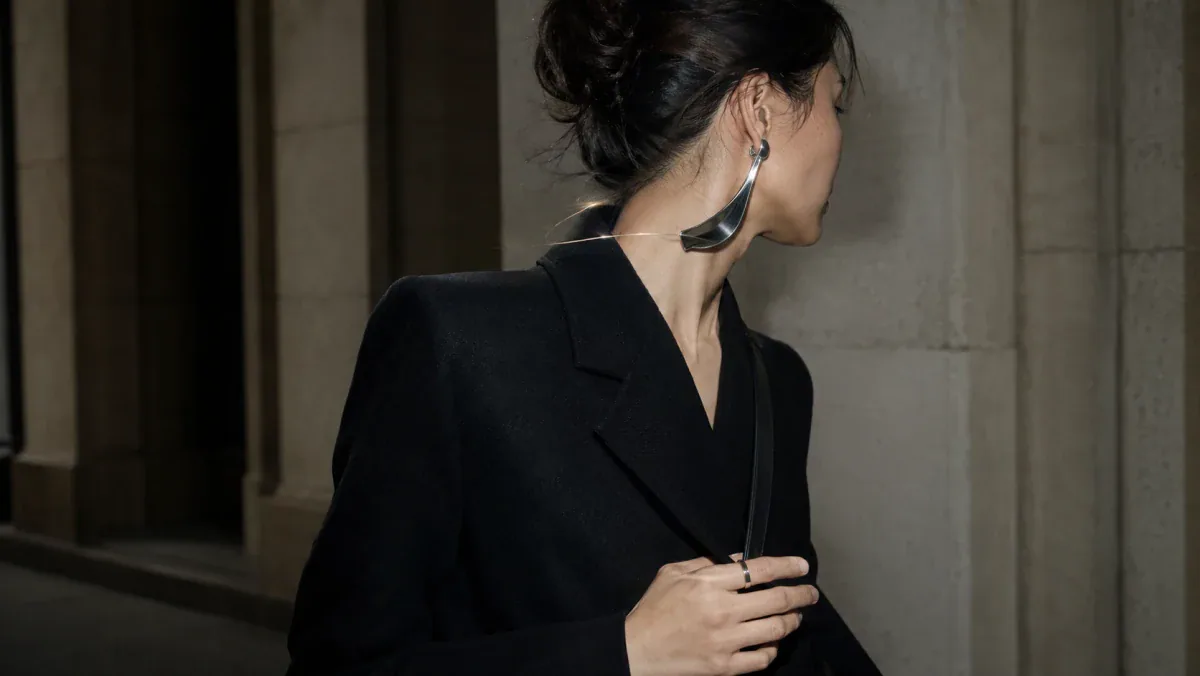
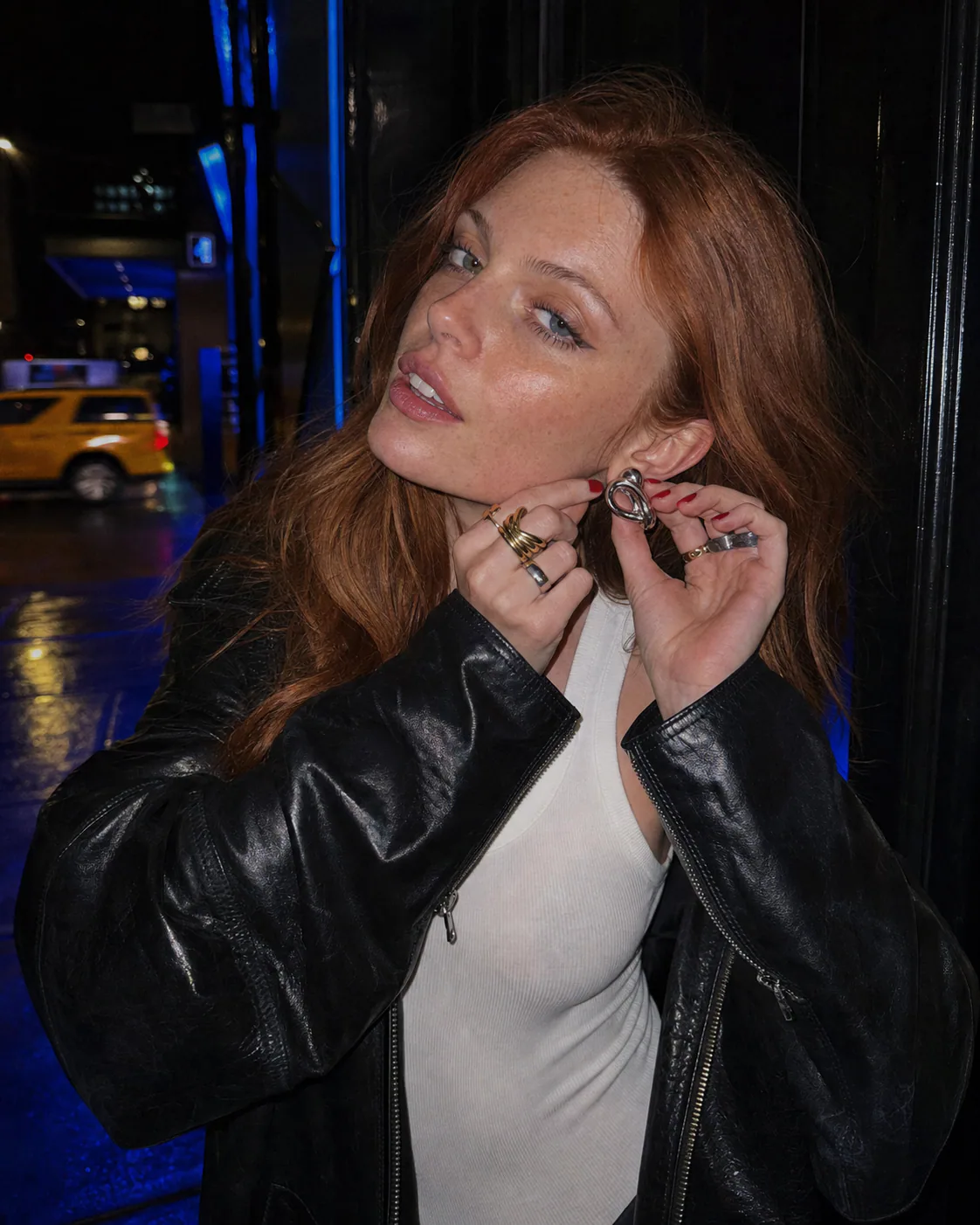
At the ear, length, balance, and movement are easy to compare across looks. When looking at New York Fashion Week jewelry, compare pieces that hug the ear with those that reach into the space beside the jaw, neck, or hair.
Let asymmetric earrings earn their place in your notes rather than declaring their return in advance. Is there just one earring, a deliberately mismatched pair, unequal lengths, contrasting finishes, or a sculptural piece at one ear balanced by jewelry elsewhere? One extraordinary look can remain just that. Look for the idea to recur with unrelated clothes and styling.
Do not overlook the quieter forms. Depth, a curve, or a small pocket of open space can give a compact earring a distinctive profile. It may change the ear’s silhouette more than a familiar large drop, without needing theatrical proportions.
Watch zone: collar and neckline
At the collar, follow the connection before calling everything a necklace. A piece clipped directly to the neckline has a different relationship with the clothes from a pendant hanging on a chain.
Does the jewelry trace the neckline or interrupt it? Does it bridge two fabric edges, sit above the collar, or slip partly beneath the cloth? When several looks leave the fastening visible, that exposed connection may be as worth noting as the ornament.
Then watch it move. A suspended piece that swings on its own creates a different rhythm from a rigid collar detail that holds its place like part of the garment’s architecture.
Watch zone: lapel and chest
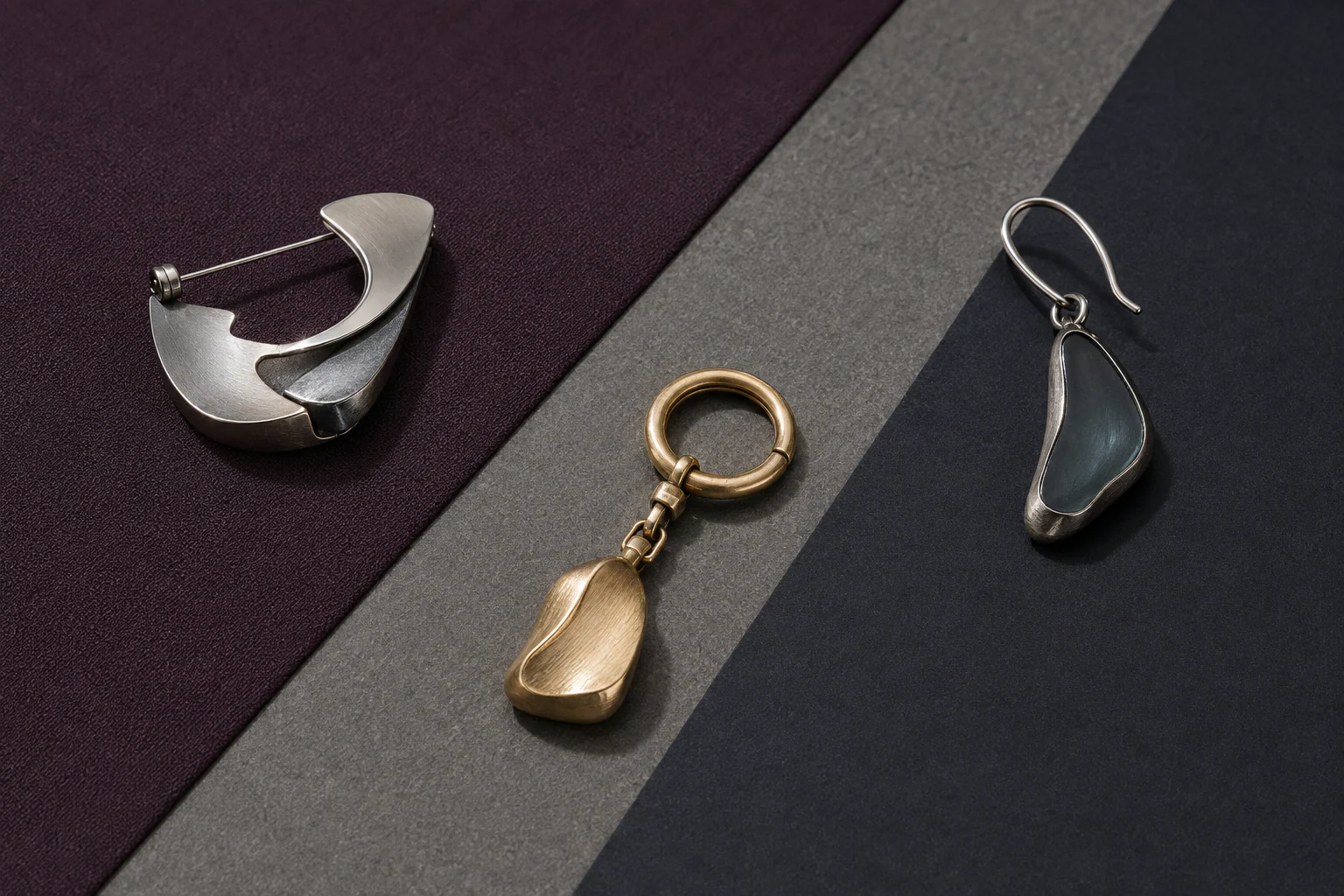
For statement brooch styling, placement is half the story. Note size, height, angle, and number, then look at the relationship with seams, pockets, lapels, and closures. A brooch’s presence alone tells you little about how it is being worn.
One enormous custom brooch on a couture-like look may be a splendid exception. The more revealing possibility is compact pins recurring across unrelated tailoring, knitwear, shirts, and outerwear, each changing otherwise simple clothes. Keep both in your notes, but do not mistake the first for the second.
Look beyond the expected upper lapel. A pinned form near a pocket, shoulder seam, waist, closure, or collar edge may suggest something subtler than “brooches are back”: small attachable pieces are changing the way garments read.
Watch zone: wrist and hand
At the wrist, count is only the beginning. A pile of bracelets does not automatically announce a new direction if everything else is familiar. Look at proportions, the space between pieces, rigidity, exposed fastenings, and the way jewelry meets a sleeve.
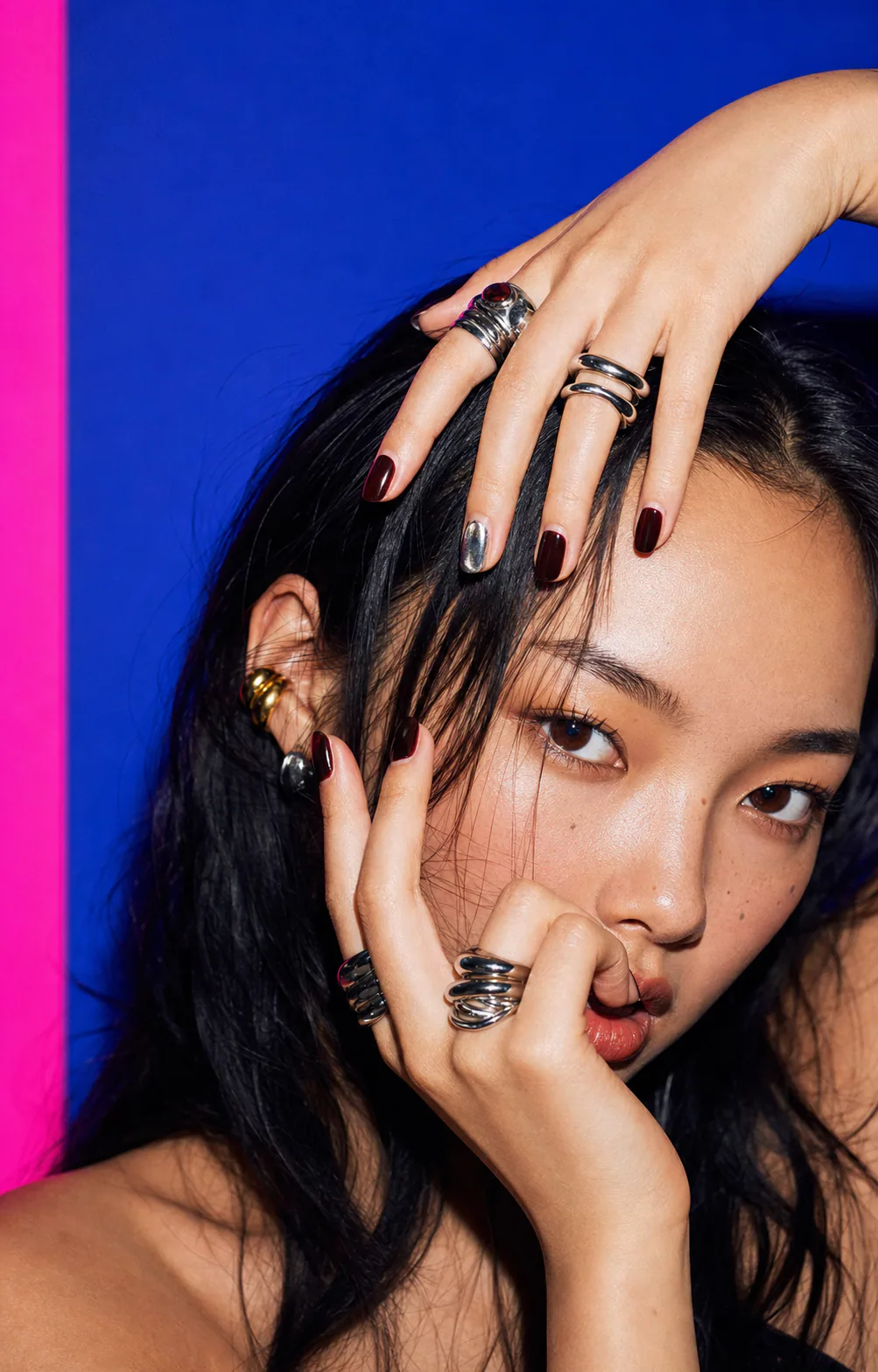
On the hand, does the jewelry stay centered on a finger, reach over the knuckles, sit between fingers, extend toward the wrist, or occupy the back of the hand? A single theatrical piece may belong entirely to one collection. Compact forms recurring at a similar scale across unrelated looks may suggest a styling idea that travels more easily.
Watch zone: belt and waist
At the waist, jewelry may begin to resemble the fittings of an accessory. Look for metal-colored details at belt loops, cords, ties, closures, and waistband edges. Keep the distinction clear: an added decoration is not the same thing as a fastening that the garment needs.
This is also a useful place to watch small-scale jewelry: pieces that sit between adornment, hardware, charm, and portable sculpture. Beauty alone is not the clue. The question is whether compact pieces attached to clothing keep appearing in different forms across unrelated looks.
Watch zone: the bag
Treat the bag charm jewelry trend as a question for the shows, not an outcome already settled. Count the attachments; note where they connect, how far they hang, and whether they move separately. Do they look personal, modular, functional, or purely decorative? The question is not just how much is hanging there, but what each addition seems to do.
A heavily decorated bag can be a one-off flourish. More telling would be one or two compact pieces recurring across unrelated looks, attached through standardized rings, short connectors, handle bases, zippers, or strap fittings. Watch the connection as closely as the charm.
Quantity and arrangement tell different stories. Ten unrelated trinkets gathered together suggest accumulation. One carefully placed modular piece directs attention to its connection and position. A crowded bag and a single deliberate accent are not saying the same thing.
Watch zone: the shoe
At the shoe, look for jewelry-like details without assuming they detach. A clip may only look removable; a small metal-colored form, articulated detail, chain, or decorative attachment may be part of the shoe’s construction. The photograph may not tell you which.
Then follow the step. Does the detail change with each movement? At the ankle or vamp, even a small reflective accent can make a rhythmic impression as the foot moves.
Watch zone: hair
For hair jewelry, start with size and attachment. Is the piece acting as a clip, comb, pin, band, or structural fastening, or is it there only for decoration? Does it sit within the hairstyle or perch on top?
Several small forms appearing in different hair placements may be more telling than one elaborate headpiece. Look for a way of fastening that could make sense beyond the original show styling, rather than assuming every dramatic arrangement can travel.
Ideas to watch, not trends to assume
Before the shows, keep a few possibilities in mind without mistaking them for predictions. Brooches could move the focus onto clothing; bag charms could draw attention to how jewelry attaches to accessories. Small modular pieces might recur on bags, belts, lapels, or shoes. Asymmetric earrings could unsettle familiar balance, compact sculptural forms could concentrate the impact of a larger piece, and mixed finishes could bring contrast without adding size.
Keep them as questions. Are compact brooches repeating across unrelated tailoring looks? Are bag attachments becoming more closely integrated with the bag? Are mixed finishes appearing in a similar relationship across looks, rather than as isolated decoration? “No” is a useful answer. It leaves room to notice what is actually there.
How to distinguish spectacle from a recurring pattern
A spectacular custom piece can be worth studying for its design without carrying an entire trend on its shoulders. Before giving it that role, ask five questions.
- More than once: Does the same idea appear again?
- Beyond one collection: Does it appear across unrelated looks, rather than within one coordinated collection story?
- With everyday clothes: Could the styling work with ordinary garments or accessories, even if the original piece is highly crafted?
- The same detail: Is the shared feature truly the same placement, attachment, scale, finish, or movement, rather than a passing resemblance?
- Without the showstopper: Does the pattern remain when you set the most dramatic looks aside?
An idea that holds up through all five deserves another look after the shows. One that rests on a single unforgettable photograph belongs in your notes as a remarkable look—not a trend by itself.
A simple way to keep notes
Give each relevant look one short entry. You do not need to write a review while the image is in front of you; a useful note can take less than a minute.
- Zone: ear, neck, chest, wrist, hand, waist, bag, shoe, or hair.
- Scale: micro, compact, medium, oversized.
- Attachment: pin, clip, ring, connector, chain, post, hook, hinge, or unclear.
- Movement: fixed, swinging, rotating, articulated, or moving with the fabric.
- Function: focal point, closure, link between colors, asymmetry, extended silhouette, decoration, or unclear.
- Finish: describe only the visible color and surface.
- Repeat? first sighting, repeated within one collection, or repeated across unrelated looks.
- So far: a single observation, a possible pattern, or a clearly recurring idea.
Photographs can be misleading, particularly when scale, fastening, or material is hard to see. Write “unclear” where it belongs. A neat description is no improvement if it turns a guess into a fact.
Your post-show checklist
Once enough official or reliably documented show images are available, return to the notes. Let what you wrote—not just the most dazzling image you remember—lead the next look.
- Remove duplicate views of the same look.
- Separate repeated styling within one collection from recurrence across unrelated collections.
- Group observations by body zone and attachment method.
- Count only genuinely comparable examples.
- Check whether the same idea appears at more than one scale or in more than one styling context.
- Set aside categories that depend entirely on one spectacular exception.
- Keep descriptions of materials visual unless construction is independently confirmed.
- Keep runway jewelry and related details separate from street style, celebrity dressing, press events, and unrelated fashion-week imagery.
- Move from “something to watch” to “a recurring pattern” only when your notes show enough comparable appearances.
NYFW jewelry observation FAQs
What jewelry directions should I watch during NYFW 2026?
Look for brooch placement, bag charms, asymmetric earrings, compact sculptural forms, and mixed finishes. These are possibilities to watch, not confirmed 2026 trends; note where the pieces sit, how they move, and whether the same idea returns across unrelated looks.
How soon can I describe a runway jewelry idea as a recurring pattern?
Wait until enough official or reliably documented show images are available to compare unrelated collections. Look for repeated placement, scale, attachment, or movement, and set aside duplicate views of the same look. Describe the recurrence you can see, without turning one striking appearance into a trend.
How can I translate a runway accessory idea into everyday styling?
Borrow one styling cue rather than the entire look: a shift in placement, a compact sculptural form, or a contrast between visible finishes. Try it with clothes and jewelry you already wear, letting that detail lead without recreating the whole runway outfit.
Do my nails need to match runway-inspired jewelry?
No exact match is needed. You could echo one visible color, keep the nails quieter beside bold jewelry, or let the two contrast. A shared accent can bring the look together without making every detail match.
What this guide does not claim
This article is not affiliated with NYFW, the CFDA, designers, venues, or publications. It does not claim access to unreleased collections or backstage information, or knowledge of street-style results, show rankings, or future outcomes. The Metropolitan Museum of Art references are included only for a historical look at recurrence, scale, rhythm, concentrated ornament, movement, and ways of attaching adornment. They do not establish anything about 2026 fashion.
A pre-show guide should leave room to be surprised. If brooches do not recur, note that. If bag charms remain isolated, let them remain individual flourishes. The most interesting jewelry may appear somewhere you had barely thought to look: shoe fittings, hair attachments, tiny ear forms, or an almost invisible fastening. Keep your attention open enough to find it.