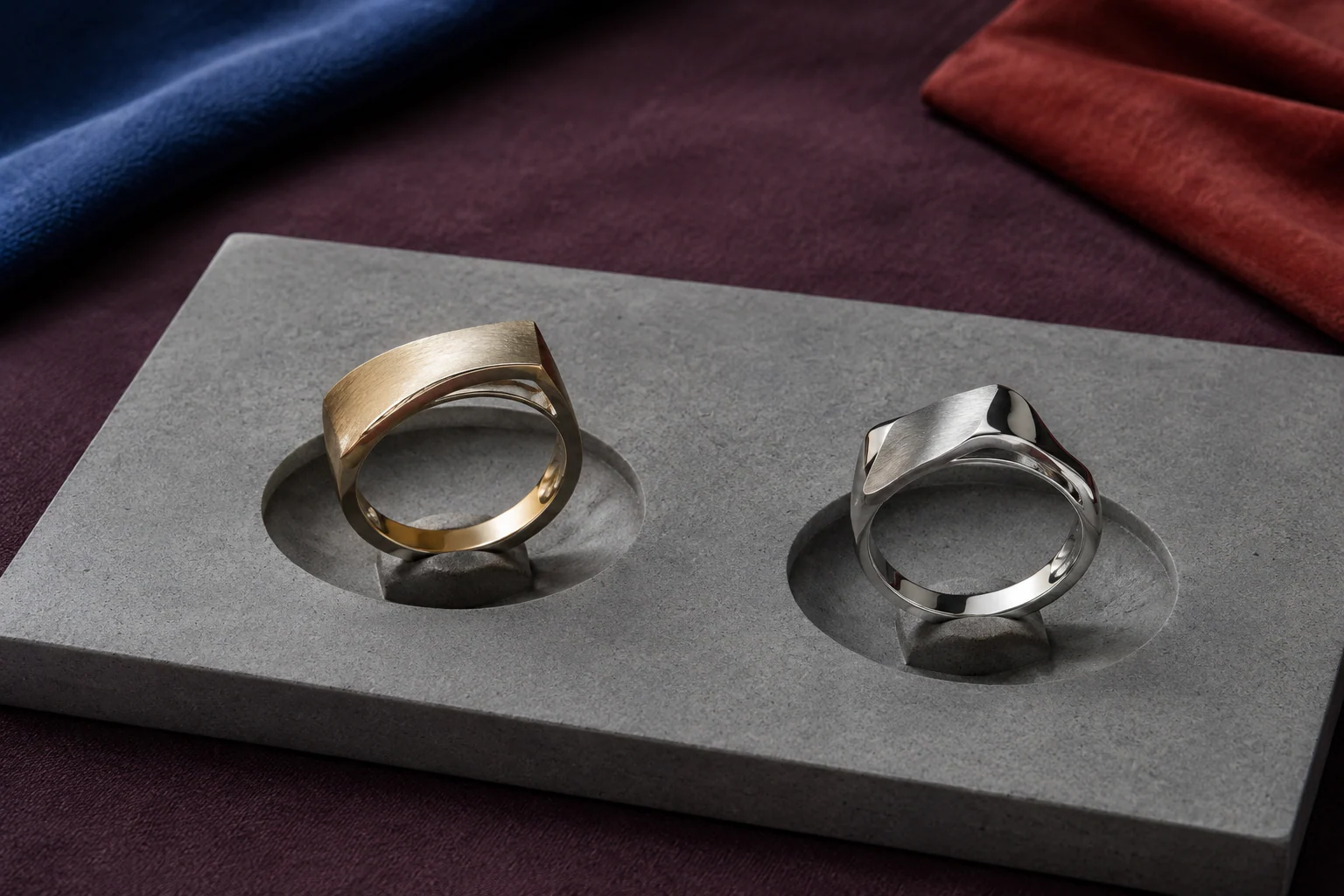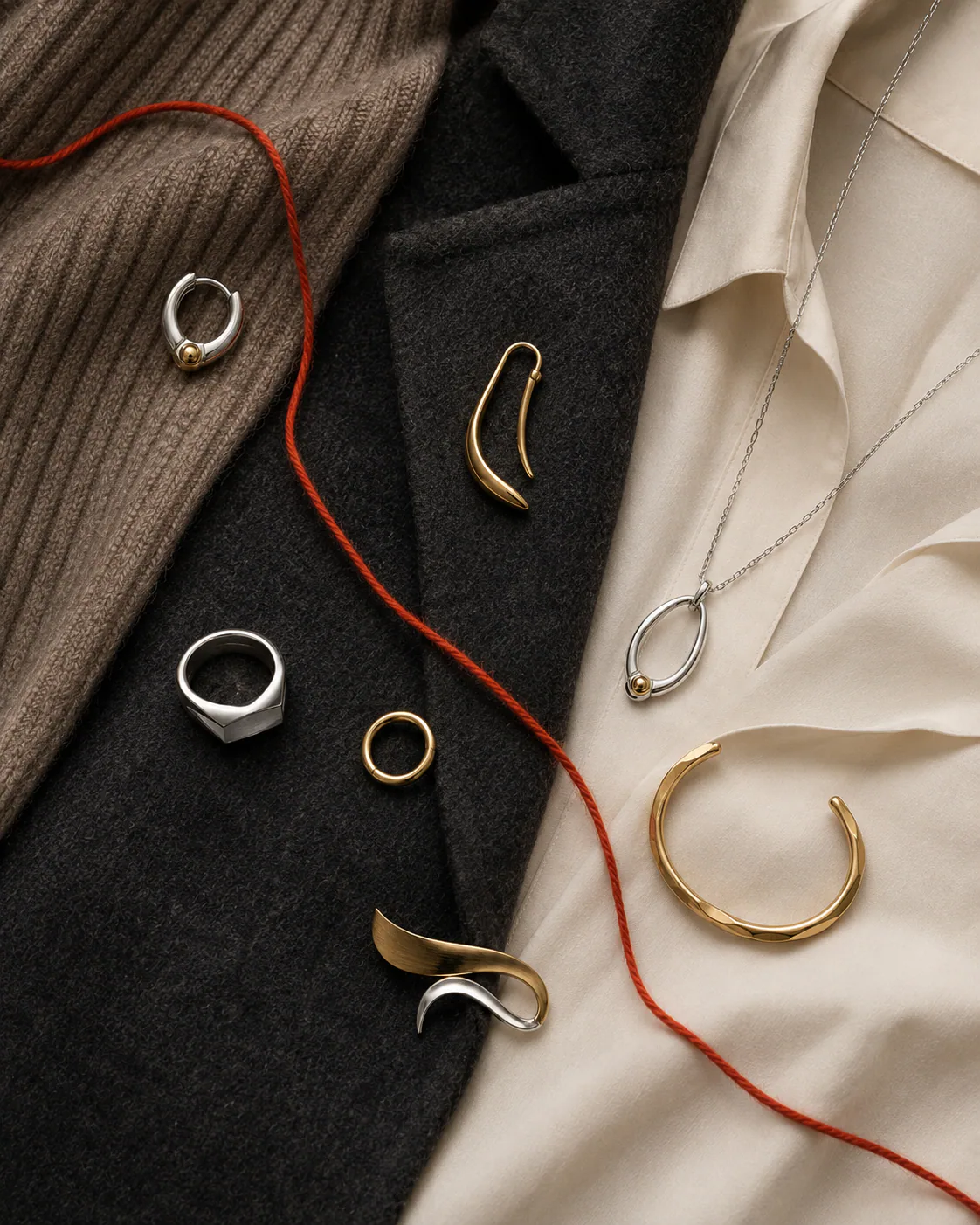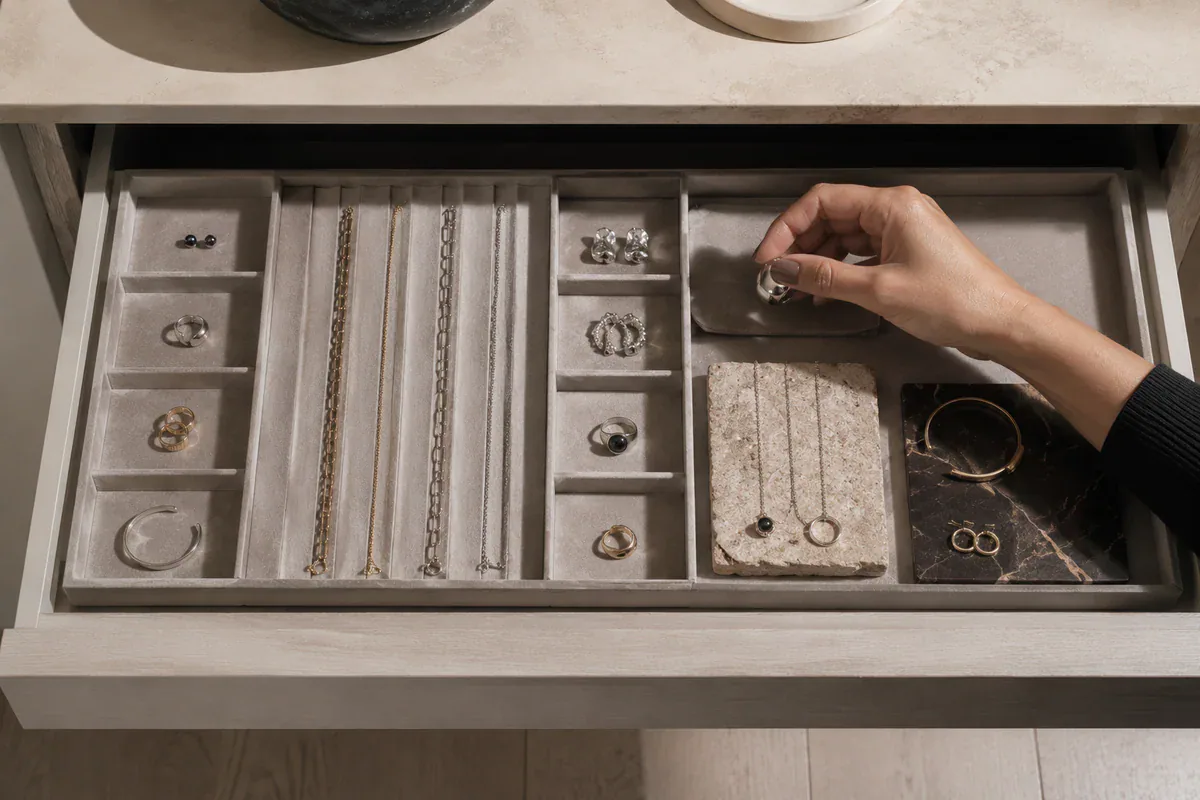
At 8:10 a.m., the difference between wearing a sculptural ring and abandoning it is often six inches of drawer space. One piece is visible, upright, and ready; another is buried beneath a chain knot, a loose earring back, and a pouch you have not opened in months. Learning how to store jewelry at home is less about buying a decorative box than designing a small drawer plan. This guide builds that approach around material sensitivity, friction, movement, frequency, and visibility—so your jewelry is protected without becoming hidden, and your drawer feels more like a working collection than a crowded archive.
How to Store Jewelry at Home: Start with Risk, Not Decoration
Before choosing trays, dividers, hooks, or boxes, map the forces that can damage or erase a piece from daily life. Jewelry storage has five practical risks:
- Contact: hard surfaces, stones, clasps, and metal edges rubbing against one another.
- Motion: chains sliding, earrings migrating, and rings colliding each time the drawer opens.
- Environment: moisture, heat, direct light, dust, cosmetics, and airborne pollutants.
- Memory: pieces disappearing beneath layers or becoming separated from their pair.
- Retrieval: an approach so complicated that you stop returning jewelry to its proper place.
The Gemological Institute of America recommends keeping frequently worn pieces within easy reach and using multiple compartments to reduce tangling and scratching. That is a useful starting point, but a home drawer should go one step further: organize first by vulnerability, then by type. A delicate pearl earring should not share the same open well as a heavy angular cuff simply because both are “ear jewelry.”
Choose a shallow interior drawer away from sinks, showers, cooking steam, radiators, and strong sunlight. Line it with clean, smooth, non-abrasive material, then add removable compartments rather than committing immediately to a fixed layout. Your collection will change. A flexible drawer can change with it. For cleaning and handling guidance before storage, consult Switchroom’s care and sizing guidance.
Build the Drawer by Contact and Material Sensitivity
Think of each compartment as a small buffer zone. The question is not only “What kind of jewelry is this?” but “What is allowed to touch it?”
Give high-friction pieces their own footprint
Large sculptural rings, stone-set rings, rigid cuffs, and earrings with projecting forms need individual cells or generous spacing. The aim is to keep edges, prongs, stones, and polished surfaces from repeatedly striking neighboring pieces. Store substantial rings upright in padded slots when their forms allow it, or lay them flat in separate shallow compartments when a tall setting could catch on a lid.
Do not force an irregular ring into a narrow roll designed for conventional bands. Compression can make retrieval awkward, and awkward retrieval leads to pulling, dropping, or abandoning the slot altogether. Storage should follow the construction of the piece rather than forcing every piece into the same furniture.
Separate soft, plated, and mixed-material pieces
Plated finishes and polished surfaces benefit from reduced rubbing. Keep them in separate soft-lined cells or individual pouches, especially when stored beside textured metal, stones, or sharp findings. Pearls are comparatively soft and should be separated from harder jewelry. GIA also cautions against assuming that the driest possible environment is suitable for every gem; pearls and opals can be harmed by excessively dry storage. Material knowledge matters more than a universal “keep everything sealed and dry” rule.
If a piece combines metal, pearl, stone, enamel, resin, textile, adhesive, or an unknown treatment, follow the needs of its most sensitive component. Save the maker’s care instructions and material information for reference. Switchroom’s materials overview can help you identify why different constructions require different handling, while the guide to quality, materials, and wear explains why surface appearance alone does not tell you how a piece will behave over time.
Use tarnish language carefully
A box does not make silver permanently tarnish-proof. The Canadian Conservation Institute explains that silver tarnishes through exposure to sulfur-containing gases, and even an enclosure may be ineffective if it is not sufficiently sealed or is made from unsuitable materials. For sterling silver, a clean anti-tarnish pouch or cloth may slow exposure, but results depend on the product, the enclosure, the surrounding air, and how often the drawer is opened. Treat “anti-tarnish” as a risk-reduction measure, not a guarantee.
Prevent Jewelry Tangling with Chain Lanes, Not Shared Piles
Necklaces tangle because flexible lengths are stored with too much freedom and too many crossing points. The solution is not a larger bowl. It is controlled direction.
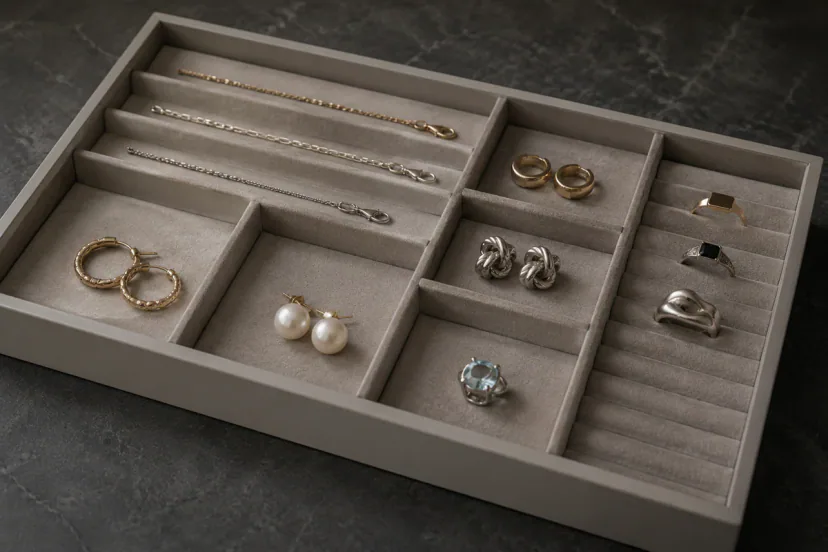
Create narrow chain lanes using dividers, padded channels, or individual compartments long enough for each necklace to rest with minimal folding. Fasten the clasp before storage; a closed loop is less likely to thread itself through another chain. Keep pendants in their own small recess so their weight does not drag across neighboring surfaces when the drawer moves.
For very fine chains, store one necklace per lane. For heavier chains, two may share a long compartment only when they are clearly separated and cannot cross. Do not stack a snake chain, fine cable chain, and linked sculptural necklace simply because their lengths are similar. Their flexibility, surface, and snag risk are different.
Bracelets can use shorter versions of the same lanes. Rigid bangles need enough space to prevent repeated edge contact; flexible bracelets should be clasped and laid in a defined curve. Hanging systems can work for selected necklaces, but only when the hooks are stable, the pieces do not strike a wall or one another, and the jewelry is not exposed to direct light, dust, or dressing-table sprays.
A small “return strip” at the front of the drawer prevents temporary chaos. When you remove a necklace late at night, place it there rather than dropping it into the main collection. Empty the strip during a weekly reset. Temporary storage is useful when it is designed, visible, and time-limited.
Use a Three-Zone drawer plan
The most functional jewelry drawer is not perfectly symmetrical. It reflects how you actually dress. Use this formula:
Placement = sensitivity × movement risk × frequency of wear.
A vulnerable piece may deserve a protected compartment even if worn often. A durable daily ring may sit at the front, but it should still have a defined landing point. A rarely worn statement earring can live deeper in the drawer, provided both earrings remain visible as a pair.
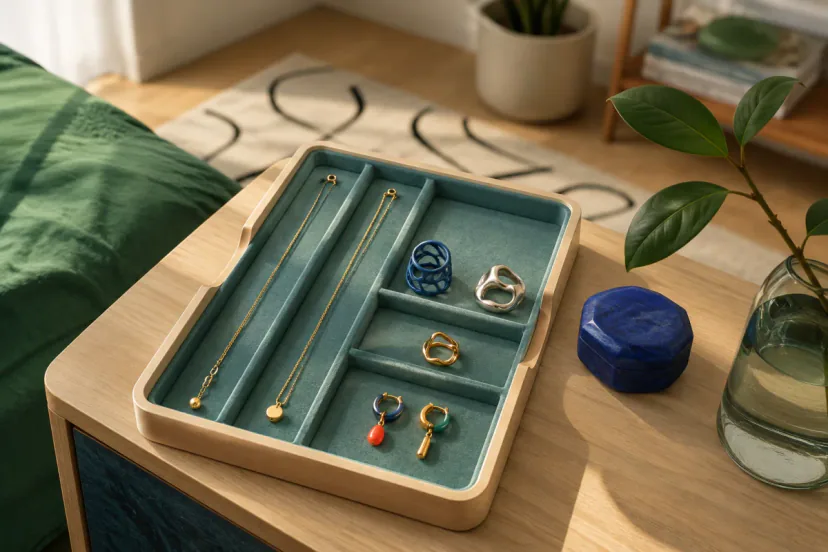
Zone 1: The daily landing strip
Reserve the front edge for a small rotation of pieces worn several times a week. Keep this zone edited; it is not a miniature version of the entire collection. A shallow ring dish can work here only if the pieces do not damage one another. Better still, assign one or two padded cells for daily rings and paired posts for daily earrings.
Zone 2: The visible collection
This is the main field of the drawer: rings grouped by scale or construction, earrings paired and secured, bracelets laid in curves, and chains placed in lanes. Grouping by type helps comparison, but preserve the material exceptions established earlier. Visibility matters because a piece you cannot see rarely enters the styling choice.
Zone 3: The protected exceptions
Use the rear or side compartments for heirlooms, delicate stones, pearls, valuable pieces, seldom-worn pieces, and anything awaiting professional inspection. Original boxes can be useful when they fit the piece well and do not introduce abrasive contact, but too many closed boxes can turn a drawer into an unreadable stack. Label the outside discreetly or keep a simple phone photograph of the layout.
Seven-minute drawer reset checklist
- Remove every piece and wipe dust from the empty drawer with an appropriate clean cloth.
- Set aside anything damaged, loose, bent, or awaiting repair; do not return it to circulation.
- Pair earrings and secure loose backs in a tiny lidded compartment.
- Fasten chains and place each one in a lane without crossings.
- Separate pieces that can scratch, rub, snag, or crush one another.
- Move the most-worn pieces to the front without sacrificing protection.
- Photograph the finished layout so missing pieces and gradual clutter are easier to notice.
Make Storage Inspiring, Not Decorative Clutter
An inspiring drawer is not one filled with ornamental pieces. It is one that makes relationships visible: silver beside gold, a severe signet near a fluid chain, a pair of geometric earrings beside a softer pearl form. The drawer becomes a quiet styling surface, where proportion and contrast can be read before anything touches the body.
Leave deliberate negative space. An empty compartment is not wasted; it prevents contact, clarifies categories, and gives future purchases a turning point. Before adding a new tray, ask whether the existing storage needs more capacity or simply a stronger edit.
Reuse can be practical here. The U.S. Environmental Protection Agency identifies reduction, reuse, maintenance, and repair as ways to extend the useful life of products and reduce waste. A clean, stable gift box, shallow rigid container, or well-made divider may be repurposed when its surfaces are smooth, its dimensions suit the jewelry, and it does not shed fibers, odor, adhesive, or dust. Reuse the right piece, not merely any piece.
Finally, keep a small exit path for pieces that no longer fit your body, style, or life. Repair them, redesign them, pass them on, sell them, or donate them rather than allowing them to form a permanent lower layer. Good jewelry drawer organization protects pieces, but it also keeps the collection active.
Build one drawer around the jewelry you reach for now, then let it evolve. To study new combinations of scale, structure, and material, explore the Switchroom jewelry collection—with enough space left for every piece to remain legible.
Build a Small World, Then Rotate It
It is a weekday morning. Three pieces rest near the front of a drawer because you simply want to wear them—perhaps a heavy domed gold band, a pair of articulated drop earrings, and a fluid mid-length chain. The rest of the collection sits further back, tucked into individual pouches and closed compartments. This active edit is a temporary arrangement. The Pinterest 2026 Hobbies Trend Report, published August 25, 2026, noted intentionally arranged, visible, and rotating micro-collections as a rising platform signal. For your drawer, it is a practical way to manage daily choices while considering the specific needs of your pieces.
Choose Three to Five Items
Select three to five pieces based on your actual routine and what you want to wear over the next few days. Count one earring pair as a single choice. You can group items by how they relate rather than by price or matching sets. You might arrange a three-item rotation—a ring, an earring pair, and a chain—or you could build a finish-led edit focusing on a brushed band, softly reflective earrings and a fine chain, each in its own compartment. If you find certain combinations particularly resonant, you can keep personal preference notes in your Jewelry Profile to remember them for future weeks.
Give Each Piece Its Own Space
Separate positions simply reduce contact between items. Rather than leaving pieces in loose piles, GIA care guidelines advise using separate, suitable boxes or padded positions. Give each piece its own designated path. Lay chains out in straight lanes, and keep heavier pieces apart. Ultimately, the material, treatment, construction, and the maker’s instructions govern how a piece should be stored. If a finish is unknown, always check before choosing its storage environment. Remember that pearls and opals can dry out if placed in environments that are too dry. Use the Jewelry Care Guide when you need to check a material or finish.
Leave a Retrieval Gap
Arrange the pieces with a physical space between them. Leave enough room to pick up a ring without moving an adjacent clasp or bumping another piece. Visibility serves the moment you are deciding what to wear. The pieces in your edit are visible when the drawer is open; close it after choosing. Avoid leaving jewelry on an exposed tray all week, which subjects the pieces to ambient light, moisture, and dust.
Set a Return Trigger
This active arrangement is meant to be temporary. Decide on a return trigger—perhaps the end of the week or the morning after a dinner—to clear the front of the drawer. Inspect the pieces you have been wearing, cleaning them only according to known care guidance if needed. Then, return them to their specific locations deeper in the drawer and take a moment to choose a new small world for the days ahead.
Small-space jewelry storage ideas for renters
The most useful jewelry storage ideas begin with risk and routine, not furniture. For jewelry storage for renters, choose a stable, dry location that does not require permanent installation: a divided tray inside an existing drawer, a closed case on a shelf or a compact organizer secured inside a cabinet. A system you can move at the end of a lease is still a permanent home for the collection while you live there.
Jewelry storage without a dresser
Jewelry storage without a dresser can use a shallow case inside a wardrobe, a lidded tray on a stable shelf or a portable roll kept flat. Avoid open bowls beside a sink and hanging displays where long pieces swing into a wall, collect dust or catch clothing. If the collection is valuable, visibility is not automatically an advantage.
How to store necklaces in a small apartment
For how to store necklaces in a small apartment, fasten each chain and give it an individual lane, soft wrap or closed pocket. Keep pendants from resting on delicate surfaces and coil chains in a loose circle rather than a tight knot. To answer how to prevent chains tangling in a jewelry box, begin with separation: one chain per channel, closure fastened, no loose ends crossing the next piece.
Wall mounted jewelry storage for renters
Wall mounted jewelry storage for renters can work only when the mounting product is rated for the exact wall finish and load. Follow its removal instructions and do not hang valuable pieces where an adhesive failure would drop them onto a hard floor. A closed organizer inside existing furniture is usually less dramatic and more forgiving.
Can mixed metal jewelry be stored together?
Can mixed metal jewelry be stored together? It can share one drawer, but pieces should not be pressed into one pile. Construction and finish matter more than color. For how to separate silver and gold jewelry in storage, use individual soft compartments and preserve the maker’s exact material record. Separate plated, polished, oxidized, porous and projecting surfaces according to their own contact and care risks.
Use the Jewelry Care Guide when a material or finish is uncertain, and save the storage method and friction notes in your Jewelry Profile. The travel organizer guide is the portable version of this system; this page owns the permanent-home setup.
FAQs About Jewelry Storage at Home
Can I store all jewelry in the same drawer?
Yes, provided the drawer has separate compartments and the pieces are grouped by sensitivity, friction, and movement risk. Pearls, plated finishes, sharp settings, heavy pieces, and fine chains should not be allowed to rub or tangle together.
Should jewelry be kept in plastic bags?
Some pieces may benefit from clean, suitable individual bags, especially when the goal is to reduce contact or slow exposure to the surrounding air. Avoid trapping moisture, and do not assume one bag type is appropriate for pearls, opals, adhesives, or every treated material.
How do I stop necklaces from tangling?
Fasten each clasp, store one fine chain per lane or compartment, and keep pendants from crossing neighboring chains. A defined temporary return strip is safer than dropping necklaces into a shared dish.
Does a jewelry box prevent tarnish?
Not completely. Tarnish depends on the metal, airborne pollutants, humidity, enclosure materials, and how well the box limits exposure. Anti-tarnish products may slow the process, but they should not be treated as a permanent guarantee.