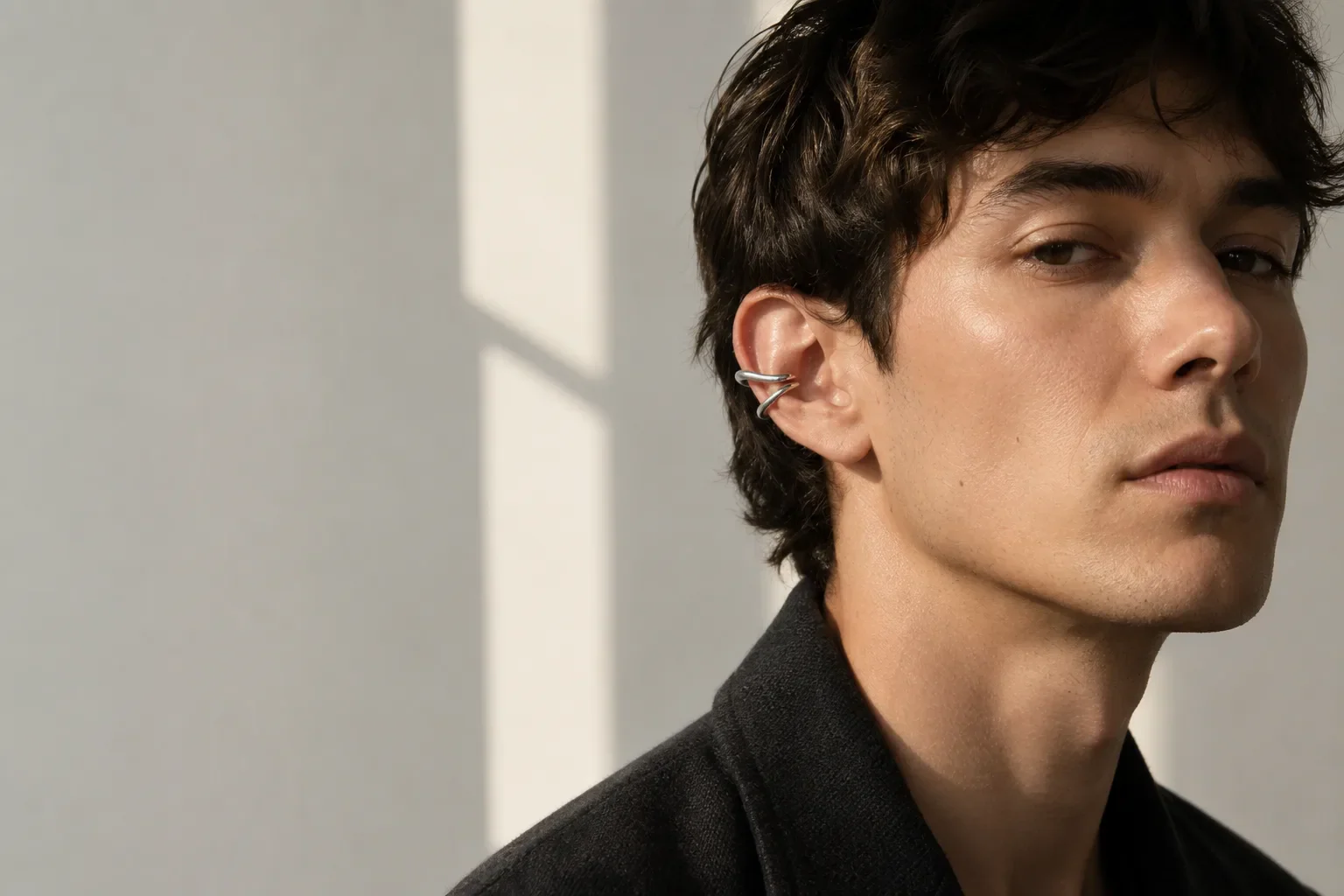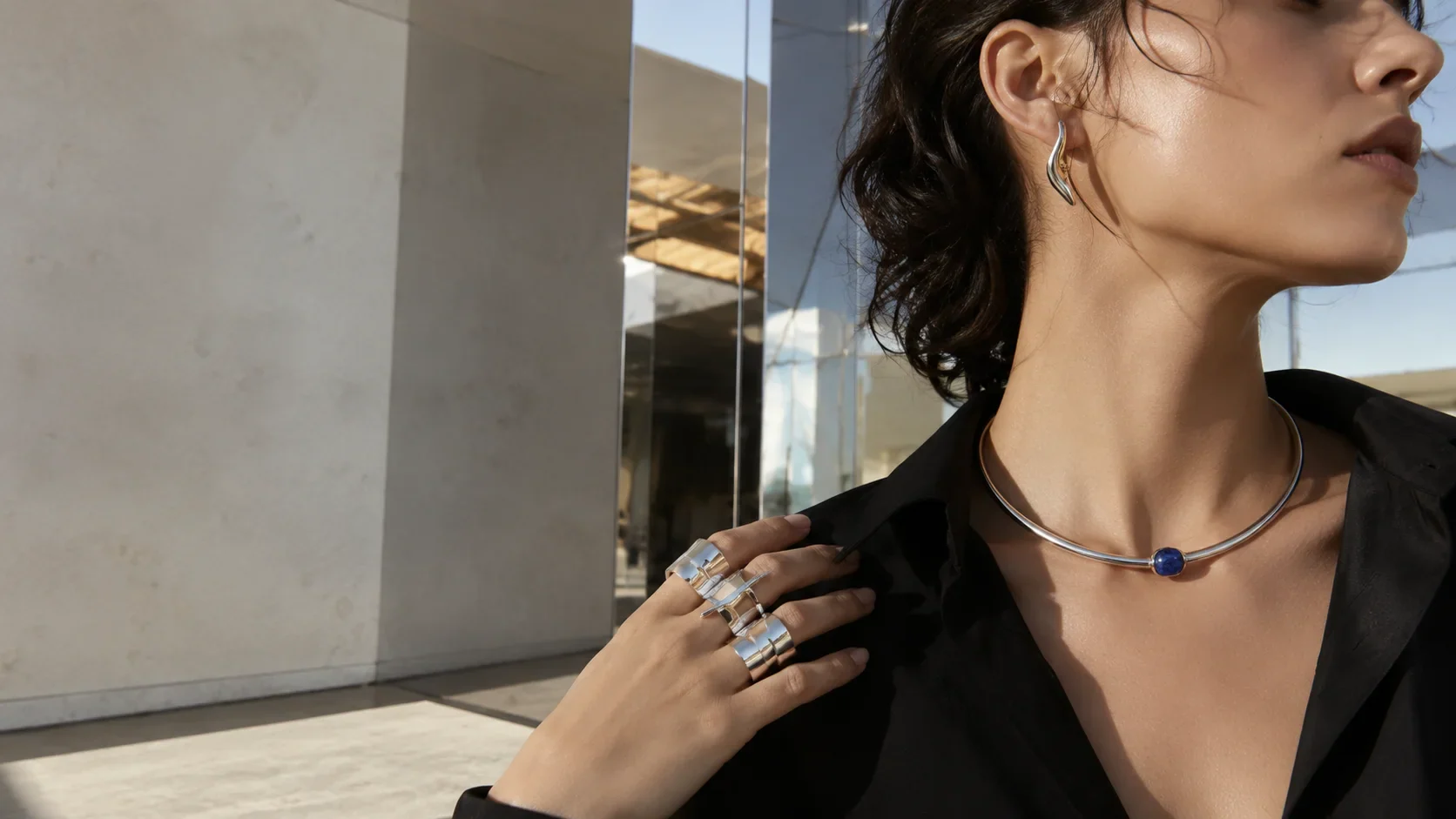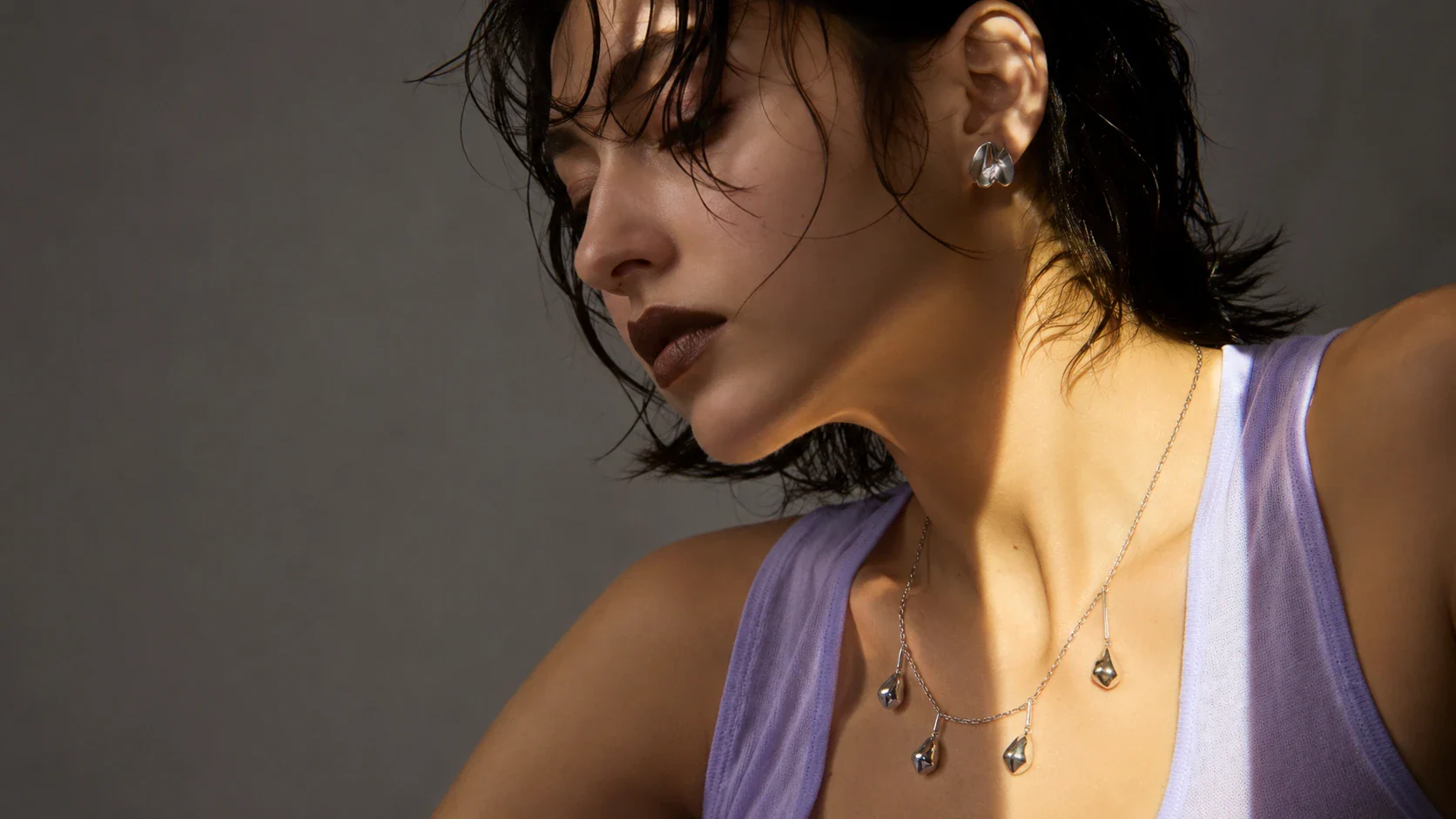
Asymmetrical earrings styling works when the two ears are given different jobs but still belong to the same sentence. Let one side carry the longer gesture, let the other act as a compact counterweight, and then check the practical things that make the idea survive outside a photograph: scale, glasses clearance, ear contour, closure security, movement and weight.
Start with a left-right hierarchy, not a matching rule
The easiest way to make asymmetrical earrings look deliberate is to choose a dominant side before you choose details. One ear can carry length, movement or a more open silhouette; the other can hold the face with a smaller, denser form. You are not trying to make both sides equally noticeable. You are trying to make them feel related while allowing one side to lead.
A useful first test is to stand straight on in a mirror and ask where your eye lands first. If the answer is the longer earring, look immediately at the opposite ear. Does it disappear completely, or does it provide enough shape to stop the composition feeling unfinished? A compact oval, small knot, short bar or reduced version of a curve can often do more than another dramatic piece.
This is also the simplest answer to how to balance mismatched earrings: balance is not sameness of length or area. It is a convincing distribution of attention. A long, narrow drop may read as lighter than a short but visually dense form. Judge the silhouette from conversational distance, not only in a close-up.
Choose one shared language and let everything else differ
If you are working out how to wear mismatched earrings, give the pair one unmistakable family resemblance. The link can be material, edge quality, curvature, surface finish, proportion or negative space. You only need one or two strong connections. Too many shared details can make the pair look like a matched set that suffered an accident; too few can make it look as if you dressed in the dark.
For example, a softly curved silver-colored drop can sit opposite a compact silver-colored oval if both have the same restrained finish and similarly rounded edges. Their dimensions can be very different because the material and contour logic keep them in conversation. Another pair might share a darkened recess while one form is vertical and the other nearly circular. The relationship should be visible without requiring explanation.
Keep the rest of the jewelry quiet while you assess the pair. A necklace, stacked ear pieces and multiple rings can make it harder to see whether the left-right relationship actually works. Once the earrings hold on their own, you can decide what else the outfit needs.
Use earring scale for each ear, not one scale for the whole face
Earring scale for each ear matters because the two sides of a face are never presented identically. Hair direction, a habitual head turn, glasses temples, cheek contour and even the way you tuck hair can change how much visual room each ear has.
A practical starting ratio is not a formula but a question: how different can the pair become before one side looks accidental? Try one clearly extended form and one clearly compact form rather than two pieces that are only slightly different. Strong asymmetry is often easier to read than hesitant asymmetry. If both pieces are medium-sized but unrelated, the eye may search for a rule and fail to find one.
Then check the pair from three views: straight on, three-quarter and profile. A drop that looks elegant from the front may overlap the jaw from three-quarter view. A small oval that seems insignificant in profile may become the needed anchor straight on. The best pair keeps its logic as your head moves.

Glasses change the available architecture around the ear
Asymmetrical earrings with glasses need a little more discipline because the temple arm already creates a horizontal line beside the ear. Before choosing the larger side, put on the glasses you actually wear and check where the arm meets the ear, how thick the frame is, and whether the earring visually collides with the hinge or temple.
One useful move is to let the longer earring hang below the lobe rather than extend upward into the glasses zone. On the compact side, keep enough negative space that the frame and earring remain separately legible. Translucent or fine frames usually tolerate more sculptural jewelry than thick, high-contrast frames, but the final judgment is visual, not categorical.
If glasses are central to your daily look, test the earrings while taking the frames on and off. The question is not only whether the pieces photograph well together, but whether your fingers can reach the glasses without repeatedly knocking the earring or backing. For a fuller treatment of frame scale and statement jewelry, read statement earrings with glasses.
Short hair makes the mismatch clearer, so edit harder
Mismatched earrings for short hair are exposed almost continuously. There is no curtain of hair to soften a difficult proportion or hide a closure. That visibility is useful: it makes a clean asymmetrical idea feel crisp and graphic. It also means every millimeter of awkward spacing becomes easier to notice.
Look at the ear as part of the silhouette of the head. If the longer earring follows the neck too closely, it may visually merge with the body. If it swings too far outward, it can look detached from the face. On the smaller side, make sure the piece does not sit so close to the lobe that it disappears into the ear contour.
With both ears visible, the pair should still read as intentional when you look straight ahead. If you want more specific hairstyle guidance without turning this page into a haircut manual, continue with statement earrings for short hair.
Check the body mechanics: post, backing, clearance and swing
The most elegant asymmetry fails quickly if the wearing path is vague. For a conventional post earring, the straight post should pass through the healed lobe piercing and meet its backing directly behind the lobe. The front element should sit where the design intends, without the lobe being twisted to create the photograph.
For a longer piece, check the full load path from front element to post to backing. Let gravity hang the earring naturally and see whether the lower section clears the neck and jaw during normal movement. If the earring repeatedly taps the neck, catches a collar or changes angle because the backing is loose, the styling problem is mechanical as much as visual.
The smaller side deserves the same scrutiny. Compact earrings can still rotate, tip or press into the lobe. Look from behind if possible. A secure closure should be easy to identify, and you should be able to tell which component is carrying the load rather than relying on an invisible or ambiguous attachment.
Weight balance is about sensation as well as appearance
Asymmetrical earring weight balance does not require the two earrings to weigh the same. In fact, a visually long earring can be physically light while a compact solid form may feel denser. What matters is whether each ear feels stable on its own and whether the difference becomes distracting over time.
Before a long day, try the pair for a shorter period and pay attention to pulling, repeated rotation or a backing that migrates. Do not assume that apparent size tells you how the pair will feel. Construction, material distribution and the distance of the mass from the piercing all affect how movement is perceived.
If you are choosing between two potential long-side pieces, the one with a cleaner swing and better clearance may create a more confident result even if it is less dramatic. The point of asymmetry is to create visual tension, not physical irritation.
Let ear contour decide direction
Not every asymmetrical pair needs one long and one short earring. Direction can provide the contrast. One piece can echo the lower curve of the lobe while the other drops vertically; one can open outward while the other stays close to the ear. What matters is that the shapes respect the body rather than pretending the ear is a flat display board.
Check where metal approaches cartilage, hair, cheek and glasses. Leave visible breathing room where the design needs to read as a separate form. If a piece is meant to touch the lobe, that contact should look intentional and structurally plausible. If it is meant to hang free, there should be daylight around it rather than unexplained collision.

Adding a cuff changes the composition from a pair to a trio
Asymmetrical earring styling with ear cuffs can work beautifully, but the cuff is not a neutral extra. It becomes a third visual event. If one ear already carries the dominant earring, placing a cuff on that same side can tip the composition into clutter; placing it on the compact side can either create a clever counterweight or erase the intended difference.
Think in clusters. Ask whether the cuff visually belongs to the compact earring, the long earring or neither. Keep enough separation that each attachment point remains understandable. And because cuffs use a different contact method from pierced earrings, assess their fit independently rather than assuming a balanced photograph means balanced wear.
Match the earrings to the neckline, not to every accessory
Asymmetry benefits from a calm frame. Open necklines, clean collars and restrained tailoring often give the long side enough air to move. A high collar can also work if the earring clears it decisively. Problems arise when the lower edge of a drop lands exactly on a collar, scarf or textured shoulder line, creating a visual and physical collision.
You do not need to repeat the earring metal everywhere else. A better approach is hierarchy: decide that the ears are the focal point, then keep other accessories subordinate. If the clothing already contains strong directional seams, folds or color blocking, notice whether they reinforce the long side or fight it.
A five-minute fitting test before you leave
- Face forward. Confirm that the dominant side is obvious and the compact side still contributes.
- Turn both ways. Check jaw, neck, hair and glasses clearance in three-quarter and profile views.
- Move normally. Walk, sit, put on a coat, use your phone and remove your glasses if you wear them.
- Check closures. Make sure each post and backing is seated as intended and that no component is relying on hair or skin pressure to stay positioned.
- Remove one competing accessory. If the look feels busy, subtraction is usually more effective than searching for a fourth element to “tie it together.”
The result should feel a little off-center but never unresolved. The strongest mismatch gives the face a new rhythm while remaining clear about how every piece is attached, how it moves and why the two sides belong together.
Read next
- Statement earrings with glasses
- Statement earrings for short hair
- Wearable art jewelry
- Current earrings edit
Sources & further reading
- V&A jewellery collection
- The Metropolitan Museum of Art: portrait study with visible earring
- The Metropolitan Museum of Art: portrait study with relaxed gesture and clothing contrast
- The Metropolitan Museum of Art: portrait study in tonal separation
- The Metropolitan Museum of Art: frontal portrait composition study