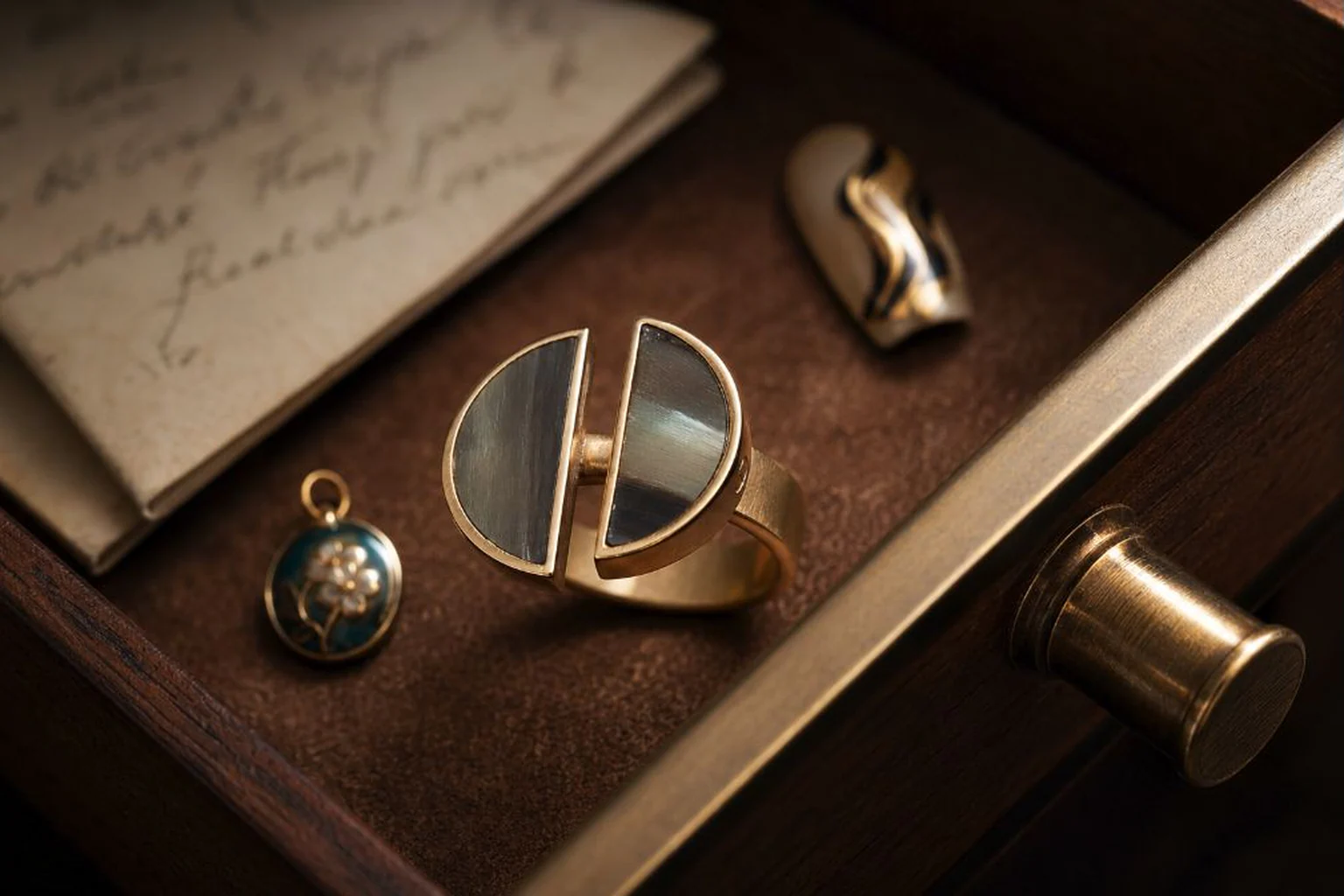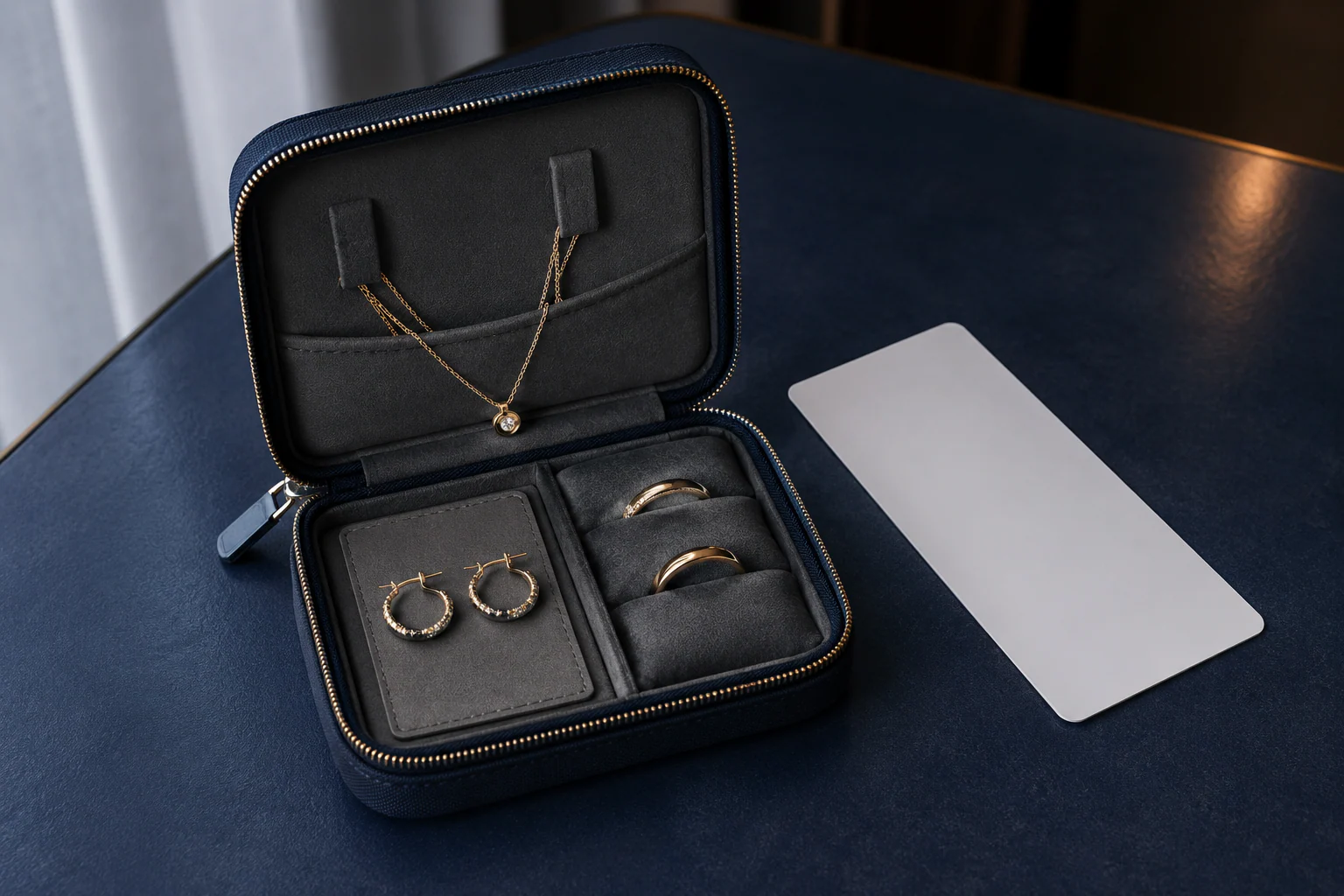
A non standard jewelry gift works when the unusual part feels specific to the person rather than merely surprising. Start with four things: your relationship, the moment you are marking, the scale they actually wear, and the private meaning you share. Then choose a piece whose form carries that feeling without asking the jewelry to explain the entire relationship for you.
Begin with the relationship, not the category
Jewelry can feel intimate even when the relationship is not romantic. That is precisely why the first question should not be “ring, earrings, necklace or bracelet?” but “what am I trying to acknowledge?” A sibling leaving home, a friend finishing a difficult year, a collaborator beginning a new chapter and a parent celebrating a quiet personal victory all call for different kinds of attention.
A jewelry gift for a friend does not need to imitate the visual language of a proposal or anniversary. In fact, it is often stronger when it avoids borrowed romance. Look for a form that says recognition rather than possession: a small architectural ring, an asymmetric earring, a pendant with an intriguing silhouette, or another piece that feels like an object chosen because you know how that person looks at things.
The same principle makes a non romantic jewelry gift easier to judge. If the piece depends on hearts, declarations, couple symbols or a story you would never naturally tell each other, it may be carrying the wrong emotional script. If it reflects a shared joke, a visual obsession, a place, a habit or a quality you admire, the gesture can remain close without becoming sentimental theater.
Choose the moment before you choose the symbolism
A gift changes meaning according to when it arrives. A birthday asks for something different from a graduation, a move, a recovery from disappointment or the end of a long project. The most convincing jewelry gift for a milestone does not have to depict the milestone literally. It can simply feel proportionate to it.
For a major transition, consider a piece with enough visual presence to register as deliberate. For a quieter threshold, a smaller form may be more exact. A person beginning a new job might value something they can wear often; someone completing a demanding creative project may appreciate a stranger, more concentrated object that feels ceremonial. The gift does not need to announce the event to strangers. It only needs to make sense to the two of you.
This is where private meaning is more useful than generic symbolism. “Strength,” “love” and “luck” are broad enough to fit almost anyone. A more precise choice might come from the recipient’s fascination with loops, maps, machinery, weather, old books, insects, mirrors or a certain kind of geometry. The reference can remain legible only to them. That is not a weakness; it is often the point.
When someone has everything, give them a sharper point of view
A jewelry gift for someone who has everything is difficult only if the goal is to add more quantity. If they already own plenty, the useful question becomes: what perspective is missing? A new piece can introduce an unexpected proportion, a quieter metal finish, a different relationship to negative space or a form they would admire but not predictably choose for themselves.
Do not confuse “different” with “louder.” One of the best unique jewelry gift ideas can be a very restrained object with one unusual decision: a ring that seems to fold around empty space, an earring with an offset rhythm, or a pendant whose front and side views tell different stories. The design should reward looking, not merely demand attention.
People with established taste often notice construction, proportion, surface and how a piece meets the body. Before buying, check the actual product information for dimensions, materials, closure and care. An arresting photograph cannot tell you whether a piece suits the recipient’s habits.
Use what they already wear as evidence, not as a shopping list
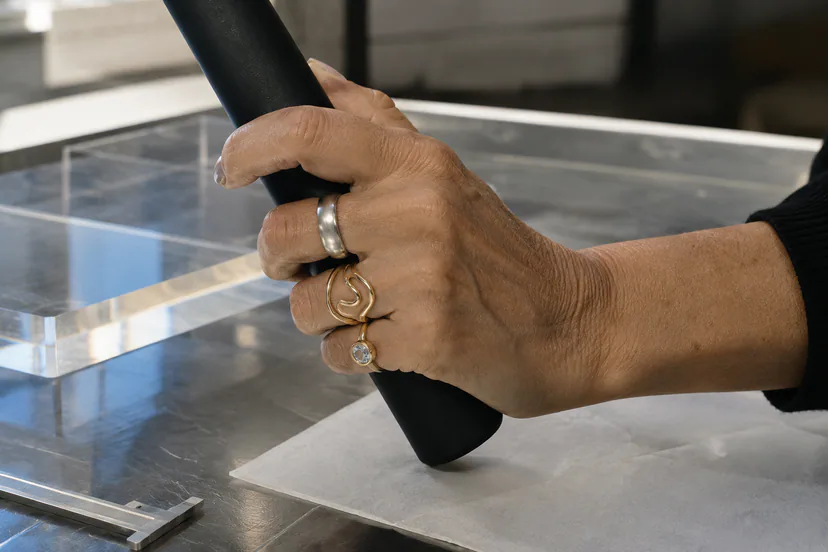
If you are unsure how to choose jewelry as a gift, study what the person repeats. Repetition reveals preference more reliably than a single dramatic outfit. Do they wear one metal almost every day? Are their rings narrow or broad? Do their earrings sit close to the ear or move below it? Do they choose polished surfaces, brushed ones, color, stones, bare metal, symmetry or deliberate imbalance?
Then look one step beyond that pattern rather than five. Someone who wears slim silver rings may welcome a slightly more sculptural silver form; someone who always wears tiny studs may not want a shoulder-length statement earring simply because it looks exciting online. A gift can extend a visual language without replacing it.
- Metal: notice the color and finish they repeatedly choose.
- Scale: compare the physical size of their everyday pieces, not just their visual impact in photographs.
- Movement: observe whether they prefer fixed forms or pieces that swing, rotate or articulate.
- Routine: think about work, travel, dressing speed and how often they actually change jewelry.
- Attention level: decide whether they enjoy being asked about what they wear or prefer details that reveal themselves slowly.
This method is especially useful for gifts for jewelry lovers. Someone who already pays close attention to jewelry is less likely to be impressed by generic “luxury” language and more likely to appreciate a precise decision.
Scale is part of the message
Scale changes the emotional temperature of a gift. A large sculptural object can feel celebratory, theatrical or challenging. A compact piece can feel private, daily and almost talismanic. Neither is inherently more meaningful.
Think about the recipient’s threshold for visual and physical presence. A person who loves dramatic clothes may still prefer quiet jewelry; someone who dresses minimally may use one substantial ring as the entire punctuation of an outfit. The point is not to match stereotypes but to notice their actual habits.
For rings, verify sizing before buying whenever the piece is size-dependent. For earrings, consider the recipient’s usual attachment style and the real dimensions of the piece. For necklaces and bracelets, check length and closure. Unconventional design is most satisfying when the practical information is ordinary and clear.
Meaningful does not require names, dates or engraving
Meaningful jewelry gifts without personalization can be more subtle than a name or date because the meaning comes from selection rather than inscription. The act of noticing can do the work.
You might choose a circular form for a friend with whom you keep returning to the same conversation, a hinge-like construction for someone who has just changed direction, or a compact object for a person who keeps private things close. These meanings are not universal truths about shapes. They are interpretations you bring to the gift, and they become convincing only when they fit the relationship.
This also avoids forcing a permanent statement onto a piece the recipient may want to style in many contexts. The jewelry can remain visually open while the reason for giving it stays specific.
A five-question test before you buy
- What is the relationship? Name it plainly: friend, sibling, parent, collaborator, partner or another bond. Notice what emotional language belongs there and what does not.
- What is the moment? Decide whether the gift is celebrating, encouraging, thanking, marking a transition or simply saying “I saw this and thought of you.”
- What scale do they actually wear? Use their existing jewelry as a reference for size, weight and visibility.
- What private meaning is real? Prefer one precise association to a catalogue of generic symbols.
- What practical facts still need checking? Confirm the exact product’s dimensions, materials, size, closure, care information and current availability on its product page.
If the piece survives all five questions, it does not need to be extraordinary in every other way. The gift already has a reason to exist.

What if you are not sure they will wear it?
When uncertainty is high, reduce risk by choosing closer to their established scale and material preferences. The more experimental the form, the more useful it is to be conservative elsewhere. A familiar metal can make an unusual silhouette easier to adopt; a compact size can make an unconventional construction feel less demanding.
If you still cannot infer their preferences, a curated route may be more appropriate than pretending certainty. The goal is not to prove how well you know someone through one object. It is to make a thoughtful choice while leaving room for their own taste.
Frequently asked questions
What makes a non standard jewelry gift feel personal?
Specificity. A piece feels personal when its form, scale or material connects to the recipient’s real habits or to a private association between you. The unusual quality should have a reason beyond novelty.
What is a good jewelry gift for a friend?
Choose something that acknowledges the friendship without borrowing romantic symbolism. A compact design with a shared visual reference, familiar metal or slightly unexpected form can carry intimacy without couple coding.
How do I choose a jewelry gift for someone who already owns a lot?
Look for a missing point of view rather than more volume: a new proportion, finish, construction idea or level of visual restraint. Then verify the practical details of the exact piece before buying.
Can jewelry mark a milestone without being personalized?
Yes. The timing, selection and private association can make the gift specific. Personal meaning does not require engraving or customization.
Let the unusual part be precise
The strongest non-standard gift is not the one with the strangest silhouette. It is the one that makes you think, “this would make sense to them.” Relationship gives the gesture its tone, the moment gives it weight, scale determines whether it can enter daily life, and private meaning makes the choice feel unmistakably considered.
Read next
- Explore a curated jewelry gift route
- Consider a jewelry subscription gift
- Use Jewelry Profile to clarify preferences
- Browse the current jewelry edit