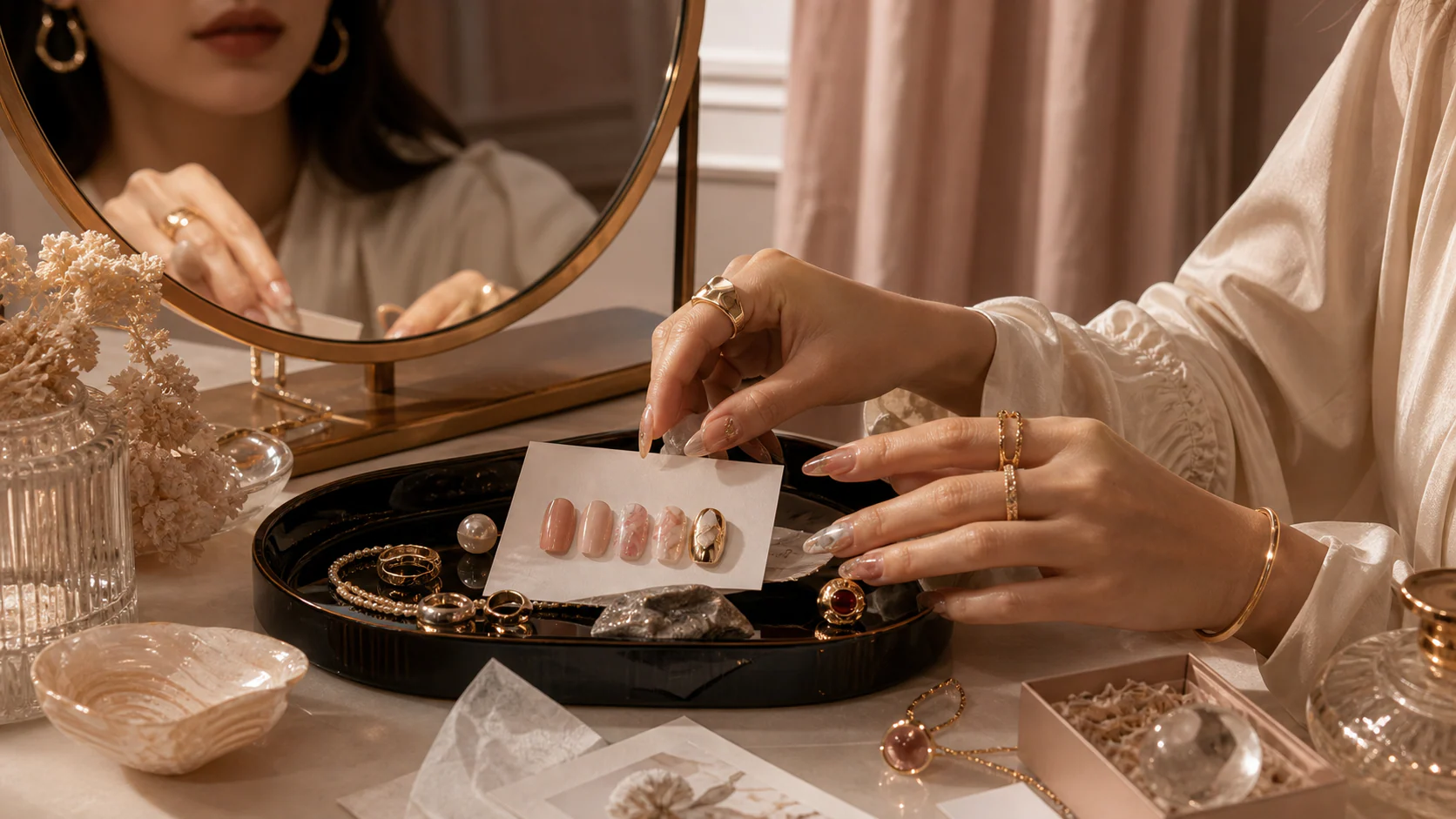
At 8:40 a.m., your tote holds a laptop, a charger, a water bottle, and exactly enough time to become three different people before midnight. The jewelry that works here is not a miniature fantasy wardrobe. It is a portable system: pieces that survive repetition, shift the reading of a simple outfit, and return safely to a small case at the end of the day. This guide builds a five-piece college jewelry capsule for adult students moving between class, work, studio, gallery openings, dinner, and night plans—without turning a dorm shelf into a crowded display.
Why a College Jewelry Capsule Needs a Logistics Test
A good capsule is not simply “neutral jewelry.” Campus life asks sharper questions: Can you wear the piece through a lecture and a work shift? Does it catch on a knit, headphone, scarf, or bag strap? Can you remove it quickly for a studio, gym, or lab rule? Will it fit in one padded compartment?
Before buying anything new, run each candidate through a five-part test:
- Repeat: You can imagine wearing it at least twice in one week without feeling visually stuck.
- Shift: It creates a different reading when combined with one other piece.
- Move: It remains manageable while typing, commuting, presenting, carrying materials, or changing layers.
- Store: It has a clear, protected place in a compact case.
- Care: You understand the material and can follow the maker’s cleaning guidance.
That is the difference between back to school jewelry bought as a seasonal impulse and a capsule designed for repeated movement. The aim is not to look identical every day, but to create controlled variation from a small number of forms. For the larger idea behind identity shifts through accessories, read why one signature style is overrated; here, that philosophy becomes a campus packing guide.
The Five Pieces in a College Jewelry Capsule
These college jewelry essentials are roles rather than mandatory silhouettes. Adapt them to your piercings, clothing, schedule, sensory preferences, workplace rules, and existing collection.
1. A low-profile earring pair
Start close to the body. A compact stud, huggie, small hoop, or ear-climbing form gives the face structure without requiring a full styling choice. The best version is visually clear at conversational distance and considered around headphones, collars, and layer changes.
Use this pair as the weekday baseline. It should work with a sweatshirt, a presentation blazer, and a stronger ring at night. Study the closure, edge profile, and weight rather than only the front view. Approach Switchroom’s earring edit by silhouette: close, linear, curved, or suspended.
2. One sculptural gesture ring
A ring changes the visual tempo of the hand: typing, holding coffee, turning pages, presenting work, or reaching across a table. Choose one with enough form to register, then test it in ordinary motion—close your hand, grip a tote, use a trackpad, and slide the hand into a pocket.
Proportion matters more than generic “statement” size. A wide ring can feel calm; a narrow projecting line can feel intense. Decide whether you want a centered mass, open frame, curve, or asymmetrical interruption. Browse sculptural rings by architecture, not by the assumption that one shape suits every day.
3. An adaptable neck piece
The neck piece should make a plain upper half deliberate. A short chain, pendant, collar-like form, or sculptural element can sit against skin, disappear beneath a shirt, then move over a knit later. Ask not “Does it match everything?” but “Can it alter its visibility?”
Relate it to your repeated necklines. With crewnecks, avoid a length that fights the collar edge; with open shirts, use the available negative space. One clear line is more useful than three near-duplicates that tangle together.
4. A compact wrist piece
A bracelet or cuff adds a second zone of attention without competing with the face. It can move from visible beside a T-shirt to half-concealed by a work shirt, then reappear with pushed-up sleeves. On laptop-heavy days, test whether it hits the desk or interferes with your dominant hand.
The campus version should be easy to put on, easy to account for, and compact enough to store without bending. A restrained wrist piece can also replace a second ring when you want the hand to feel less crowded.
5. One signal piece
The fifth piece prevents the capsule from becoming polite but forgettable. It may be a single drop earring, ear cuff, brooch, charm, pearl form, vivid stone, or enamel interruption. Its job is to change the emotional temperature of the other four pieces.
Choose one signal, not a pile of accents. It might introduce color into gray tailoring, create asymmetry beside the baseline earrings, or move a black top from seminar to opening. One unusual construction, reflective surface, or point of color is enough.
One Week of Different Selves From Five Pieces
Let combinations follow context rather than a rigid outfit calendar. Adapt this rehearsal to your dress codes, sensory preferences, piercings, and course requirements.
| Moment | Combination | What changes |
|---|---|---|
| Monday seminar | Low-profile earrings + neck piece | A simple knit or shirt gains structure without demanding attention. |
| Tuesday studio or lab | Low-profile earrings only, where permitted | The capsule contracts. Remove projecting or catching pieces and follow the specific safety rules of the space. |
| Wednesday campus job | Earrings + compact wrist piece | The look stays composed while the hands remain relatively clear. |
| Thursday critique or presentation | Earrings + gesture ring + neck piece | Three points—face, hand, sternum—create authority without a full formal outfit. |
| Friday class to night plans | Day: earrings + ring. Night: add the signal piece. | One addition changes the reading without requiring a clothing change. |
| Saturday gallery or city day | Neck piece + wrist piece + signal piece | The focus moves away from the weekday baseline and becomes more spatial. |
| Sunday reset | Wear less; inspect all five | Check closures, wipe surfaces as appropriate, untangle the chain, and return every piece to its place. |
The strongest shift happens through addition and subtraction, not stacking everything at once. The signal piece matters because it arrives late; the ring feels stronger when the wrist is quiet. Five pieces can produce different selves without becoming costume.
Dorm Jewelry Storage Without a Vanity Table
Dorm jewelry storage should reduce friction and prevent damage. In shared, compact space, use one case or roll with defined zones rather than several open decorative containers.
- Give each piece one address. Earrings stay fastened together; the ring gets a padded slot; the neck piece lies in its own channel; the wrist piece is not forced into a tight bend.
- Separate hard surfaces. Do not let rings, chains, keys, coins, and metal hardware scrape together in a tote pocket.
- Pack only the day’s change. Carry the baseline pieces and one planned switch, not the whole capsule.
- Keep products away from the case. Apply perfume, lotion, hair products, and sunscreen before dressing, then let them settle before adding jewelry.
- Make Sunday visible. Put a five-minute inspection beside laundry or bag-reset time so care is part of the week, not an emergency after damage.
For travel between home and campus, GIA advises padding jewelry in a separate box or case to reduce scratches and impact. That small rule is more valuable than a complicated organizer: separation, cushioning, and a consistent return habit do most of the work.
Material and Care choices for Everyday Campus Accessories
Do not buy by color name alone. “Gold,” “silver,” and “platinum” can describe different compositions, constructions, and surface treatments. The U.S. Federal Trade Commission explains that karat marks indicate how much pure gold a piece contains; sterling silver is 92.5% silver; vermeil is gold plating over a sterling-silver base; and plated surfaces eventually wear depending on use and plating thickness. Read the full material description, not only the finish shown in the image.
That information sets expectations. Different constructions may suit different budgets, frequencies, and care routines. Material category alone does not decide whether a design belongs; the question is whether you understand it and will wear it enough to justify the space.
Campus care should stay simple and material-specific. GIA notes that perfume, lotion, hairspray, household cleaners, and chlorinated water can damage or discolor metals and harm some gems; ultrasonic cleaning is not safe for every stone or construction. Follow the seller’s instructions, especially for pearls, porous or treated gems, coatings, glued components, and mixed materials. Switchroom’s care and sizing guidance keeps the baseline clear: clean gently, store dry, and avoid harsh chemicals.
Before adding a piece, ask three purchase questions:
- Is the base metal, plating, stone, pearl, or other material clearly described?
- Can I wear this in at least three real contexts already on my calendar?
- Do I have a protected storage place and a care method I will actually use?
If the answer to one is no, pause. A capsule is strongest when every piece has a visual role and a maintenance plan. Start with what you already own, identify the missing role, then explore the wider jewelry collection only for that specific gap.
College Jewelry Capsule FAQs
How many pieces should a college jewelry capsule have?
Five is a useful starting point, not a rule. It is enough to create variation while remaining easy to store, inspect, and carry. Add a sixth piece only when it performs a clearly different role rather than duplicating an existing one.
What jewelry is best for everyday campus wear?
Choose pieces that are comfortable in ordinary movement, legible at conversational distance, compatible with your repeated necklines and sleeves, and easy to remove when a studio, lab, gym, or workplace requires it.
How should I handle dorm jewelry storage?
Use one padded, compartmented case or roll. Keep chains separated, earrings fastened together, rings away from keys and coins, and cosmetics outside the jewelry case. Return each piece to the same place after wear.
Should I bring expensive or sentimental jewelry to college?
Bring it only when you expect to wear it and have a secure, consistent storage plan. If loss would be emotionally or financially difficult to absorb, keeping the piece at home may be the more practical choice.