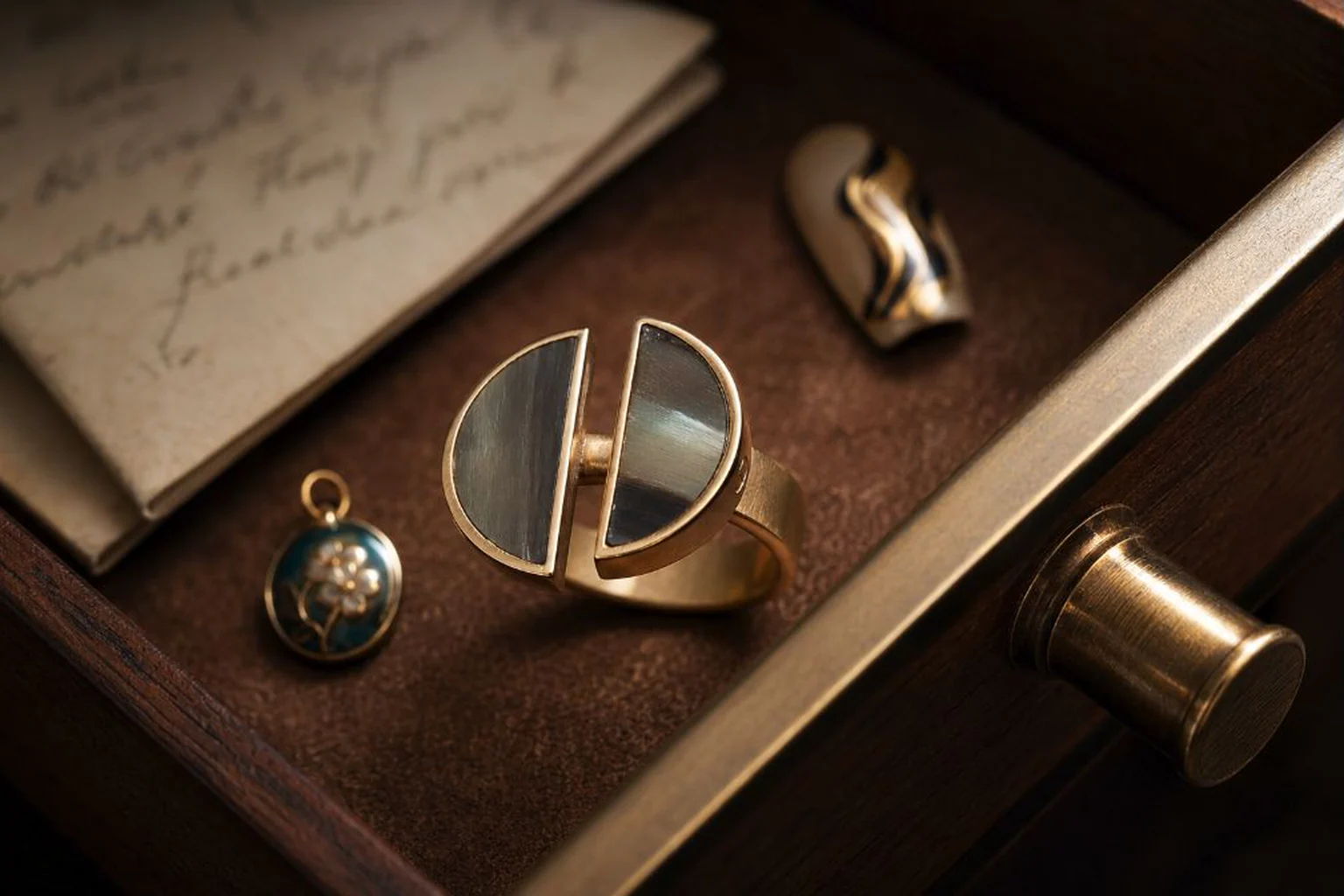
What is enamel jewelry? In its traditional fired form, it is metal jewelry colored with a glass-based material that is fused to the surface by heat. The color is not simply painted on, and it is not automatically the same thing as resin. Think of it as color that has been through a kiln: luminous, structural, and rather less forgiving of a collision with a marble countertop.
Fired enamel can feel stable in ordinary wear, yet it remains glass-like. Its beauty comes from color, metal, heat and finishing becoming one composition; its vulnerability comes from sharp impact, exposed edges and unsuitable cleaning. The useful way to understand enamel jewelry is as a relationship between surface and support.
Enamel is color with a metal skeleton
Vitreous enamel usually begins as finely ground glassy material. It is placed on prepared metal, heated until it bonds to the surface, then cooled and often fired again as color or depth is built. Recipes and firing cycles vary, so a photograph cannot reveal every production fact.
This is also why the word enamel deserves a quick inspection on a product page. Some contemporary jewelry descriptions use “cold enamel” for resin, epoxy or another unfired colored coating. Those materials can be perfectly intentional, but they are not made by the same process and may need different care. If the description matters to your choice, look for specific language such as vitreous, fired, cloisonné or champlevé rather than guessing from shine alone.
Fired enamel may be opaque, translucent or somewhere between. A glossy pool can make a compact ring look electrically blue; a matte surface can mute the same color toward stone or chalk. Small variations may record the process, but they are not an automatic certificate of quality. The surface, edges and construction still need to look deliberate and sound.
The main types of enamel jewelry, without the museum fog
The phrase types of enamel jewelry can refer to rings, earrings, pendants and brooches, but it more often points to the way the enamel is held. The technique changes what you see and where the vulnerable points may sit.
- Cloisonné: thin metal wires or strips create cells, and different enamel colors fill the spaces between them. The metal lines remain visible, becoming both drawing and division. ’s reversible brooch is a useful historical example of gold wire separating colored enamels, but the underlying principle is broader: color is organized by a network of raised borders.
- Champlevé: recesses are cut, cast or otherwise formed into a thicker metal surface, then filled with enamel. Instead of wire sitting on top, the surrounding metal itself forms the walls. The result often feels more architectural and can offer useful edge protection when the enamel sits slightly below the metal.
- Basse-taille: a low-relief pattern is engraved or worked into metal beneath translucent enamel. Light passes through the colored layer and catches the metal texture below, giving depth without adding a separate stone.
- Painted enamel: enamel colors are applied pictorially and fired in layers, allowing scenes or fine tonal detail while remaining part of a fired material system.
- Plique-à-jour: enamel fills open metal cells without a solid backing, producing a stained-glass effect. Open, unsupported areas deserve especially careful handling.
The V&A’s jewelry collection and The Met’s enamelled necklace show enamel moving from minute pictorial work to repeated color cells within gold constructions. They reveal a broad design range without implying that every historical method suits modern daily wear.
Cloisonné vs champlevé enamel: look at where the metal lives
The simplest way to understand cloisonné vs champlevé enamel is to follow the borders. In cloisonné, added metal partitions draw the design across the surface. In champlevé, the design is excavated into or formed within the metal, leaving raised metal between the colored recesses.
Neither technique is universally “better.” Cloisonné can produce extraordinarily precise lines and color changes; champlevé can make enamel feel embedded in a more substantial metal plane. For daily wear, construction matters more than the name alone. A beautifully made cloisonné pendant may remain relatively sheltered on the chest, while a champlevé ring with a broad exposed top can still meet every desk, door handle and suitcase zipper in its path.
Inspect the transition between enamel and metal. Are the borders continuous? Does the color sit securely inside its intended area? Look for chips, branching cracks, lifted sections or sharp gaps. Some irregularity may be intentional, but damage and design are not the same thing. Ask for front, profile and back views rather than letting one glamorous photograph do all the talking.
How to judge enamel jewelry at everyday scale
Enamel looks persuasive in macro because color can fill the frame. On the body, scale changes the argument. A 12-millimeter earring may read as one blue punctuation mark; a ring of the same width must negotiate fingers, sleeves, pockets and bags.
Before choosing a piece, look for four practical relationships:
- Edge protection. Enamel that sits slightly below a metal rim is less exposed than a domed field standing proud of the setting. A rim does not make the piece impact-proof, but it can take some first contact.
- Body contact. Check where the jewelry touches skin, hair and clothing. Smooth backs, intentional clearances and sensible proportions matter as much as the front view.
- Load and movement. Earrings need a closure and balance that support the front component. Pendants need attachment points that do not force enamelled sections to knock repeatedly against harder elements.
- The whole construction. Enamel may share a piece with plating, stones, adhesives, cords, hinges or darkened finishes. The most delicate component sets the care limit.
Repeated cells, articulated links and metal borders can show how color is divided, protected and made to move. A contemporary piece should solve those questions for its own scale and body zone rather than borrowing a recognizable old silhouette.

Enamel rings: beautiful, visible and in the line of fire
Rings are usually the most demanding category because hands meet hard surfaces all day. If you want an enamel ring for frequent wear, pay attention to whether the colored field is recessed, whether the corners are protected and whether the top projects far beyond the finger. A compact signet-like face with a continuous rim will generally encounter the world differently from a tall sculptural dome with enamel at its highest point.
Try ordinary gestures, not just the mirror pose: typing, holding a phone and slipping a hand into a coat pocket. No responsible description can promise indefinite survival; the real question is whether the ring’s scale and exposed surfaces make sense for the way you move.
What does an enamel ring mean?
Searches for enamel ring meaning often lead to sweeping claims about color symbolism. There is no universal code. Blue may feel protective, nocturnal, corporate, devotional or simply irresistible depending on culture, design and wearer; red can signal ceremony in one context and pure visual heat in another. Meaning comes from the particular piece, its imagery, its history and what you decide to attach to it. Enamel gives that meaning unusual chromatic force, but it does not supply a single dictionary.
Can enamel jewelry get wet?
Can enamel jewelry get wet? Brief contact with clean water does not automatically ruin fired enamel, but that does not make the whole piece waterproof. Water can reach seams, closures, plating, porous stones, cords or adhesives. Pool and sea exposure also introduce chemicals, salts and extra impact.
Remove enamel jewelry before bathing, swimming, cleaning or applying hair and skin products. If a compatible piece is splashed, blot it gently and dry it completely, including crevices and the reverse. Follow the maker’s instructions; when materials are unknown, do not turn uncertainty into a soak test.
Does enamel jewelry tarnish?
Does enamel jewelry tarnish? Enamel does not tarnish in the way exposed metal can. The metal around it may tarnish, oxidize, wear or corrode according to its alloy, plating, finish and environment. Residue may cloud the enamel, while scratches or chips change its reflection.
That distinction matters because aggressive metal polish may brighten one area while abrading another, thinning plating or catching along enamel borders. Do not diagnose every dark line as dirt. It may be intentional patina, a recess, a changed metal surface or a sign that needs professional inspection.
How to clean enamel jewelry without turning care into an experiment
The best answer to how to clean enamel jewelry begins with the complete piece, not the blue or red section that caught your eye. GIA advises material-aware care, caution with chemicals and ultrasonic machines, and separated storage; its broader guidance also notes that heat, treatments, settings and attached materials can change what is safe.
- Read first. Check the maker’s material and care information for the metal, enamel method, plating, stones, adhesives and moving parts.
- Inspect under good light. Pause if you see a crack, chip, loose setting, lifted edge, failing hinge or unexpected movement. Cleaning cannot repair structure.
- Begin dry. Use a clean, soft, non-abrasive lint-free cloth with very light pressure to remove surface dust and skin oils.
- Add moisture only when confirmed compatible. If the maker approves it for every component, use a barely damp soft cloth or brief contact with lukewarm water and a small amount of mild soap. Do not soak by default.
- Skip abrasive heroics. Toothpaste, baking soda, metal polish, chemical dips, stiff brushes, steam and ultrasonic cleaning are not universal solutions. They may affect metal finishes, settings and other materials even when the fired enamel appears stable.
- Dry completely. Blot rather than scrub, then let the reverse, seams and closure dry before storage.
For antique, valuable, cracked, repaired or unidentified jewelry, ask a qualified jeweler or conservator before doing more. The elegant move is sometimes to put the cloth down.
How to care for enamel jewelry between wears
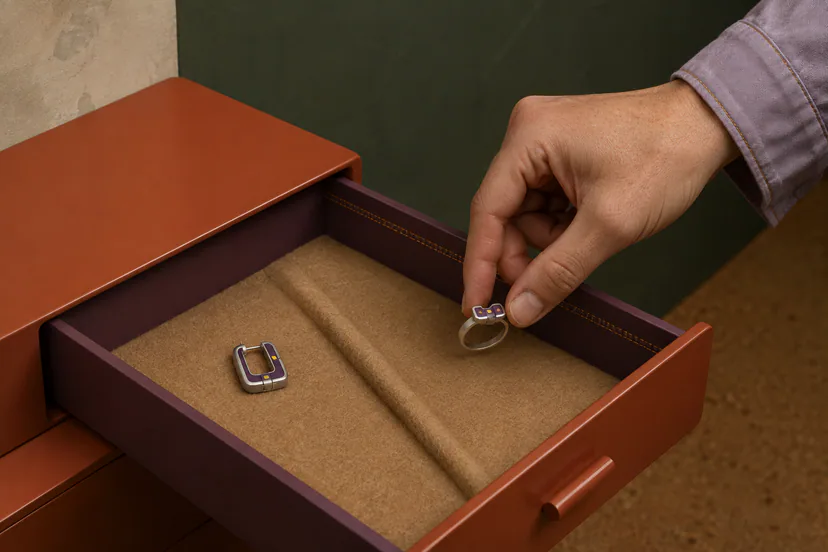
How to care for enamel jewelry is mostly a matter of preventing contact you would later have to correct. Store each piece dry and separated in a soft-lined compartment or individual pouch. Keep rings from pressing against one another, prevent chains from striking enamelled pendants, and avoid dropping earrings loose into the bottom of a travel case.
Apply perfume, hairspray, lotion and makeup before the jewelry goes on. Remove it before exercise, household cleaning, gardening or heavy lifting. Avoid extreme heat and abrupt temperature change. This is not treating enamel like a nervous relic; it is giving a glass-like surface the respect you would give a good pair of lenses.
Before wearing, take ten seconds to look at the edges and attachment points. If a line has changed, a component moves or the surface has chipped, stop wearing the piece until it is assessed. Small damage can become a larger loss when movement and impact continue.
Frequently asked questions
Is enamel jewelry the same as painted jewelry?
Not necessarily. Traditional vitreous enamel is a glass-based material fused to metal by heat. Paint, lacquer, resin and “cold enamel” are different surface systems. Product photographs cannot reliably prove which one you are seeing, so check the material description.
Is enamel jewelry suitable for everyday wear?
It can be, when the category, construction and routine align. Earrings and pendants often face less direct impact than rings or bracelets, while recessed enamel and protected metal borders may reduce exposure. Everyday does not mean indestructible.
Can chipped enamel be polished away?
No simple polishing step restores missing fired material. Polishing may alter nearby metal or worsen the visual edge. Stop wearing a damaged piece and ask a qualified professional whether repair is possible and appropriate.
Choose the relationship, not color in isolation
The most compelling enamel jewelry uses border, recess, curve and scale to decide how color meets light and how the piece meets the body. Once you know where the enamel sits, what supports it and what else belongs to the construction, the choice becomes clearer.
Then comes the pleasurable part: deciding whether you want a tiny blue signal at the ear, a dark red line on the hand or a translucent field that changes near a window. Color may be the first seduction. Structure is what lets it stay interesting.
Read next
- See how sculptural jewelry uses volume, balance and body placement
- Compare enamel with brushed, hammered and polished metal surfaces
- Use the Jewelry Care Card before cleaning an unfamiliar piece
- Read the material-first guide to cleaning silver jewelry