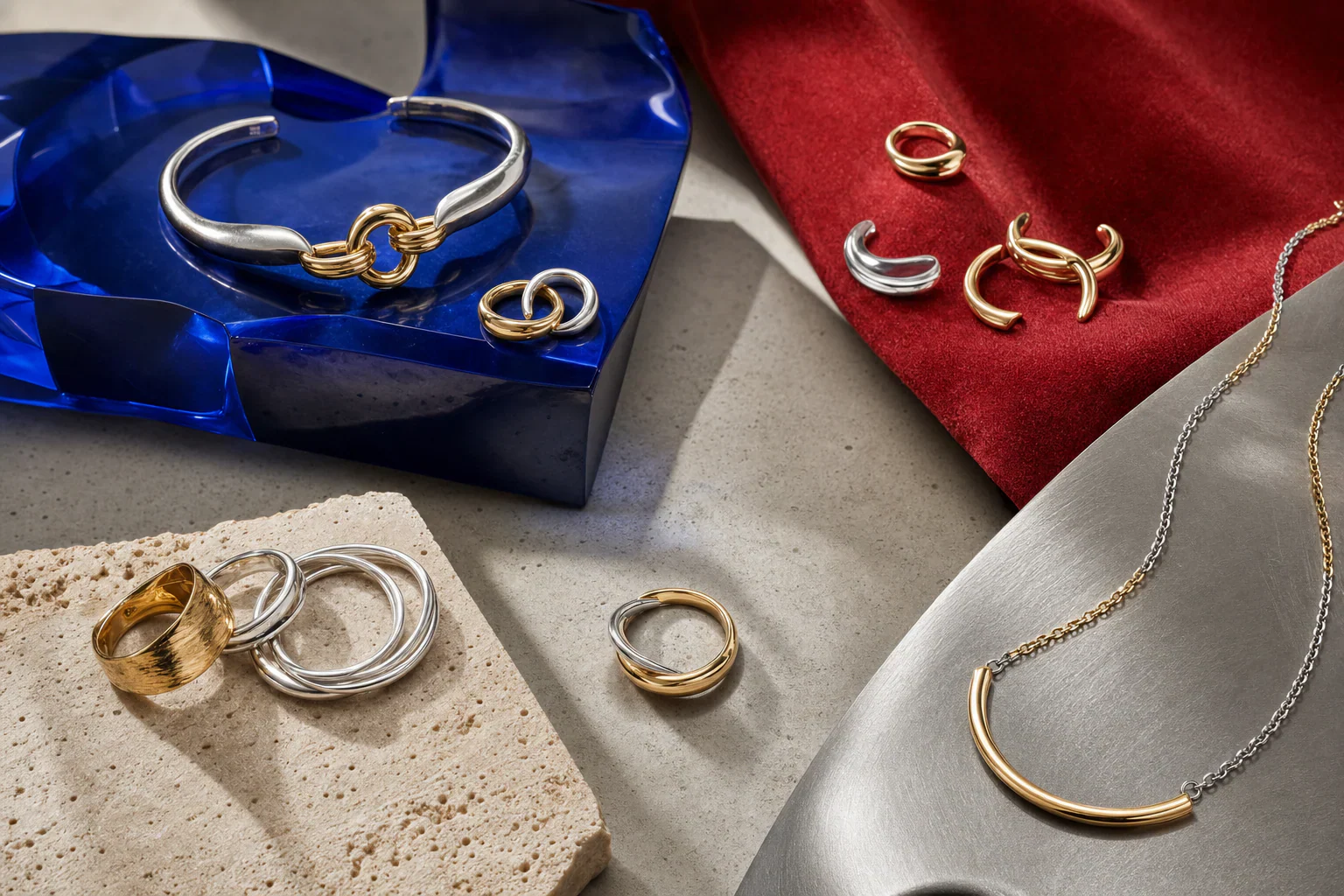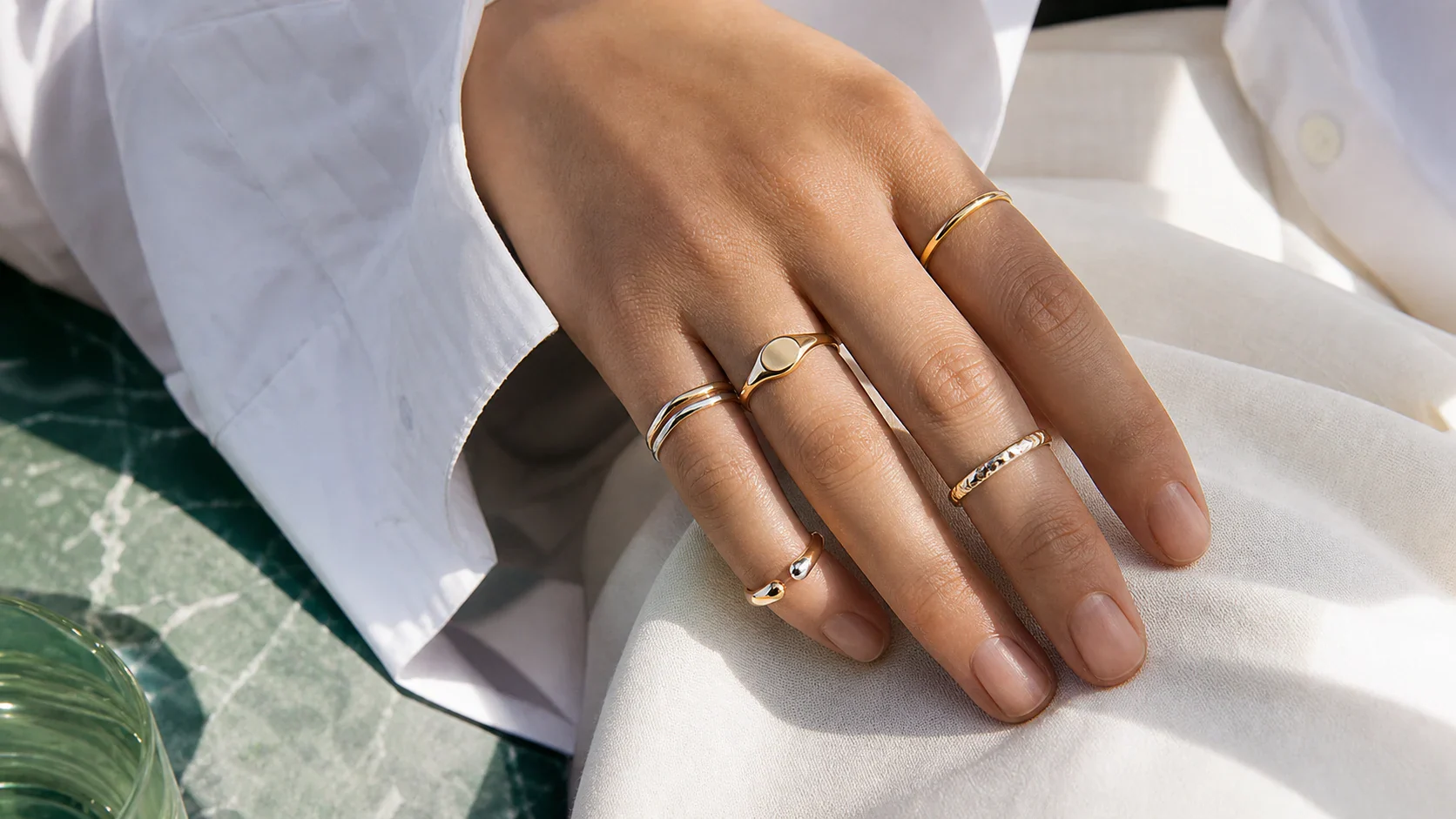
The short answer
You can wear gold- and silver-toned jewelry together. The strongest combinations usually share five things: one lead piece, a link between the tones, one repeated detail, an uneven balance, and enough empty space for both metals to remain visible.
Do not begin by trying to make every piece half gold and half silver. Begin with the piece you most want to wear. The rest should make its presence feel inevitable.
Step 1: choose the anchor
The anchor is the piece with the strongest silhouette, scale, movement, or emotional pull. It may be a broad silver cuff, a warm-gold sculptural ring, or an ear piece that changes the line of the jaw.
Place the anchor first and leave it alone for a moment. If it already occupies a large amount of visual space, the supporting metal should arrive in a quieter form rather than as a second competing statement.
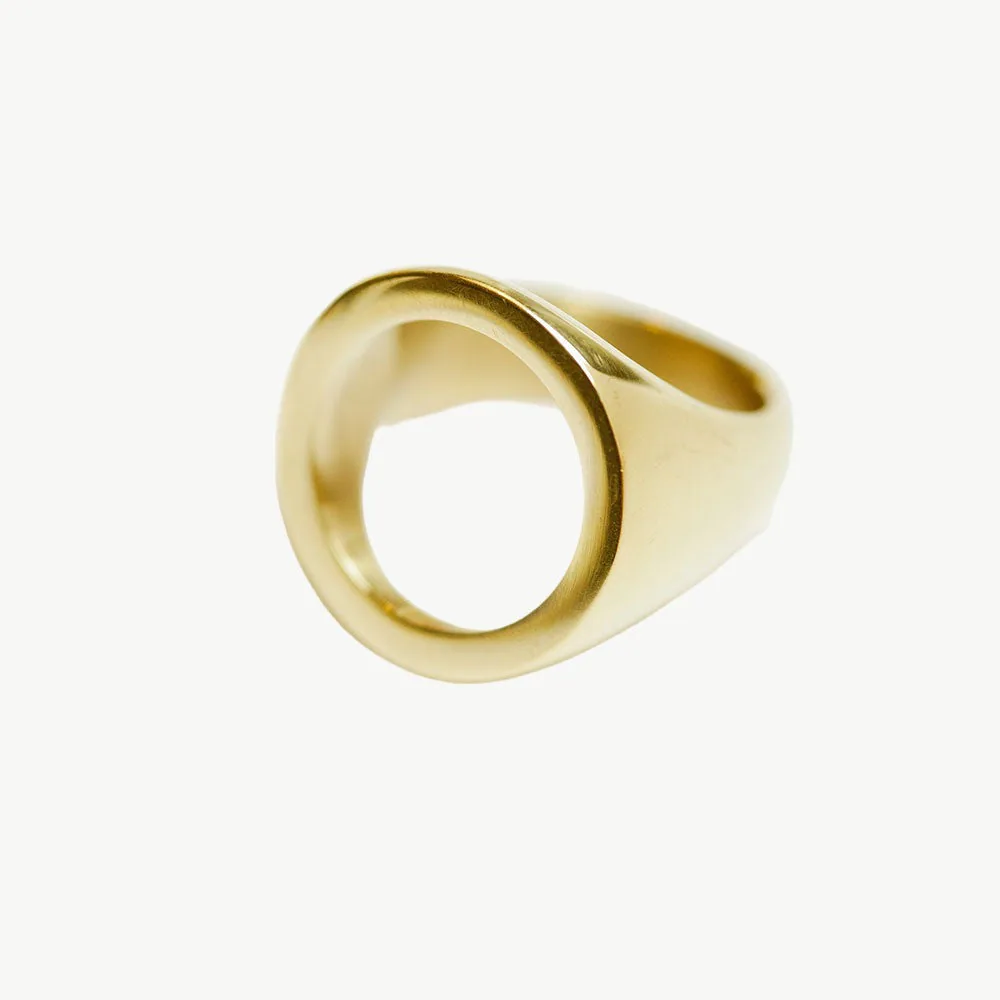
Begin with the piece that changes the silhouette. The second metal should explain the anchor, not compete with it.
Step 2: add one bridge piece
A bridge piece contains both tones or repeats a visible feature from the other metal. It can be a two-tone ring, a chain with contrasting hardware, or a curve that appears again elsewhere on the body.
The bridge does not have to sit between the two pieces physically. A mixed-tone ring at the hand can connect a silver ear cuff to a gold necklace because the eye reads the repeated metals across the complete body composition.
Step 3: choose a dominant metal
Equal amounts of gold and silver can work, but equality is not required. A dominant metal gives the look a point of view. Try two or three quieter pieces in one tone and one decisive piece in the other.
Think in visual weight rather than counting pieces. One wide silver cuff may carry more weight than three fine gold chains. Judge width, shine, position, and negative space—not just the number of pieces.
Step 4: repeat one relationship
Choose one feature to repeat across both metals: a curve, a hard edge, a polished surface, an oxidized finish, a chain scale, or a gap between forms.
Repetition is what changes contrast into rhythm. If the anchor ring is rounded and heavy, a narrow curved earring may support it more effectively than another heavy ring in the opposite metal.

A mixed-metal look becomes clearer when one body zone leads and the remaining zones repeat or pause.
Step 5: distribute the metals
Decide whether the composition is ear-led, neck-led, or hand-led. Let that zone carry the strongest contrast, then echo the quieter metal once elsewhere.
A practical ear-led look might use a silver cuff and gold hoop at the ear, one fine silver-toned chain at the neck, and a single mixed-tone ring at the hand. The path is visible, but every zone does not shout.
Step 6: edit from a distance
Step back far enough to read the whole look rather than each piece. If the eye jumps between several equally loud zones, remove one piece or reduce one surface from high shine to something quieter.
The final question is not whether the metals match. Ask whether the eye can identify what leads, what repeats, and where it can rest.
Sources
- Victoria and Albert Museum — Jewelry design connects drawings, materials, makers, customers, and expressive intent
- U.S. Federal Trade Commission — Precious-metal content and surface applications must be represented truthfully