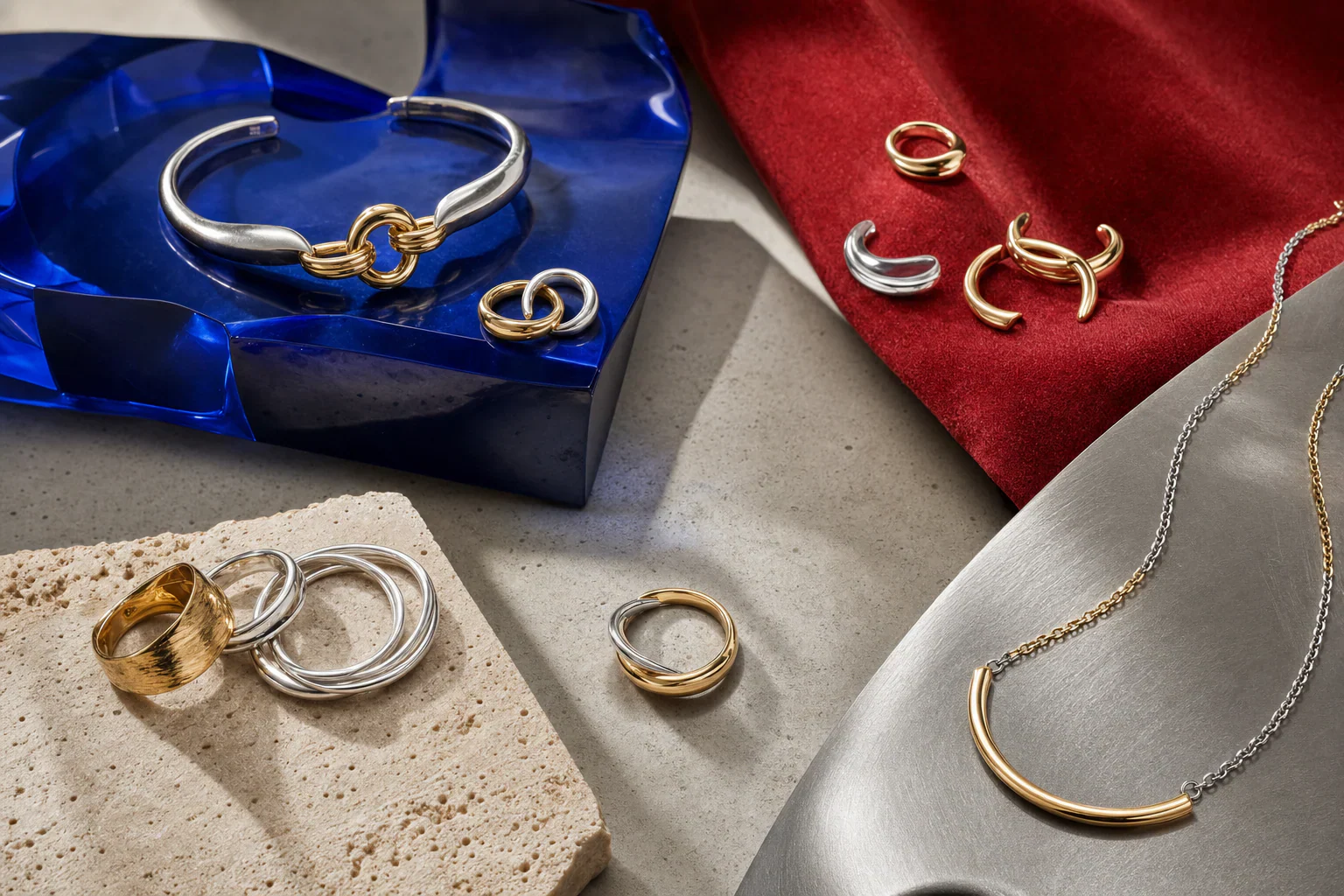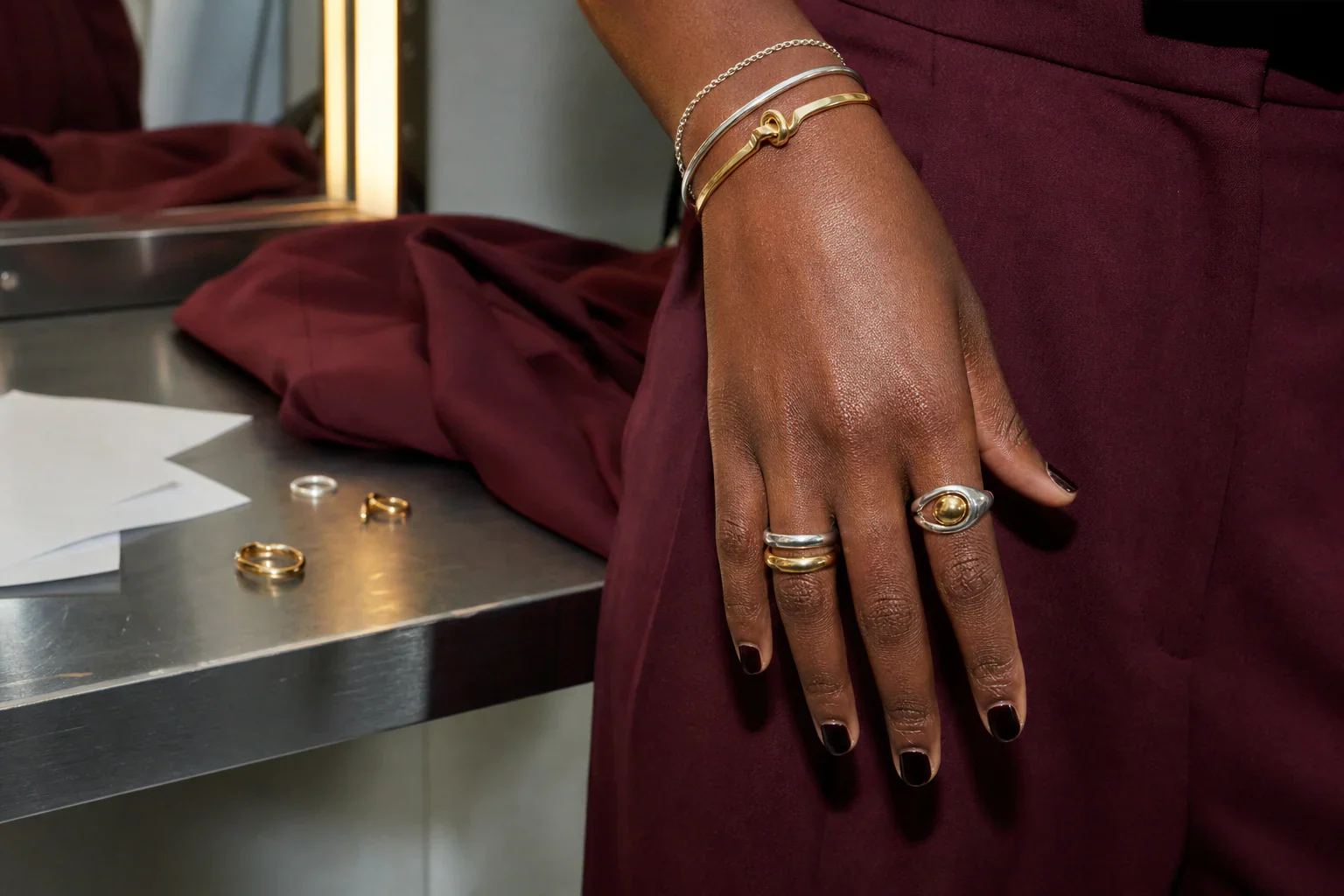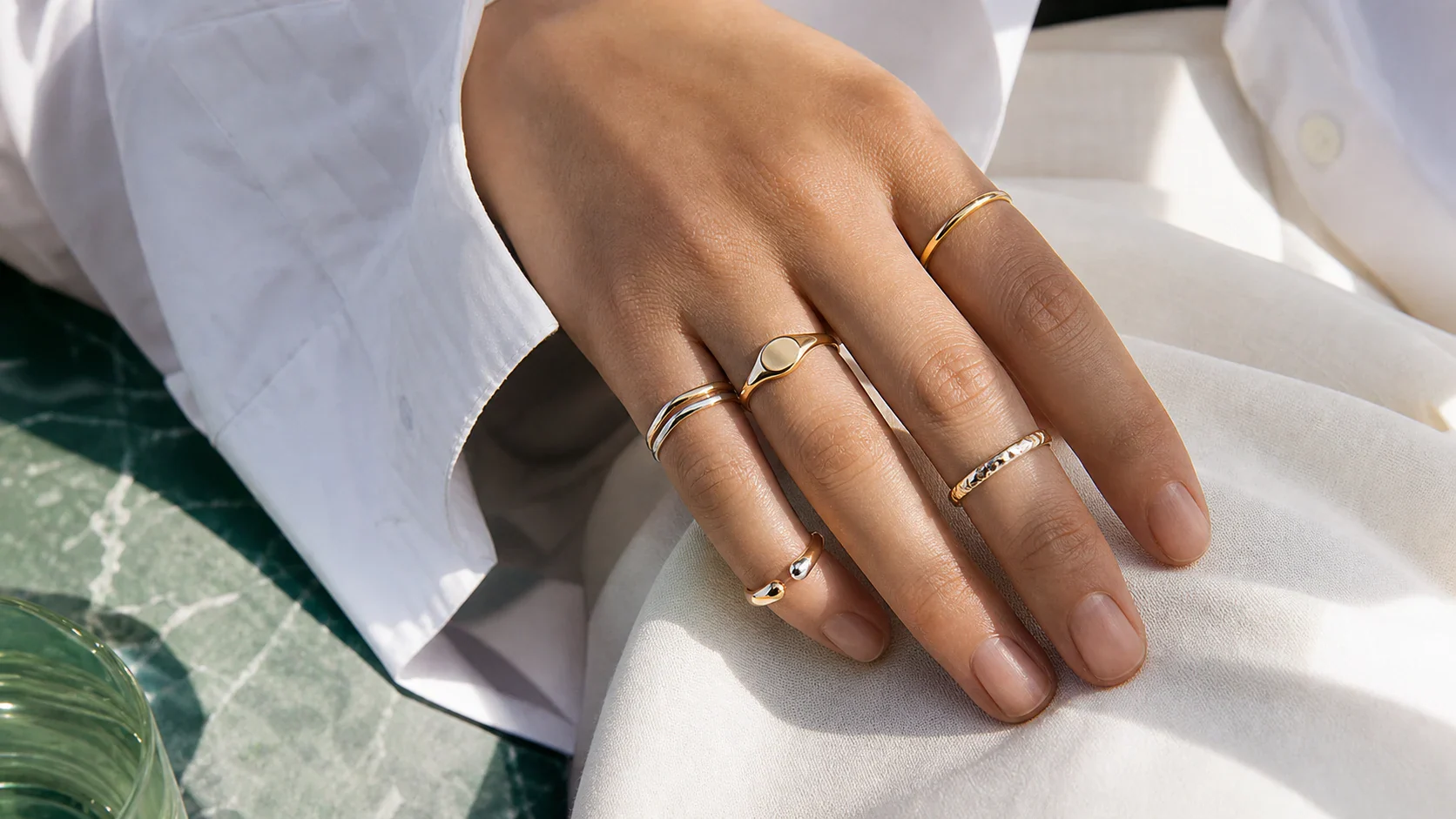
Idea 1: begin with a whisper-thin base
A slim polished or softly textured band creates a baseline without deciding the whole look. It can sit alone on one finger while a second finger carries a small focal ring.
The aim is not to fill the hand. The thin band gives later choices a scale to answer, making a small signet or contour pair feel deliberate rather than random.
Idea 2: frame a small signet
Choose a low-profile signet rather than assuming the focal ring must be large. Place one slim band beside it or on the neighboring finger, then stop before the signet loses its outline.
A rounded, oval, or softly geometric face works especially well when the support ring repeats one edge or curve without copying the entire shape.
Idea 3: nest two contour bands with air
Pair two curved bands that answer each other while preserving a narrow channel of skin. The visible air keeps the pair from reading like one heavy ring.
The curves do not need to match perfectly. A slight offset makes the composition feel collected, while a shared radius keeps it coherent.
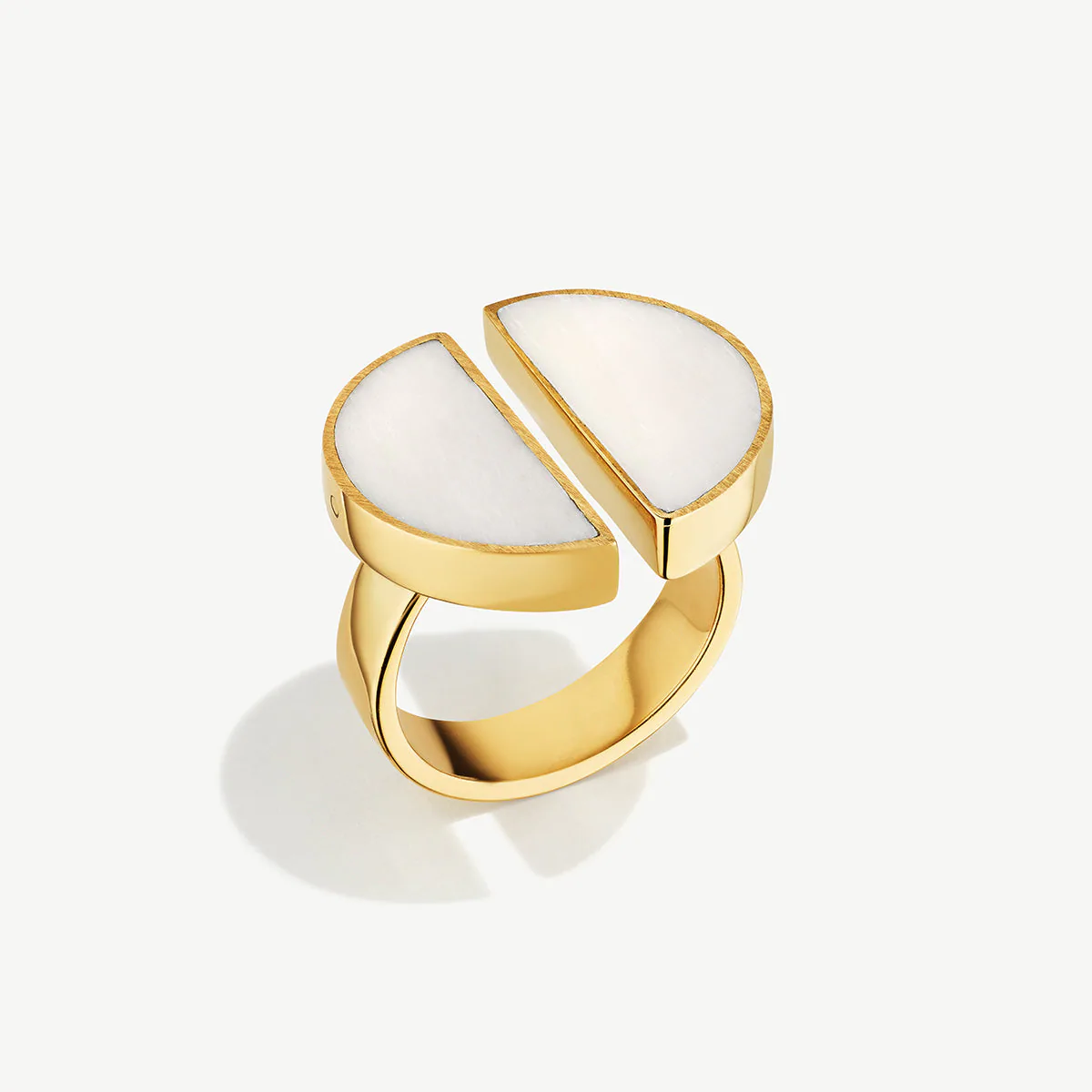
A visible channel of skin keeps two curved bands from merging into one heavy block.
Idea 4: connect mixed metals once
A mixed-metal stack does not need equal amounts of both tones. Use one two-tone link, then let one metal dominate elsewhere.
A narrow mixed-tone ring, repeated curve, or shared finish can explain the contrast. The bridge should be compact; every finger does not need to become a two-tone event.
Idea 5: relay texture, not bulk
Combine polished, softly sanded, and restrained hammered surfaces while keeping most widths slim. Light changes across the hand even when the silhouettes remain easy to wear.
Repeat only one texture twice. Three or four equally loud surfaces can make a small stack look busier than one bold ring.
Idea 6: build a sideways 1 + 2 + 1 map
Distribute the stack across three fingers: one quiet ring, a two-ring focal pairing, then one small echo. The middle pair carries the story without turning every finger into a pile.
This layout works with both delicate and medium rings because spacing—not sheer ring count—creates the rhythm.
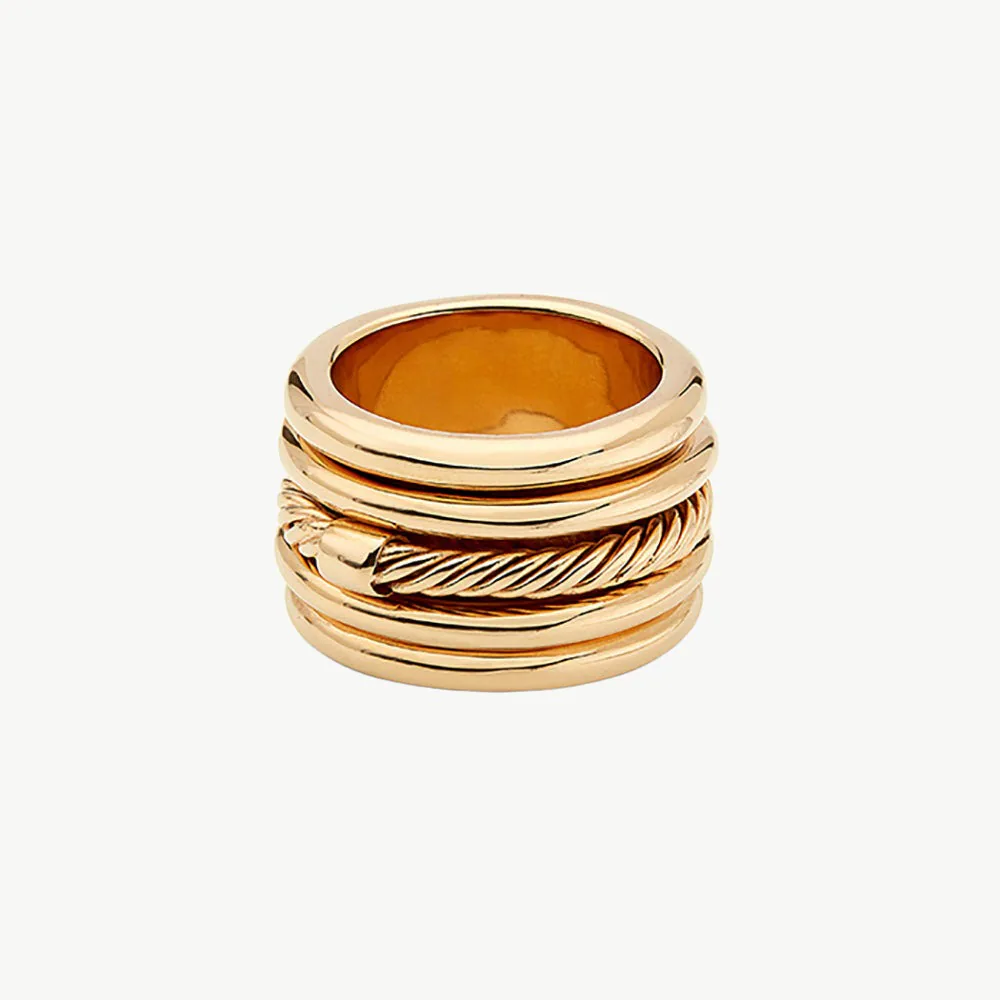
A ring with layered construction can carry the focal point while the rest of the hand stays quiet.
Idea 7: use height only when the ring is designed for it
A pinky ring or properly sized upper-finger ring can create a second level without adding width at the finger base. Use it as a small accent, not an instruction to force a standard ring over the knuckle.
Fit remains the limit. Follow the specific product sizing guidance and test ordinary hand movements before treating height as part of the composition.
Idea 8: let one statement ring stand apart
A compact open form, spinner, or sculptural ring can be the only bold element. Place it on a separate finger and keep the nearest support ring narrow or omit it.
Statement is one option in the spectrum, not the default. Count movement and visual weight as layers before adding more metal.

This is the one deliberately experimental end of the spectrum—not the default for every ring stack.
The five-minute edit
- Decide whether today is quiet, characterful, or statement.
- Keep at least one ring clearly slimmer than the focal piece.
- Create one visible gap between rings or fingers.
- Repeat one curve, texture, or metal tone once.
- Distribute weight before adding another ring to the same finger.
- Check every product-specific fit, opening, finish, and movement note.
- Move the hand naturally before deciding the stack is finished.
Run the sculptural-ring collision test
A sculptural ring stack has two silhouettes: the one you see with the hand open and the one the rings create when the fingers close. Test both. Bend every joint, make a loose fist, grip a phone, hold a cup and slide the hand into a pocket. Notice where projecting forms meet neighboring fingers or where two hard edges strike each other.
Build thick–thin rhythm before adding volume. Place the widest or most dimensional ring first, then use a slimmer band on another finger to repeat one curve, finish or metal direction. Keep visible air around moving, hinged or open forms. The negative space is not unfinished; it is what lets the construction remain legible.
If two rings repeatedly collide, do not assume the surface can tolerate it. Separate the pieces, change fingers or wear them in different combinations. Exact fit, finish and material guidance belongs to each product, and a visually successful stack is not worth preventable pressure or damage.
- Check the open hand and the closed hand.
- Let one dimensional ring lead.
- Repeat one curve or finish with a slimmer support.
- Keep moving parts clear of neighboring rings.
- Separate pieces that strike, pinch or scrape.
Connect the ideas back to ring stacking structure
These eight ideas share one instinct: let a single ring lead, leave visible space, and give the hand enough room to close, type, carry, and gesture.
Use the inspiration here to choose a direction, then return to the full ring-stacking guide for fit measurement, open and adjustable construction, spinner movement, mixed-metal hierarchy, and product-specific checks.
Sources
- Catbird — Ring stacks can begin with a favorite anchor and vary texture, scale, metal, and finger placement
- Mejuri — Ring stacks can be organized by occasion, metal, texture, color, and nesting collection
- Missoma — A hero ring can be balanced by skinny bands or distributed as a sideways stack across fingers
- Monica Vinader — Dainty rings can form a base while one or two feature pieces supply contrast
- U.S. Federal Trade Commission — Precious-metal content and surface applications must be represented truthfully