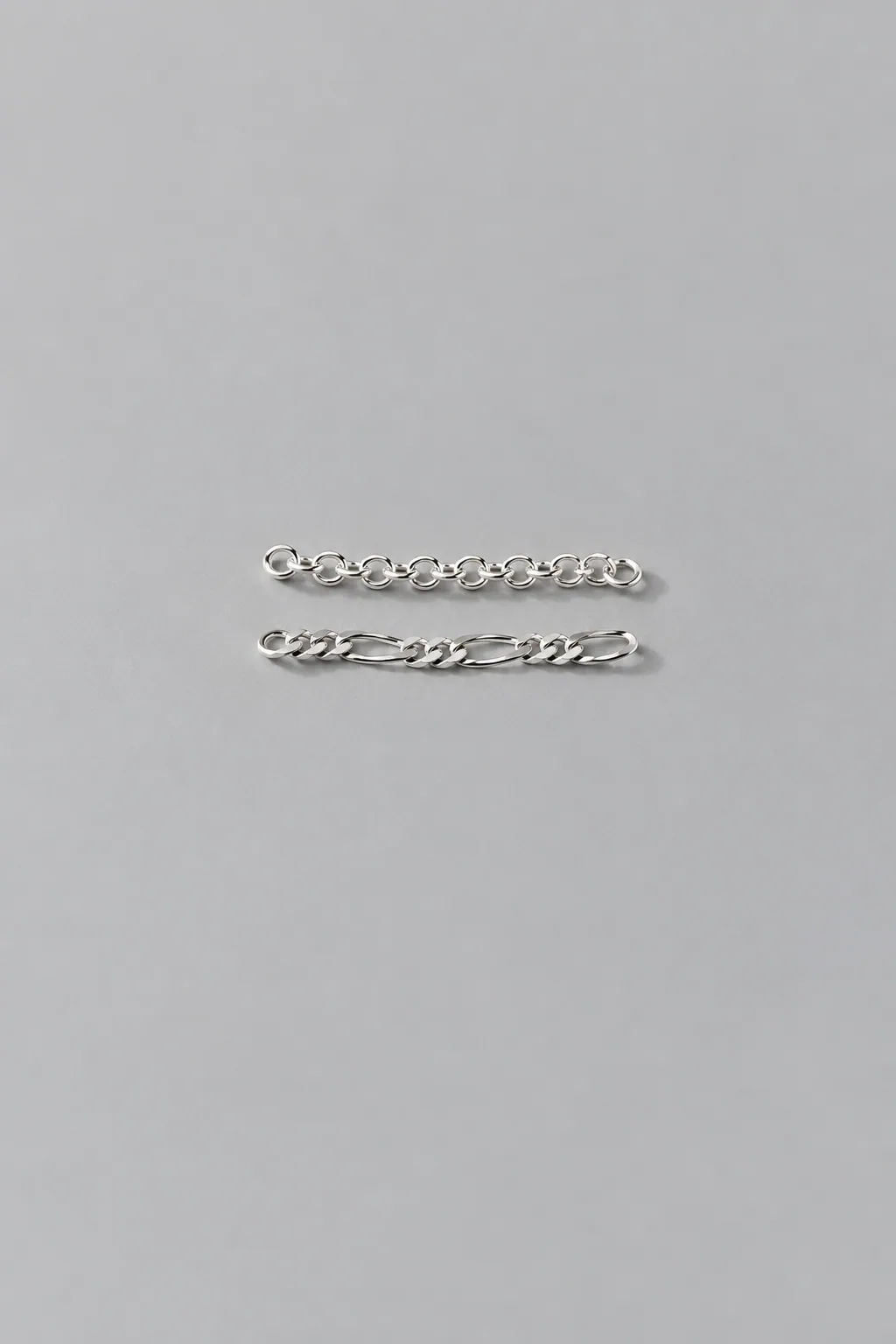
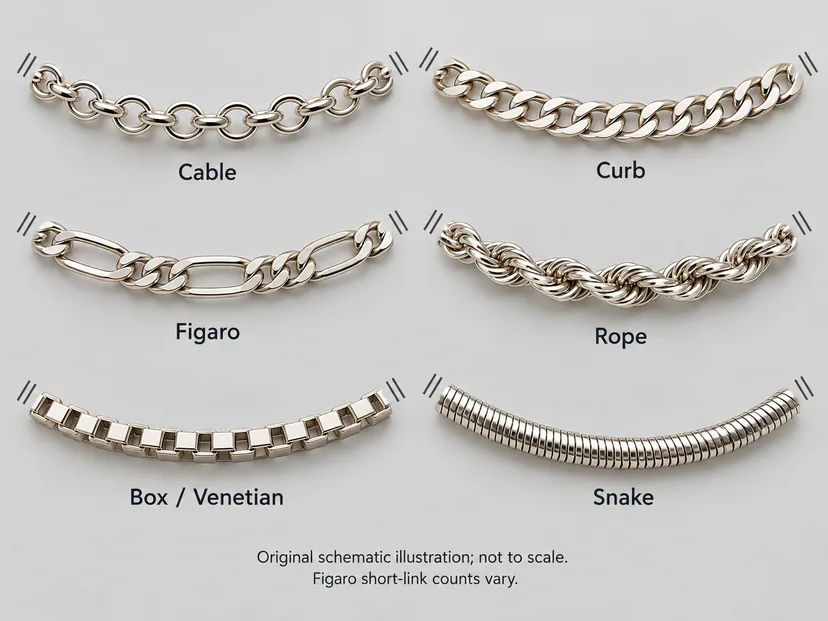
To tell necklace chain types apart, look at the repeating unit, the direction neighboring links face, and the pattern they make together. Cable shows separate open loops; curb brings open links into a flatter plane; Figaro repeats a longer link with a group of shorter ones. Rope has a spiral rhythm, box a compact squared repeat, and snake a closely packed, smooth-looking surface.
Those clues can suggest a family. Confirming a precise trade label may require a closer view or the maker’s documentation. These six families offer a useful starting vocabulary; jewelry chains extend well beyond them.
At a distance, a necklace can become one bright line against a shirt. Up close, that line acquires punctuation: an opening, a turn, a long interval, a dense run of small units. Two chains with a similar silhouette may have quite different rhythms. Learning to see the repeat gives you something more useful to ask about than “the shiny one.”
Start with the repeat
Choose a clear stretch of the chain body in a photograph and follow several consecutive units. A single attractive link, especially near a fastening, may not represent the pattern along the necklace. Keep the clasp in a separate observation: it describes how the necklace closes, while the chain family describes its linked body.
Three questions make the details easier to read:
- What repeats? Look for open loops, a sequence of longer and shorter links, or tightly arranged units whose individual outlines are harder to separate.
- How do the units face? Notice whether neighboring links turn across one another, share a flatter orientation, or build a pattern that appears to rotate around the chain.
- Where are the openings? Follow the spaces through several repeats. Their shapes and spacing can be more revealing than the brightest reflections.
Here, an “open” link means a link with a visible central opening. It does not tell you whether the joint is soldered. Keep wire thickness, link length and overall chain width distinct, too: a generous opening and a thick outline describe different features.
Six types of chains to recognize
Cable: separate loops, alternating directions
Cable chains have discrete oval or round links that usually alternate in roughly perpendicular planes. One loop may present its opening toward the camera while its neighbor appears more edge-on. Across several links, that change of direction creates an easy-to-follow sequence.
Look for both the individual openings and the way adjacent links meet. The proportions can vary considerably: the wire may look fine or substantial, and the openings more circular or elongated. Neither a particular thickness nor a particular oval shape defines the whole family. A useful description might be “open oval links with alternating orientation,” followed by “consistent with a cable chain.”
Curb: open links in a flatter plane
Curb links are twisted or formed so that neighboring open links lie in a flatter shared plane. Compared with the alternating orientations of a typical cable chain, the repeat presents a more aligned face. The shapes remain linked loops, even when their outlines sit closely together.
Read that relationship over several repeats in face and oblique photographs. The relevant clue is how the links are formed and arranged; simply placing any necklace on a flat surface does not make it a curb chain. Not every curb is a Cuban chain. Keep “curb” as the broader family description unless the more specific trade label is supported.
Figaro: a longer link sets the pace
Figaro is recognizable by a recurring longer link combined with a group of shorter links. Follow the sequence until it repeats, rather than stopping at the first elongated opening. That longer interval gives the chain its distinctive visual punctuation.
The number of short links is variable. Three is not a universal rule: Cooksongold’s chain overview, for example, describes more than one short-link count. Figaro arrangements may be cable-like or curb-like, so link-length rhythm and link orientation should be read separately. Describe the sequence you can actually see, and use documentation to settle the exact name applied to that piece.
Rope: the repeat appears to spiral
Rope chains create a rotating, helical rhythm through interlinked paths. Highlights and darker intervals appear to travel around the chain’s length, giving the eye a spiral to follow. The resemblance is to a rope’s visual rhythm; the jewelry is not literal cord.
A twisted impression alone is insufficient for a confident identification. Wheat and Singapore chains can also present a twisted or woven appearance. Look for enough detail to follow how the units connect across several repeats. If the photograph gives you only a gleaming spiral, “a twisted-looking chain” is an accurate observation while the more specific family remains unresolved.
Box or Venetian: compact squared geometry
Box chains, often described as Venetian chains, have a compact repeat with squared geometry. Focus on the small, joined units along the body. The pattern can look architectural, with short edges and changes of plane creating a more closely ordered line than a run of open oval loops.
Every corner need not look sharp. Rounded-box variations exist, as noted in Rio Grande’s guide to jewelry chain. A rounded profile therefore needs a closer reading of its repeat. Also keep “box chain” and “box clasp” distinct: a box clasp is a fastening, and its presence does not identify the structure of the necklace attached to it.
Snake: a closely packed surface
Snake chains present a closely packed, smooth-looking articulated surface. Individual units may be difficult to distinguish in a distant photograph, so the body can register as a continuous line. Smooth-looking does not mean structurally featureless.
Move from the overall impression to appropriate macro, side or underside photographs. Seamed and unseamed constructions require evidence suited to that distinction; a distant view cannot settle how the chain was made. Even a line visible in a close-up needs careful interpretation. If the available view shows only a dense, smooth-looking surface, describe it as consistent with the snake family and leave the construction question open.
Ask for photographs that answer the question
A useful request gives the person taking the pictures a clear job. Ask for:
- A well-lit macro of several repeats. The image should keep the link boundaries and spaces readable, rather than losing them in glare or shadow.
- A face view and an oblique view. The pair helps show openings and the relationship between neighboring units. A side or underside view may be needed for an unresolved snake-chain detail.
- A scale reference. A ruler beside the chain helps communicate its visible size. It is a scale aid, not proof of its material or construction.
- A separate clasp photograph. Keep the fastening distinct from the chain-body close-ups so their descriptions do not become mixed.
For example: “Could you send a well-lit close-up showing several repeats, photographed face-on and at an oblique angle, with a ruler alongside, plus a separate clasp photo?” Ask for the extra side or underside view when a particular detail needs it.
Keep this to observation and documentation. There is no need for bending or pulling tests, scraping, acid or other home assays, weight tests, or destructive handling. A label is not worth damaging a necklace to obtain.
What a photograph cannot establish
“Consistent with this family” reports a visual match. A confirmed trade label needs supporting evidence for the actual piece. Chain names do not establish a piece’s material, history or performance. Stuller’s chain-selection guide treats style, metal, length, clasp and pendant choice as separate questions, a useful distinction to retain when reading a listing.
A photograph cannot prove a chain’s metal, fineness, plating, solid or hollow construction, soldering, authenticity, maker, origin or age. It also cannot establish strength, a safe pendant load, repairability or kink resistance. A closely framed image can improve the description without resolving those questions.
Depending on what you need to know, a jeweler’s assessment or a documented maker specification may be necessary. Ask for information about the particular chain. A broad claim about a chain family cannot establish the condition or capabilities of the piece in front of you.
When comparing gold chain styles, separate the shape of the chain from the evidence for its material. For material construction, the guide to gold vermeil and gold-filled jewelry explains those terms. Their meaning cannot be read from the chain’s pattern or color.
Give the necklace a useful description
You do not have to force a name before the evidence is there. “Long oval link followed by a repeating group of shorter links” is already useful. So is “closely packed surface; the underside is not visible.” Each description tells a seller or jeweler what you can see and what still needs clarification.
Once the pattern is clearer, move to the next question on its own terms. Use the necklace length guide for placement and fit, or how to store jewelry at home for contact, tangling and storage. For browsing necklace designs, continue to the Switchroom necklace collection.
The pleasure of looking closely is that an apparently simple line becomes particular. You begin to recognize its intervals, openings and changes of direction—and to ask a question precise enough to get a useful answer.
Chain identification questions
Why can the same chain look different in two photographs?
Camera angle, magnification and lighting can change which openings, edges and reflections are visible. Compare the same stretch of chain at similar scale, using matching face and oblique views where possible. A mismatch between photographs is a reason to request clearer views before changing the description.
Will two chains with the same name look identical?
Two chains in the same family can still differ in link proportions, spacing and overall dimensions. When matching an existing necklace, request comparable close-ups and documented measurements for both pieces. Treat a shared name as the beginning of the comparison.