Gold vermeil and gold-filled jewelry are both gold-coated, but the labels describe different constructions. In the United States, vermeil uses a sterling-silver base under a qualifying gold coating. Gold-filled uses a mechanically applied gold-alloy layer over a base metal and the term carries a weight-ratio requirement. Neither label, by itself, promises a particular lifetime, weight, skin response or permission to wear the piece in water.
The practical choice begins with the exact listing details: base metal, gold karat, coating or layer specification, construction, care instructions and the parts that touch your skin. If a seller gives only a warm photograph and the phrase “premium gold,” there is not enough information to compare.
Gold vermeil vs gold-filled: the quick comparison
| Question | Gold vermeil | Gold-filled |
|---|---|---|
| What is under the gold? | Sterling silver, under the U.S. vermeil definition. | A disclosed base metal; the construction should not be guessed from the finish. |
| How is the gold applied? | The sterling-silver base is coated or plated with qualifying gold or gold alloy. | A gold-alloy layer is applied by a mechanical process. |
| What does the U.S. label require? | Gold of at least 10-karat fineness and a minimum thickness equivalent to 2.5 microns of fine gold on significant surfaces. | The term “gold filled” may be used when qualifying mechanically applied gold plating accounts for at least one-twentieth of the metal weight of the article. |
| What does the label not prove? | Exact weight, fit, comfort, allergy compatibility, water resistance, care method or how long the finish will look unchanged. | |
Those U.S. definitions come from the current vermeil and gold-content sections of 16 CFR Part 23. Other countries may use different rules, so a product sold across markets should identify the standard and the actual construction instead of relying on the label alone.
What counts as gold vermeil?
For a product described as vermeil in the United States, the base is sterling silver. The gold or gold-alloy coating on significant surfaces must be at least 10 karat and meet the 2.5-micron fine-gold-equivalent minimum. If another base-metal layer sits between the sterling silver and the gold, the current rule says that layer must be disclosed.
That definition is useful because it tells you what the underlying precious-metal base should be. It does not tell you whether a particular ring will suit constant hand contact, whether an earring feels light, or whether a wearer will react to every component. Posts, backs, solder, barriers and decorative parts still need exact disclosure.
What counts as gold-filled?
Gold-filled is not the same process as ordinary electroplating. The current U.S. guidance describes a gold-alloy layer applied by a mechanical process. The term may be used when the qualifying layer accounts for at least one-twentieth of the metal weight of the article. A mark such as “1/20 14K GF” communicates both the fraction and the karat fineness of the gold alloy.
That construction can make gold-filled useful for forms that manufacturers can produce from bonded sheet, wire or tubing. It still does not make every gold-filled piece identical. The base metal, component construction, joints, closures, surface coverage and care directions can differ from one product to another.
How is ordinary gold plating different?
“Gold-plated” is a broader surface description. The FTC consumer guide to buying gold jewelry explains that plating can be applied through different processes and that the surface can eventually wear away depending on how the item is worn and the thickness of the plating. A seller should state the karat quality and use an accurate qualified term rather than presenting a coated product as solid gold.
The useful shopping question is therefore not “Is plated always bad?” It is “What exactly is the base, what is the gold specification, how was it applied, and is the price consistent with those disclosed facts?”
Which is better for everyday wear?
There is no honest universal winner. Gold-filled may be the more relevant comparison when you want a mechanically applied layer and the product gives a complete weight-ratio and base-metal disclosure. Vermeil may be the more relevant comparison when a sterling-silver base matters to you and the seller lists the coating specification. The correct choice still depends on the exact piece and the way it meets your routine.
Choose by contact and construction, not by slogan
- For rings and bracelets: ask how the finish behaves at edges and high-friction contact points, then follow the maker’s restrictions.
- For earrings: check the post, back, hinge or cuff opening separately from the decorative body.
- For necklaces: check the chain, clasp, jump rings and pendant rather than assuming every component has the same construction.
- For sensitive skin: request the complete metal composition. “Vermeil” and “gold-filled” are not substitutes for an allergy or medical assessment.
Do not turn a material category into a durability promise
Friction, chemicals, storage, surface thickness, component design and frequency of wear all affect a finished piece. A product-specific warranty or care statement describes that seller’s offer; a generic label does not. Phrases such as “waterproof,” “tarnish-free,” “hypoallergenic” or “wear it forever” require their own substantiation and should not be inferred from either category.
A five-point product-page check
- Read the complete material line. Look for the base metal and every skin-contact component.
- Check the gold specification. Confirm karat plus the relevant thickness, weight fraction or process.
- Separate finish from form. Dimensions, weight, closure and adjustability belong to the exact design.
- Read the care instructions before purchase. Do not assume shower, exercise, sleep or chemical exposure is allowed.
- Keep the seller’s record. The listing, receipt and warranty matter if the delivered construction does not match the claim.
Switchroom applies the same rule to its own catalog: a piece should appear as vermeil, gold-filled or plated only when its product listing supports that wording. Browse the current gold-vermeil jewelry collection for live item-level facts rather than treating this guide as a promise about every product.
Care starts with the exact piece
The safest routine is the maker’s routine for the confirmed materials, stones, adhesives and finish. As a general precaution, reduce unnecessary friction, keep pieces separate in storage and remove jewelry before exposure the seller has not approved. Cosmetics, household cleaners, chlorine and some jewelry-cleaning methods can affect metals or gems.
GIA’s jewelry-care guidance notes that chemicals can damage or discolor precious metals and that not every gem or treatment is suitable for steam, heat or ultrasonic cleaning. If the material or treatment is uncertain, begin with the Switchroom material-first care guide instead of choosing a cleaner by color.
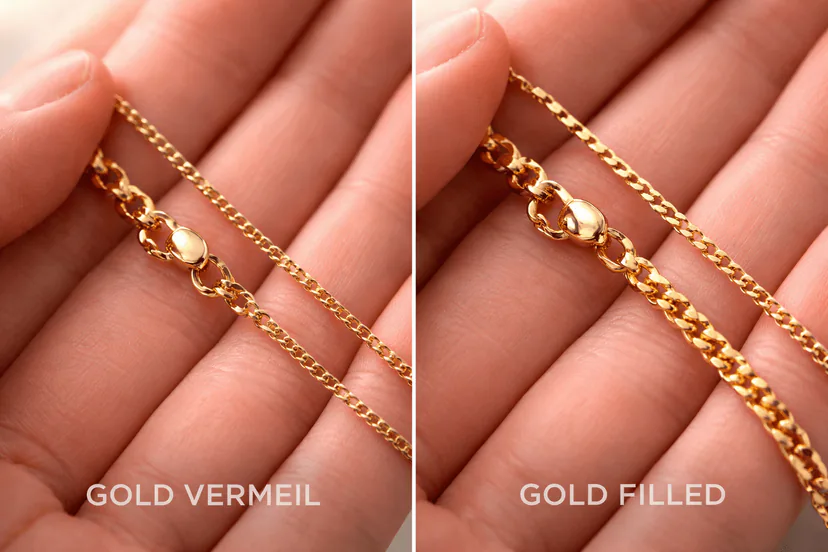
Appearance alone cannot show whether a piece is vermeil or gold-filled; use the seller’s disclosed material details and markings for that distinction.
Frequently Asked Questions
Is gold-filled better than gold vermeil?
Not in every case. Gold-filled and vermeil describe different constructions. Compare the exact base metal, gold specification, components, care limits and intended use rather than treating either label as an automatic quality ranking.
Is gold vermeil good for everyday wear?
It can suit regular wear when the exact design, coating, contact points and care instructions fit your routine. The vermeil label alone does not promise unchanged finish, water resistance or suitability for constant friction.
Does gold-filled mean solid gold?
No. Gold-filled jewelry has a mechanically applied gold-alloy layer over a base metal. Solid-gold terminology describes a different construction and should not be inferred from the surface color.
Can I shower in gold vermeil or gold-filled jewelry?
Follow the product-specific instructions. Do not infer water or chemical resistance from either material label; stones, adhesives, clasps and other components may require stricter care than the outer gold layer.
Choose from disclosed facts
The shortest answer is also the most useful: vermeil tells you to expect qualifying gold over sterling silver; gold-filled tells you to expect a qualifying mechanically applied gold layer over a disclosed base. From there, choose the exact piece whose dimensions, components and care match your life. Save metal sensitivities and wear habits in your Jewelry Profile, or compare forms across the current jewelry collections.