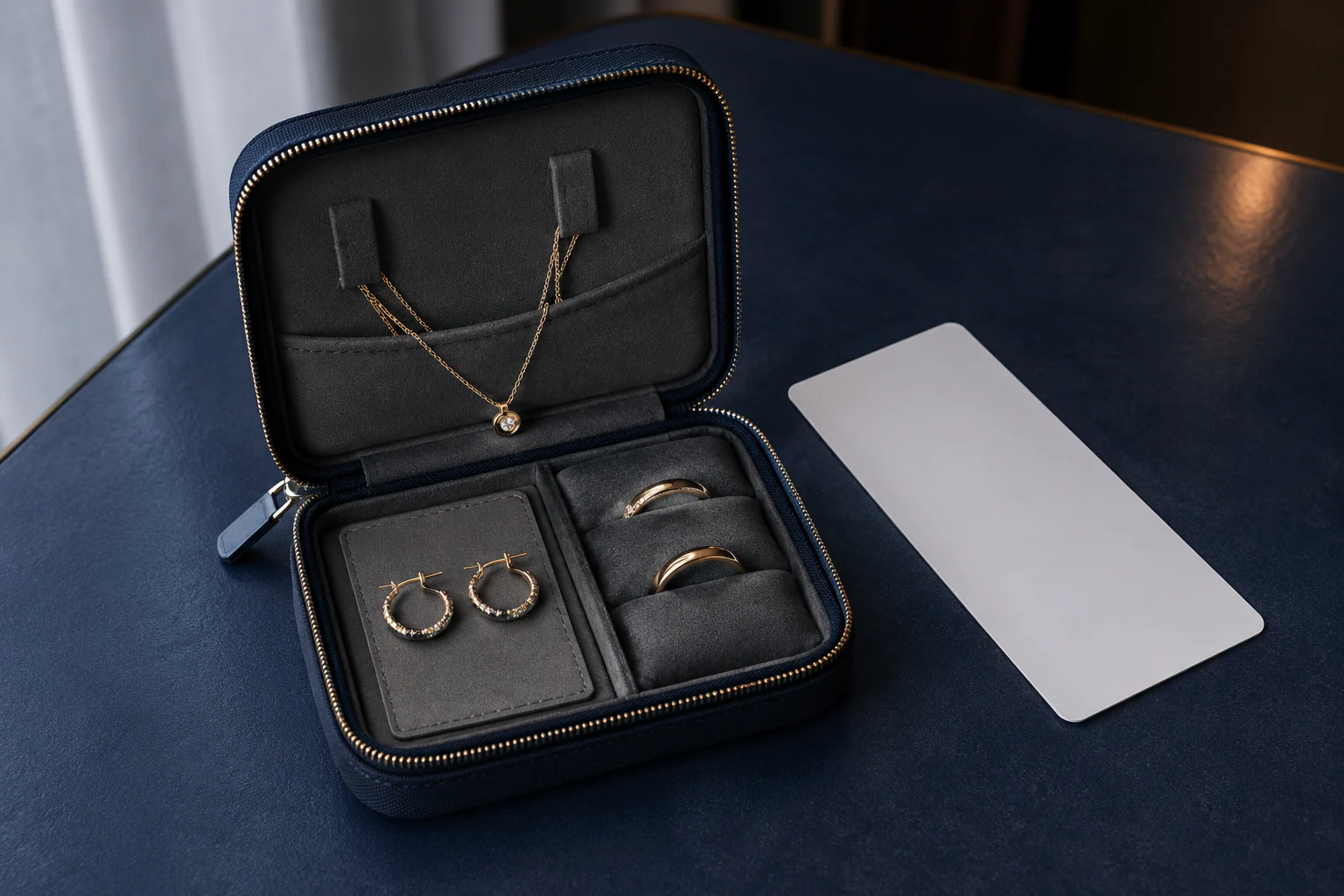
The best travel jewelry case is the one that keeps each piece physically separated, positively retained and easy to account for after the case has been turned, carried and compressed. That sounds less romantic than velvet, brass hardware or an immaculate miniature mirror, but it is the test that matters. A beautiful case can still let a chain migrate under a divider, release a ring from a loose roll or scatter an earring back into the hinge.
Instead of looking for one universal winner, evaluate a case as a small transport system. You are asking six things of it: separation, closure, chain routing, retention, portability and quick visual readback. Get those right and even a modest travel jewelry case can outperform a much larger organizer whose interior only looks convincing while sitting flat on a dresser.
Start with movement, not compartment count
Travel changes the problem. At home, a jewelry box can remain level for weeks. In transit, your case may stand vertically in a tote, disappear sideways between clothing, pass through a security tray and spend an afternoon pressed beneath a laptop charger. The useful question is therefore not, “How many sections does this have?” It is, “What stops one piece from entering another piece’s space?”
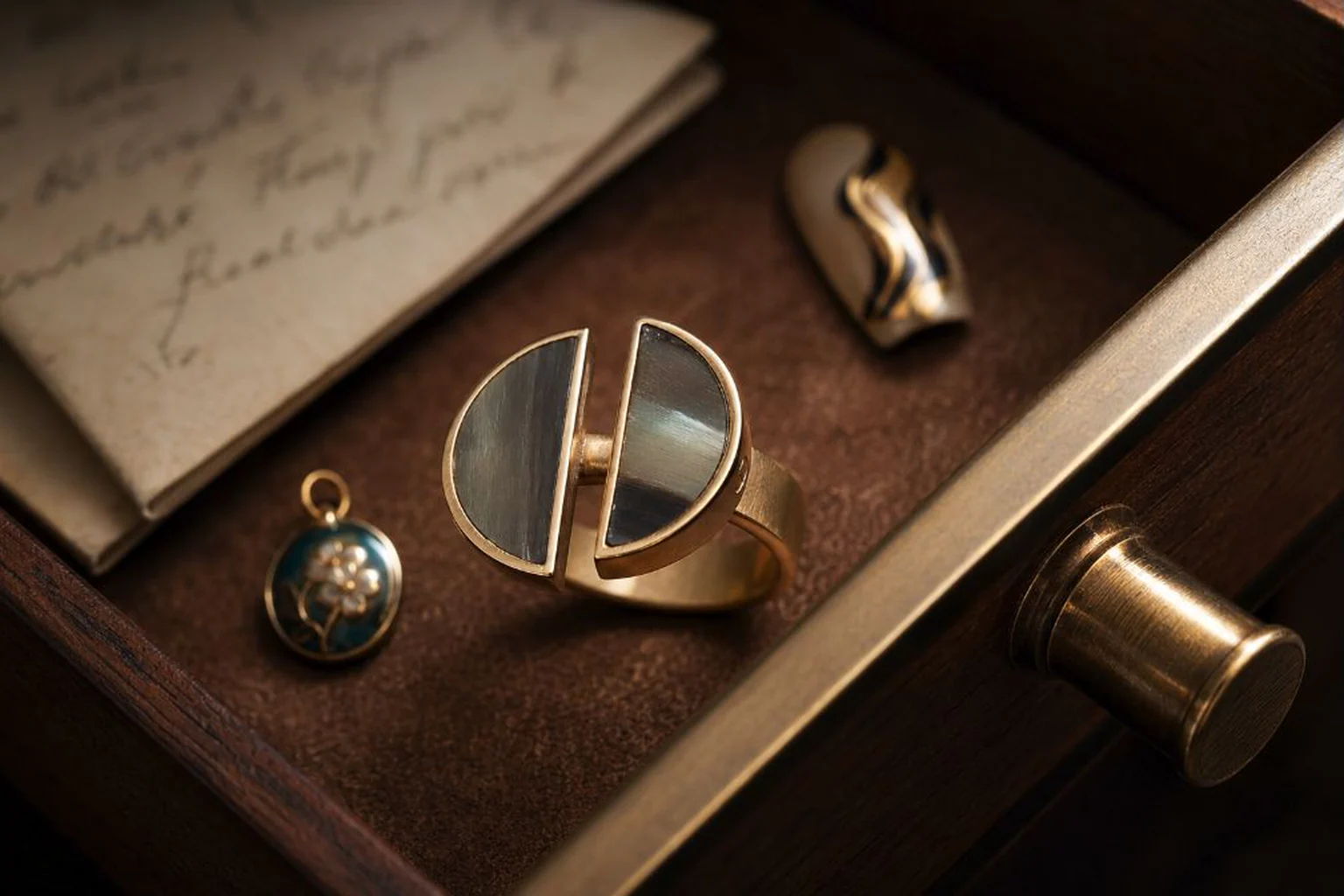
The most successful historical storage pieces often make separation legible through construction itself: distinct chambers, controlled openings, fitted lids and clear relationships between what belongs where. You do not need to reproduce the weight, ornament or architecture of an antique box to borrow that principle. A contemporary case should communicate its internal logic just as clearly.
Open the case and look at the actual boundaries. Soft dividers should rise high enough to matter when the case closes. Pockets should not gape so widely that small pieces can escape. Ring rolls should compress a band gently rather than merely provide a decorative ridge. If the interior becomes one continuous cavity as soon as you turn it sideways, its apparent organization is mostly cosmetic.
Test the closure before you fall in love with the lining
A good jewelry packing case needs two levels of closure: the outer case must stay shut, and the jewelry inside must remain retained within its assigned zones. These are different jobs.
For the exterior, inspect the zipper, clasp or fastening path. A zipper should move around corners without forcing the shell to distort dramatically. Its tape should feel integrated into the body rather than attached to an edge so lightly that tension concentrates in one seam. If the case uses a snap or other point closure, check whether the opposite edges still meet securely when the case is moderately full.
Then inspect the interior closure logic. An earring card that floats loose inside a compartment is not true retention. A necklace pocket without a way to control the chain above it is only partial containment. A ring bar that can unclip under light pressure may turn two tidy bands into free-moving metal before you reach the airport.
Try a simple test at home: load the case with inexpensive pieces of roughly the same dimensions as the jewelry you intend to travel with, close it, rotate it slowly through every orientation, then reopen it. Nothing should have changed address. This is more revealing than pressing the lining with your fingers in a shop.
For necklaces, look for routing rather than storage volume
If you regularly travel with chains, the most important feature is not a large necklace compartment. It is a believable route from clasp to chain to pendant.
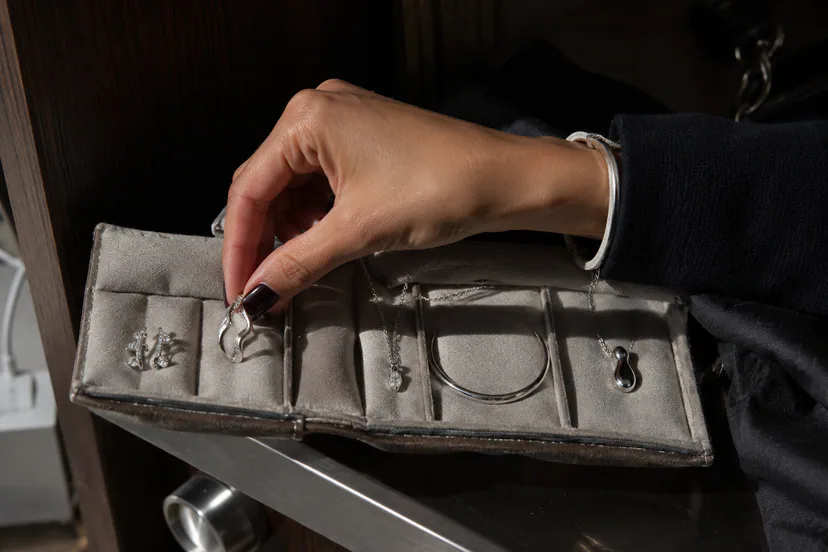
A useful jewelry case for necklaces generally gives each chain at least two points of control. That might mean a small top loop plus a lower pocket, two soft tabs along a channel, or another arrangement that keeps the chain extended without placing sharp bends into it. The exact mechanism matters less than the geometry.
If you are wondering how to keep necklaces from tangling while traveling, imagine what happens when gravity reverses. When the closed case stands upright, can the pendant swing across another chain? Can the clasp slip out of its loop? Can two lower sections fall into the same pocket? If yes, the design has not really separated the necklaces.
Avoid confusing tightness with security. Fine chains do not need to be stretched like instrument strings. They need enough controlled slack to avoid strain while preventing one chain from crossing another. Smooth loops, rounded contact points and individual lower zones are more useful than aggressive clips that pinch delicate links.
Earrings need pairing and retention
Earrings present a smaller but more irritating travel failure: one piece survives perfectly while its partner disappears into a lining fold.
A removable earring card can work well because you can see the pair together, but check how the card itself is secured. It should fit into a pocket, strap or dedicated recess rather than drift through the case. Posts should pass cleanly through intended holes, and backs should have enough space to sit without being crushed against the closed lid.
For hoops or irregular forms, make sure the organizer does not assume every earring is a flat stud. A rigidly gridded interior may photograph beautifully and still be useless for anything with projection. You want clearance around the jewelry, not a system that forces every piece into the same depth.
The principle is simple: the earring should be attached to something, and that something should be attached to the case.
Ring rolls should hold, not merely display
Ring rolls are one of the easiest features to misread because almost every padded interior looks convincing when photographed from above. What matters is the contact around the band.
Insert a ring, close the case and gently turn it. The roll should create enough friction to resist sliding without demanding excessive force when you remove the ring. Very wide, angular or sculptural bands may not fit conventional rolls at all; in that case, an individual padded compartment can be safer and more practical.
Also inspect what sits opposite the rings when the case closes. A deeply set ring can tolerate a relatively shallow lid. A tall form needs clearance. If you can see that the jewelry will press into a zipper seam, mirror, earring card or the top shell, the case is too shallow for that piece regardless of how comfortably the band enters the roll.
The best small travel jewelry case is edited, not miniature
A small travel jewelry case should reduce volume without reducing logic. There is a difference between compact and cramped.
Before buying, decide what a realistic three-to-five-day jewelry rotation looks like for you. Perhaps it is two rings, one fine chain, a pair of small earrings and one additional pair. If so, you do not need twelve tiny compartments. You need four or five zones that fit those actual forms cleanly.
Measure the closed case against the bag you normally use. A very structured case can protect well but consume awkward dead space. A soft-sided case can be more forgiving inside a carry-on, provided its internal partitions and closure remain stable under light compression. Portability is therefore a relationship between size, shape and stiffness rather than a single ideal dimension.
Your carry-on jewelry organizer should also be easy to remove and inspect without unpacking half your luggage. The U.S. Transportation Security Administration advises travelers to keep valuable items such as jewelry with them rather than placing them in checked baggage. Its current guidance can be reviewed on the TSA jewelry page. Airport and destination rules can change, so check current official guidance for your route.
Quick visual readback is an underrated feature
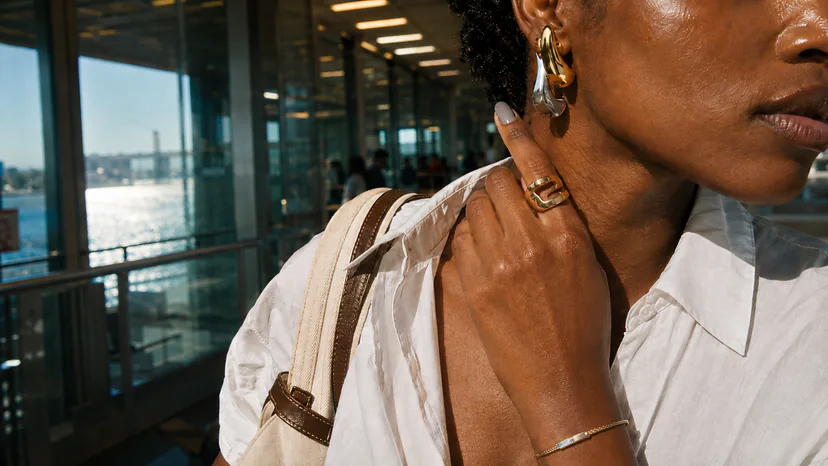
A good travel jewelry organizer lets you understand what is present almost immediately. This matters at checkout time, when you are trying to remember whether the second ring is still beside the sink or already packed.
Look for an interior that presents categories distinctly enough that a missing item leaves an obvious gap. Rings in one visible run, a necklace in its own route, earrings paired on one card: that is faster to audit than three opaque zip pockets containing mixed pieces.
This does not mean everything must be exposed. A protective flap can be useful, particularly when it prevents metal from rubbing against metal. The question is whether opening one or two layers gives you a reliable overview, or whether you must excavate every pocket.
Think of the case as a visual sentence. You should be able to read it.
Material matters, but avoid magical claims
Soft lining can reduce direct abrasion, but no lining makes every jewelry material universally safe. Surface finish, stones, treatments, adhesives, settings and construction all affect how a piece should be handled. The Gemological Institute of America’s jewelry care guidance is a useful reminder that different materials require different care.
Be cautious with sweeping promises such as “tarnish-proof,” “waterproof,” or “safe for all jewelry” unless the manufacturer provides specific support for those claims. A case is primarily a physical organizer. It can reduce rubbing, uncontrolled movement and accidental mixing; it cannot erase the material properties of the jewelry inside it.
If you are carrying something unusually delicate, valuable or difficult to replace, follow the maker’s care guidance and consider whether it deserves its own protective container within your broader travel jewelry storage system.
A six-point buying test
Before choosing a case, run through this short evaluation:
- Separation: Can every piece occupy a distinct zone even when the case is vertical?
- Closure: Does the outer fastening stay secure, and are the interior holders themselves restrained?
- Chain routing: Does each necklace have more than one point of control, with enough slack but no opportunity to cross another chain?
- Retention: Are earrings physically paired and rings held with appropriate friction and lid clearance?
- Portability: Does the closed shape fit the bag you actually travel with without becoming a rigid little brick?
- Readback: Can you spot a missing piece in seconds?
If a case performs well across those six points, you have a strong candidate. If it wins only on appearance, compartment count or a particularly photogenic lining, keep looking.
Choose for your jewelry, not for an imaginary collection
The best case is ultimately collection-specific. Someone traveling with three fine chains needs a different interior from someone carrying two broad rings and a single pair of earrings. A case built around rows of stud holes may be excellent for one person and completely wrong for another.
Before buying, place your usual travel jewelry on a sheet of paper and sketch the footprint each piece needs without touching another. That simple exercise tells you more than a product photograph. You will see whether you need vertical chain length, ring depth, earring-card area or simply fewer but larger compartments.
This is also where restraint becomes useful. Travel is not the moment to recreate your entire jewelry drawer in miniature. A well-edited selection is easier to separate, easier to check and easier to return to the case correctly at the end of the night.
The right case should make that edit feel intentional rather than restrictive: a tiny architecture for a temporary collection, with every piece given enough space to remain itself.
Read next
- Travel Jewelry Organizer: A Beautiful Little Order
- How to Store Jewelry at Home: Build a Drawer That Protects and Inspires
- How to Clean Silver Jewelry: A Material-First Guide
- How to Clean Jewelry After Summer: Sunscreen, Sweat, Salt, and Storage