Begin with the piece that changes the outline
A sculptural piece earns its role through form: a void inside a ring, a curve around the ear, an articulated joint, or a volume that redirects the line of the hand. Start with the silhouette that remains readable before adding anything else.
The anchor can be small. A compact ear piece beside the jaw or an open ring across one finger can change a gesture more clearly than several similarly weighted pieces.
Let negative space stay visible
Space is part of the composition. Keep a visible interval between the anchor and the next necklace, ring, cuff, collar, or garment detail so the construction does not collapse into visual noise.
On the hand, this may mean leaving one finger bare. Near the face, it may mean skipping a necklace or choosing a neckline that does not compete with the ear.
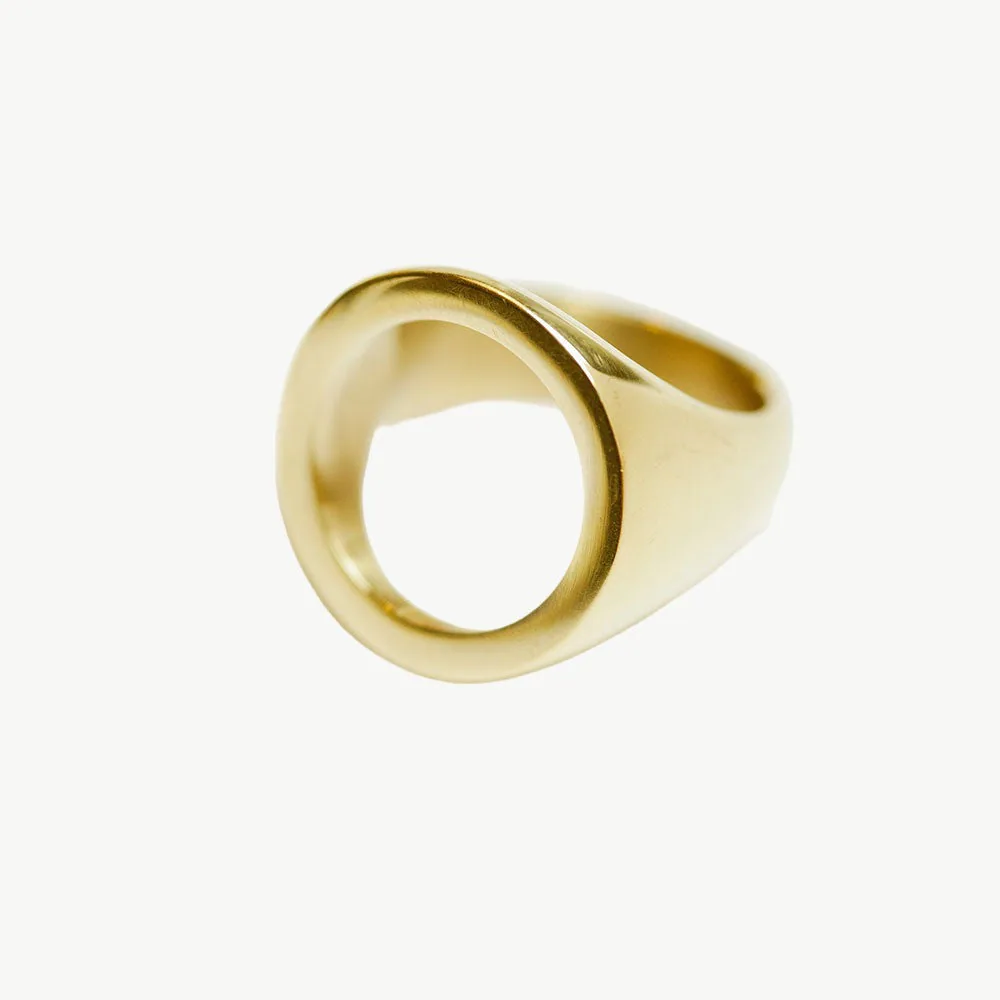
The opening is not missing decoration. It is the part of the ring that lets the hand remain visible.
Test the piece in the movements that define your day
Sculptural jewelry has to survive ordinary motion, not just a still photograph. Turn the head, type, carry a bag, put on headphones, reach into a pocket, and move through a coat or sleeve before deciding the styling is finished.
This is not a universal comfort promise. Dimensions, weight, closure, opening, finish, and fit remain product-specific, so use the live product information as the final limit.
Repeat one relationship, not the whole design
A supporting piece can echo one curve, one surface, one direction, or one metal tone without copying the anchor. Repetition makes the composition coherent; literal matching can flatten it.
If the anchor is an open ring, the support might be a narrow earring with a visible gap. If the anchor is articulated, the support can stay still and repeat only its polished edge.

A compact ear piece changes the silhouette while the surrounding neckline stays quiet.
Use ring stacking as a controlled extension
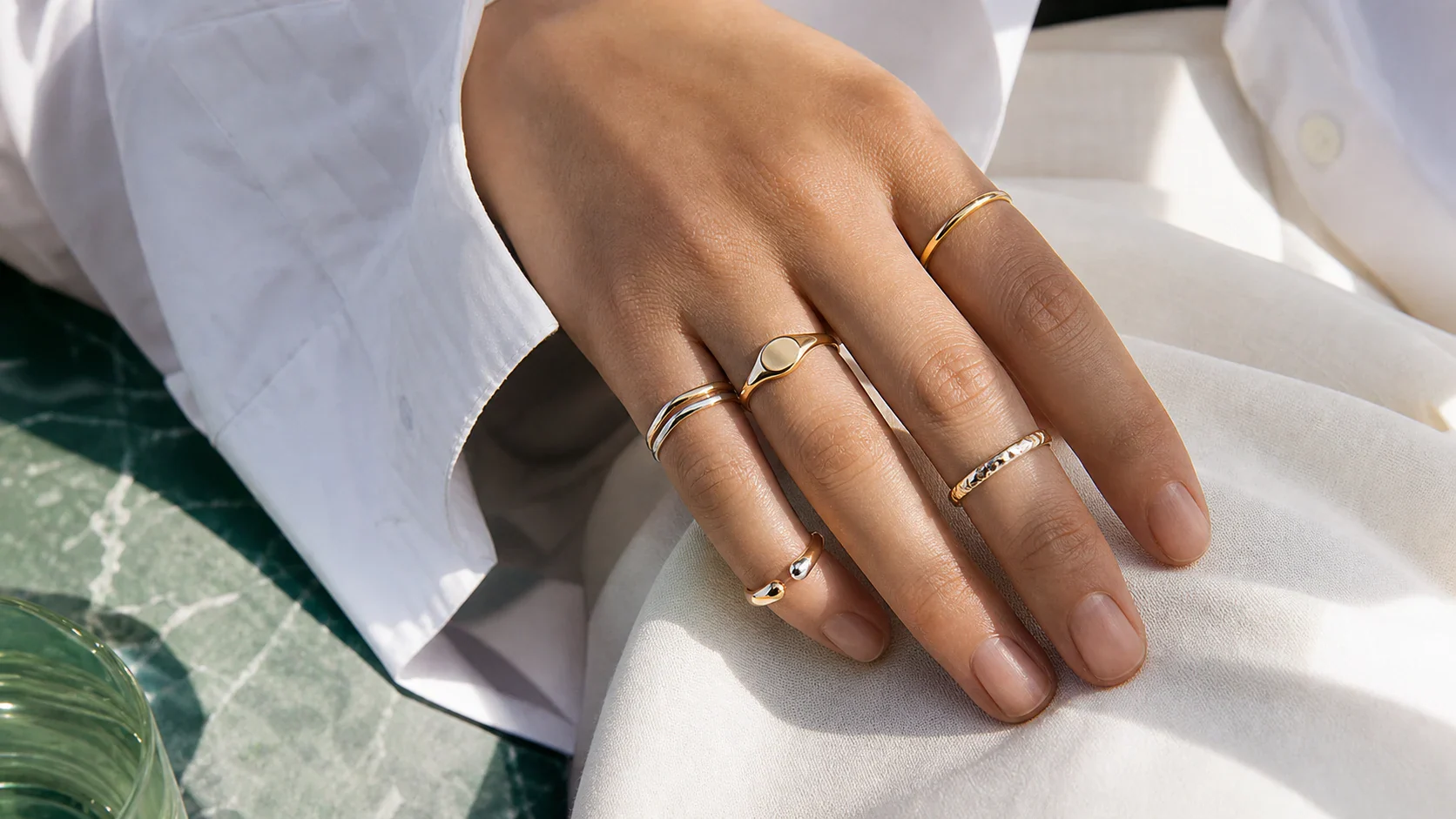
When the anchor sits on the hand, build outward through scale rather than ring count. Add one narrower band or a small signet, preserve a channel of skin, and stop before the original form disappears.
The ring-stacking guide and the ring-stack ideas Journal story separate broad technique from specific compositions, so the hand can stay varied without turning every ring into a statement.
Make the box part of the ritual
Returning the jewelry to a defined place is part of wearing it. A small box, tray, or soft compartment protects the piece while keeping the arrangement together.
Room Key extends that logic: preferences and exclusions shape a curated edit, while the exact live offer, materials, sizing, billing, and fulfillment terms remain visible on the membership page.
A five-minute everyday edit
- Choose one piece whose outline remains readable from ordinary viewing distance.
- Leave one visible interval of skin, fabric, or empty space around it.
- Test the movements that matter today before adding a supporting piece.
- Repeat one curve, surface, direction, or metal relationship once.
- Check the live product page for construction, dimensions, closure, and care.
- Photograph the finished look, then return the jewelry to its own place.
Sources
- The Metropolitan Museum of Art — Jewelry acts upon and activates the body it adorns
- Victoria and Albert Museum — Contemporary artist-jewelers have explored scale, wearability, and jewelry as wearable art