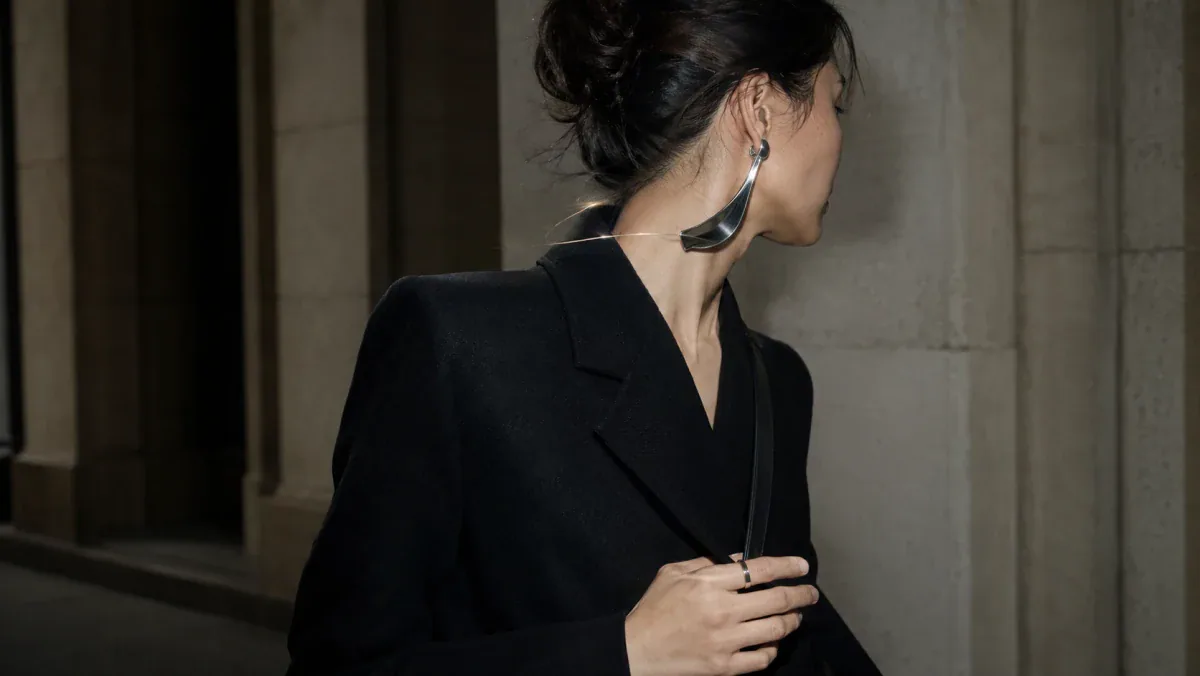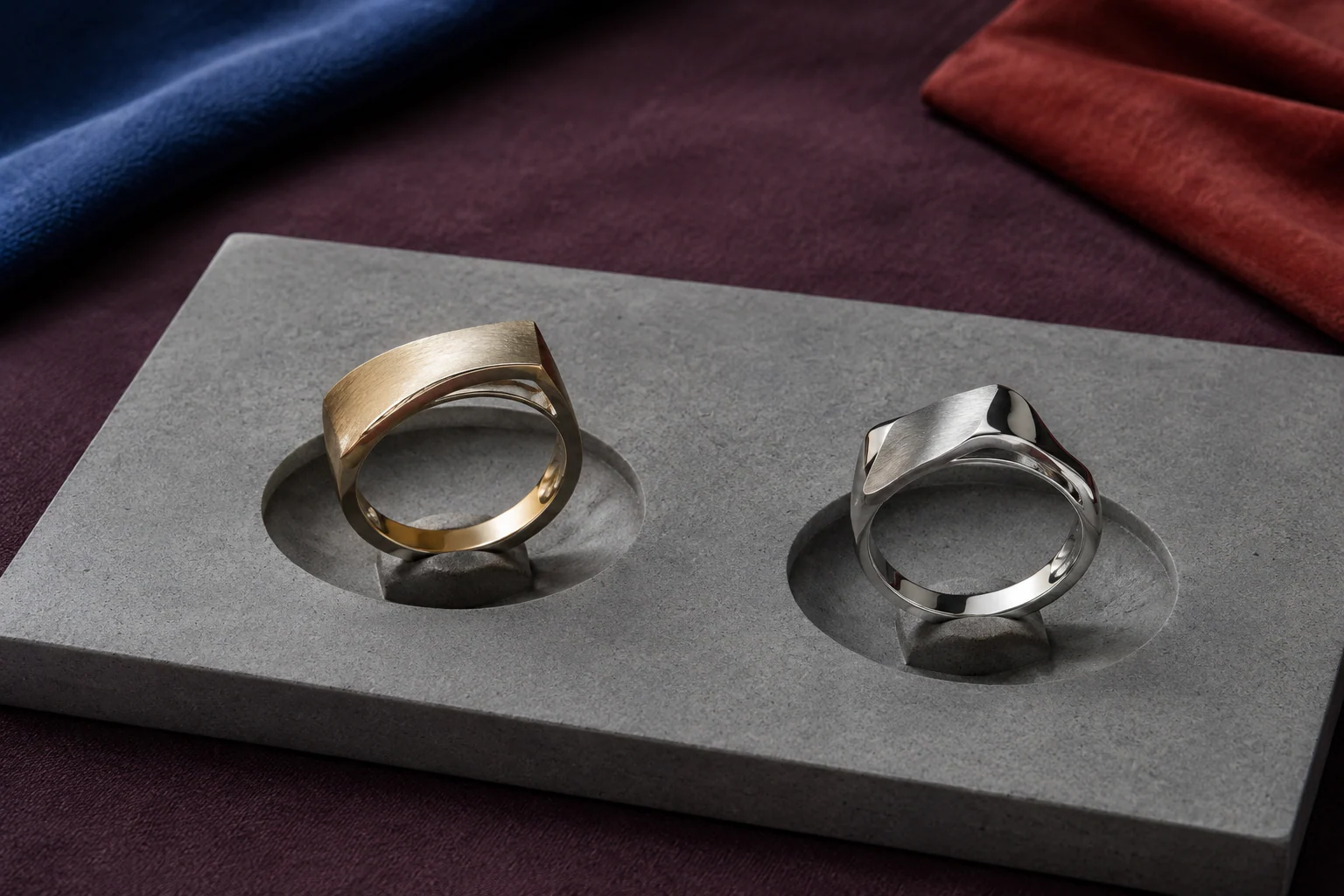
Brutalist jewelry is jewelry whose visual force comes from mass, void, visibly worked surface and readable construction. It may be compact or expansive, blunt or finely articulated, polished at the edges or dark in the recesses. What matters is that the piece makes you notice how metal occupies space, carries tension and meets the body. That is the clearest answer to what is brutalist jewelry—and the reason the label should not be pasted onto every chunky, irregular ring.
A convincing piece feels built rather than merely decorated. Its opening is as deliberate as its solid area. Its shadows reveal changes in depth. Its surface may preserve ridges, pits, tool-like marks or oxidized-looking recesses, but roughness alone is never the point. Form, surface and construction must appear to belong to the same argument.
The name is architectural, but the jewelry is not miniature architecture
The term carries associations with postwar architecture and its interest in forceful geometry, exposed material and legible structure. Jewelry, however, does not become Brutalist by imitating a concrete building, adding a tiny staircase or borrowing the mood of a severe public plaza. The body introduces different questions: contact, scale, articulation, balance and movement.
Nor was Brutalist jewelry a single, neatly bounded school with one manifesto and one approved set of techniques. The label is often applied retrospectively and inconsistently to work by different makers. For anyone trying to pin down brutalist jewelry meaning, the safest answer is a family of formal choices rather than a certification: concentrated mass, purposeful voids, direct transitions, visibly worked metal and construction that does not pretend to be weightless.
Historical pieces can sharpen this way of looking without proving a direct lineage. The Metropolitan Museum of Art’s neck ring demonstrates how a broad central arc can narrow into taut returning lines. Its bronze bracelet with linked rings makes assembly and interdependence immediately visible, while a gold ring with repeated ribs shows how shallow relief changes the rhythm of reflected light. These works should not be retroactively renamed Brutalist simply because certain formal principles feel relevant.
Four clues that make the label useful
1. Mass is concentrated, not merely enlarged
Mass is a visual condition, not a claim about actual grams. A small ring can feel dense when its top is compressed into one forceful block, while a large open cuff may feel comparatively light because air passes through it. Look for where the form gathers, where it thins and whether the distribution creates a clear sense of pressure or counterweight.
2. Void is designed as actively as metal
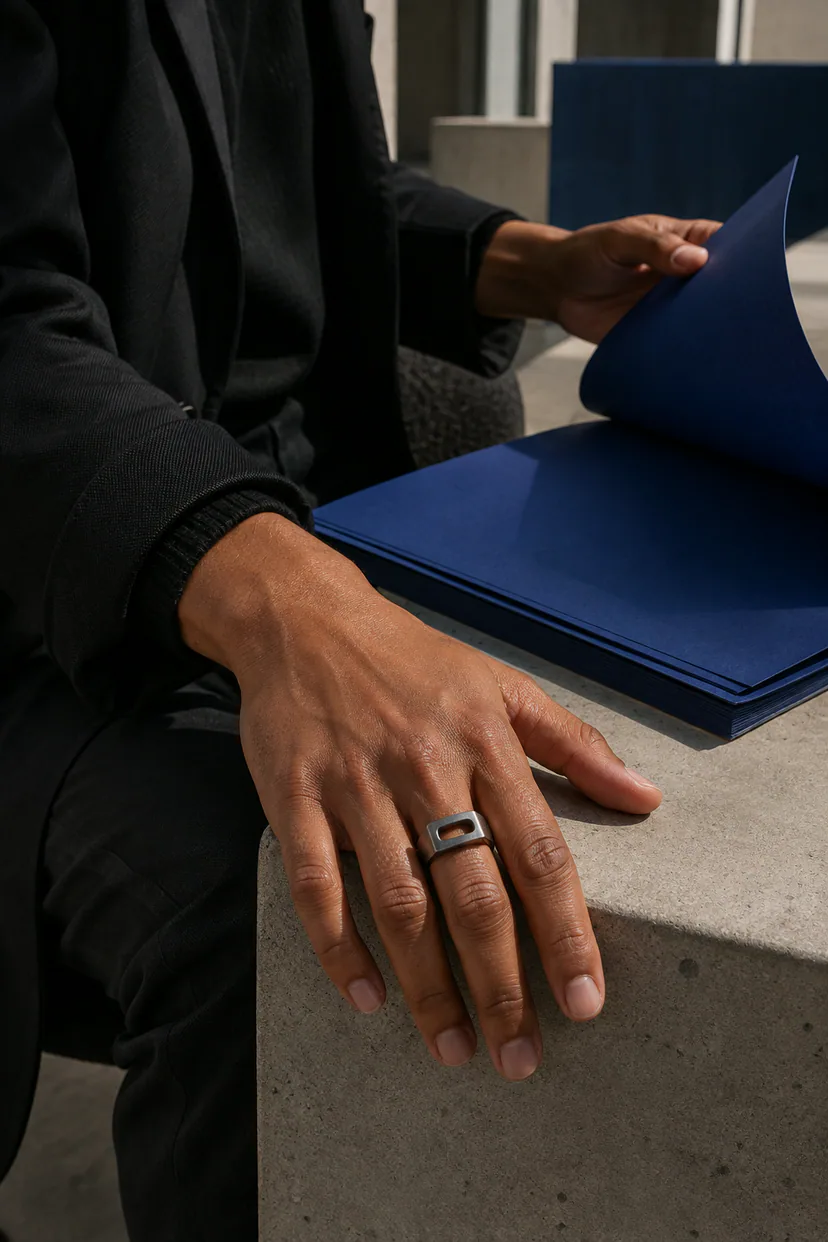
Negative space is not leftover emptiness. A cut-through opening may expose skin, frame cloth or allow a shadow to become part of the piece. In strong sculptural jewelry, a void often clarifies the surrounding mass: the solid area looks more deliberate because the opening has a precise contour. An accidental-looking gap, by contrast, can make construction appear unresolved.
3. Surface reveals intent
A convincing brutalist metal texture is not roughness sprinkled over a conventional shape like seasoning. The surface should reinforce the form. Ridges may direct light across a curve; dark recesses may separate planes; irregularities may make a cast or worked volume feel more immediate. Raw-looking does not necessarily mean untreated. A highly controlled finish can be designed to preserve the appearance of process.
4. Structure remains readable
Structural honesty does not require every joint or seam to be exposed. It means the piece offers a believable answer to simple questions. What supports the raised part of a ring? Where does an earring transfer its load? How does a cuff open, flex or close? Do connected elements overlap in a way that could actually move? A dramatic silhouette loses authority when its attachment appears impossible.
Not every chunky ring is Brutalist
Chunkiness describes scale. Irregularity describes contour. Darkness describes color or finish. None of those qualities is sufficient on its own. A thick band with a familiar polished profile remains a thick band, even if it is photographed against concrete. A conventional form covered in random dents does not automatically acquire structural intensity.
The weakest imitations rely on instant signals: blackened metal, jagged edges, oversized proportions, pseudo-archaeological patina or a vaguely industrial backdrop. The strongest pieces create a relationship among silhouette, void, surface and construction. Remove one of those elements and the others still make sense; remove the theatrical styling and the piece continues to hold its ground.
Modernist jewelry vs brutalist jewelry
Modernist jewelry vs brutalist jewelry is not a perfectly clean opposition. Modernist jewelry is the broader field, often associated with abstraction, clarity, material inquiry, function and resistance to inherited ornament. Brutalist work can share all of those qualities.
The difference is usually one of emphasis. Brutalist-influenced pieces tend to make mass, fracture, roughness, asymmetry, compression or exposed construction more confrontational. A restrained modernist ring might reduce itself to a lucid circle and one precise plane. A Brutalist ring may interrupt that circle with a dense shoulder, an abrupt cut or a cavity that produces a darker, more bodily shadow. Many pieces sit between the two, and forcing them into a rigid category can be less illuminating than describing what the form actually does.
Brutalist rings and brutalist earrings at body scale
Brutalist rings
Rings reveal whether a design works in the round. The top cannot be judged separately from the shank, shoulders and underside. A raised mass needs visible support; a void should remain legible when the hand turns; projections need enough clearance to avoid appearing fused into the neighboring fingers. Because the hand constantly opens, closes, carries and gestures, even a compact ring can produce an emphatic series of changing shadows.
Stacking is possible, but it can erase the architecture of an individual piece. Before adding another band, look at whether the first ring already establishes a dominant horizontal, vertical or diagonal line. A quieter companion may create rhythm; a second equally forceful form may simply turn the hand into visual traffic.
Brutalist earrings
Brutalist earrings do not have to be enormous. A small earring can create the effect through projection, concentrated volume, an open internal shape or a sharply controlled shadow beside the ear. What matters is that the post, hook, clip or cuff path remains credible and that the relationship between front, rear support and gravity can be understood.
The ear also makes asymmetry especially useful. One dense form may be balanced by a smaller open element, a bare opposite ear or a shift of attention toward the hand. Exact comfort, weight and security remain product-specific matters and should not be inferred from an image or category label.
How to style brutalist jewelry without turning it into costume
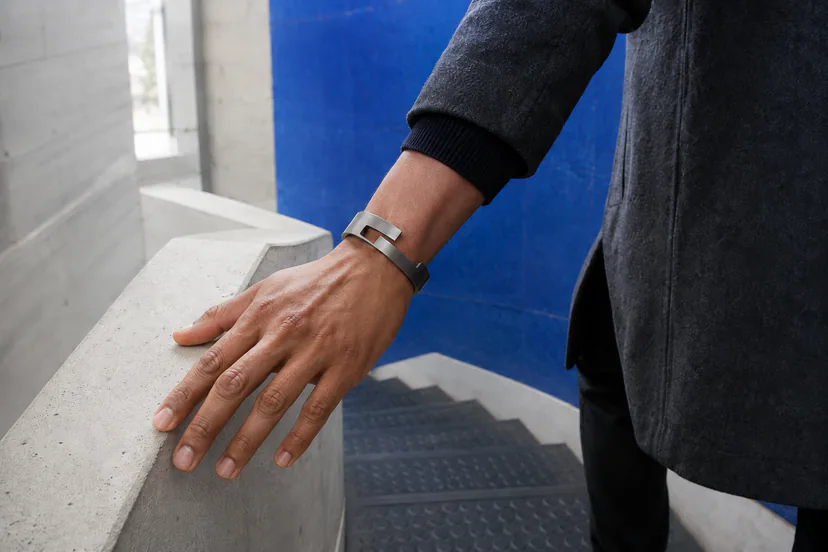
The simplest answer to how to style brutalist jewelry is to give its structure enough room to be read. Choose one primary zone—ear, throat, wrist or hand—then protect the space around it. A cuff needs sleeve clearance. An open ring needs a gesture that does not hide its aperture. An earring with lateral projection benefits from hair or a collar that does not dissolve its outline.
Quiet black tailoring is effective because it provides a stable field, but it is not mandatory. Dense metal can become more articulate against washed denim, translucent cloth, dry wool, crisp cotton or softly draped silk. The useful contrast is not simply hard versus soft. It is fixed against moving, reflective against absorbent, compressed against open or dark recess against uninterrupted color.
Avoid styling every surrounding element into the same severe theme. Concrete walls, angular sunglasses, heavy boots and four more rough-metal pieces can make the jewelry feel like a costume prop. One ordinary element—a soft knit, a bare hand, a worn shirt or an unforced posture—often makes the form feel more contemporary.
A quick form-first test
- Find the mass. Identify where the form becomes most concentrated.
- Trace the void. Check whether openings have intentional contours and remain visible on the body.
- Read the surface. Ask whether texture clarifies planes, depth or direction.
- Follow the structure. Locate the band, support, opening, joint or closure that carries the piece.
- Check the body relationship. Look for credible contact, clearance and orientation.
- Remove the mood board. Decide whether the piece still feels compelling without dramatic styling.
FAQ
What is Brutalist jewelry made from?
There is no single required material. Pieces described as Brutalist may be made from silver, gold, bronze, brass, iron, mixed metals or other materials. Color alone is not reliable proof of composition: a dark area may be oxidation, coating, patina, shadow or image treatment. Material and care information should be checked against documentation for the specific piece.
Is sculptural jewelry the same as Brutalist jewelry?
No. Sculptural jewelry is the broader idea of jewelry behaving as three-dimensional form on or around the body. Brutalist jewelry can be sculptural, but sculptural jewelry may also be fluid, delicate, highly polished, biomorphic, kinetic or vividly colored. The Brutalist label becomes useful when mass, void, worked surface and structural directness are central to the design.
Can Brutalist jewelry be delicate?
Yes, if delicacy refers to physical scale rather than visual language. A fine ring with one compressed bridge and a sharply cut aperture can feel more Brutalist than an oversized but conventionally decorative piece. The category depends on how force is organized, not on a minimum diameter.
When the label earns its keep
The best Brutalist jewelry does not need to announce itself with rubble, spikes or a concrete pedestal. It makes you notice a darker recess, a controlled interruption, a piece of air held inside metal or a joint that explains the whole form. When mass, shadow, void and construction remain legible on the body, the label begins to mean something.
Read next
- Explore sculptural jewelry
- How to wear ear cuffs
- Jewelry for a high-neck dress
- What to wear to an art gallery