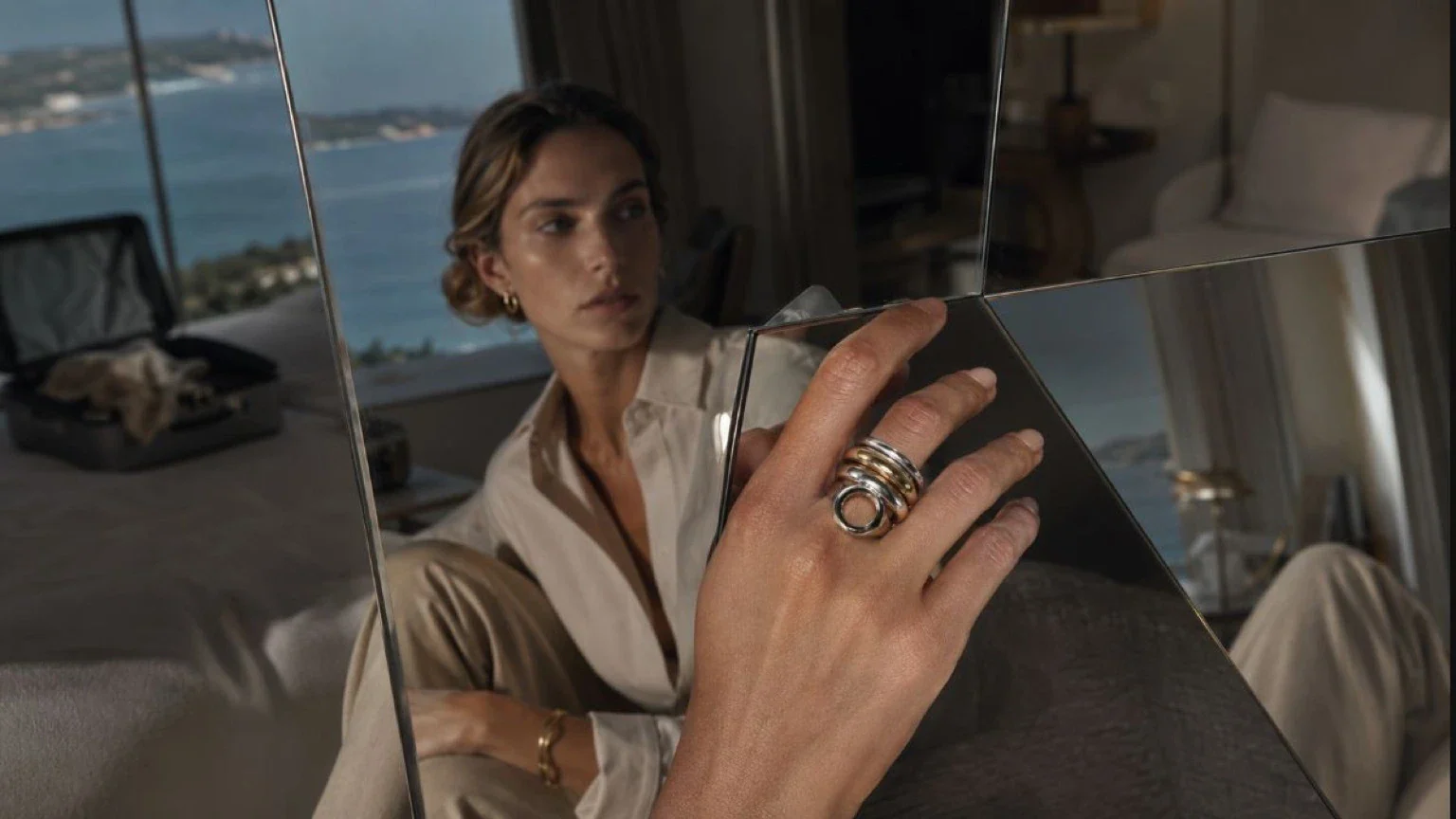
You get home with both earrings on. By the time the bag is down, one is in your hand. The other remains in place while you read a message. For a few seconds, the pair belongs to two different scenes: one still frames a face; one is a small object held between finger and thumb.
There is a coat over a chair, one sleeve turned inside out, and a question from the next room about dinner. Turn the earring slightly. The curve you recognized in the mirror is now an edge, then a narrow patch of light. You have been wearing it all afternoon. This is the first proper look you have given it.
The intervals between wearing change how we encounter jewelry. Taking something off, closing it away and seeing it tomorrow give us different views of the same object. They also let us decide how much of it belongs in the room, and how much remains our own business.
The outfit comes apart unevenly
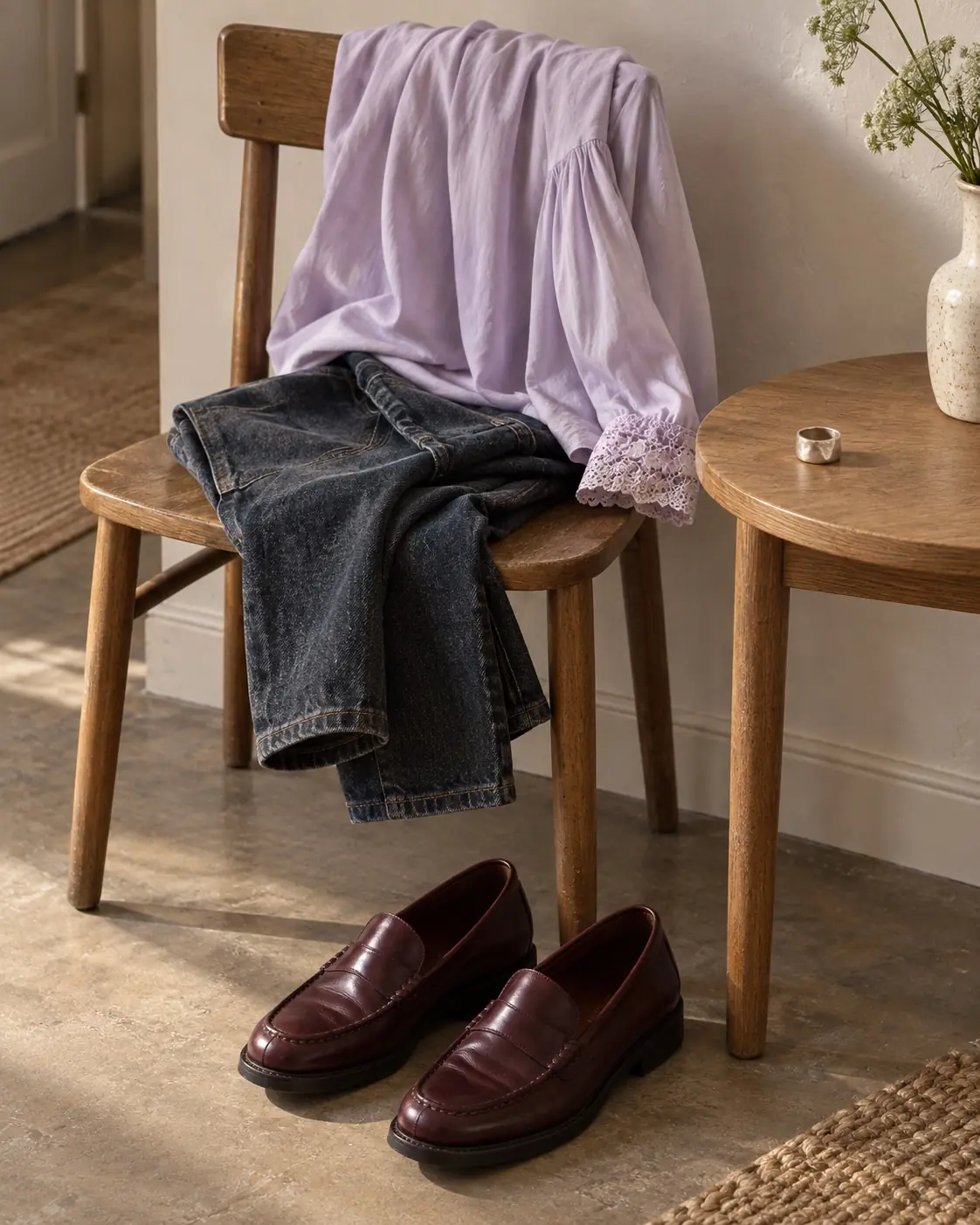
Getting undressed has its own slightly disorderly sequence. A jacket goes first. A ring stays on while you look for the remote. The earrings survive the change into an old sweatshirt, so that, for half an hour, something carefully chosen hangs above a neckline you barely considered. There it is: an accidental second outfit.
That overlap is worth a glance. The earrings that seemed perfectly at home beside a crisp collar may look unexpectedly emphatic against a faded crew neck. You can see how much of the earlier effect belonged to the clothes, and how much the jewelry contributed. The difference becomes visible because the rest of the outfit has changed around it.
You might enjoy the new combination enough to keep it. You might take the earrings off as soon as you notice. For a brief interval, the morning’s decision is still present, although the morning’s clothes are gone.
Sometimes you have an hour at home before going out again. Dinner is still being negotiated in the group chat; you have changed your shoes but kept the trousers. The jewelry comes off while you decide. It may go straight back on with a different top, making its removal a pause within one evening. Notice that provisional quality: a piece lying in its usual place can still seem attached to the outfit you are considering. You look between it and the clothes, deciding whether to resume where you left off.
If you want to catch that interval, look once before removing the last piece. Notice what remains of the outfit and what has changed. Perhaps the only deliberate thing left is a bracelet below a pushed-up sleeve. Perhaps that is plenty for dinner on the sofa.
A different angle on the familiar
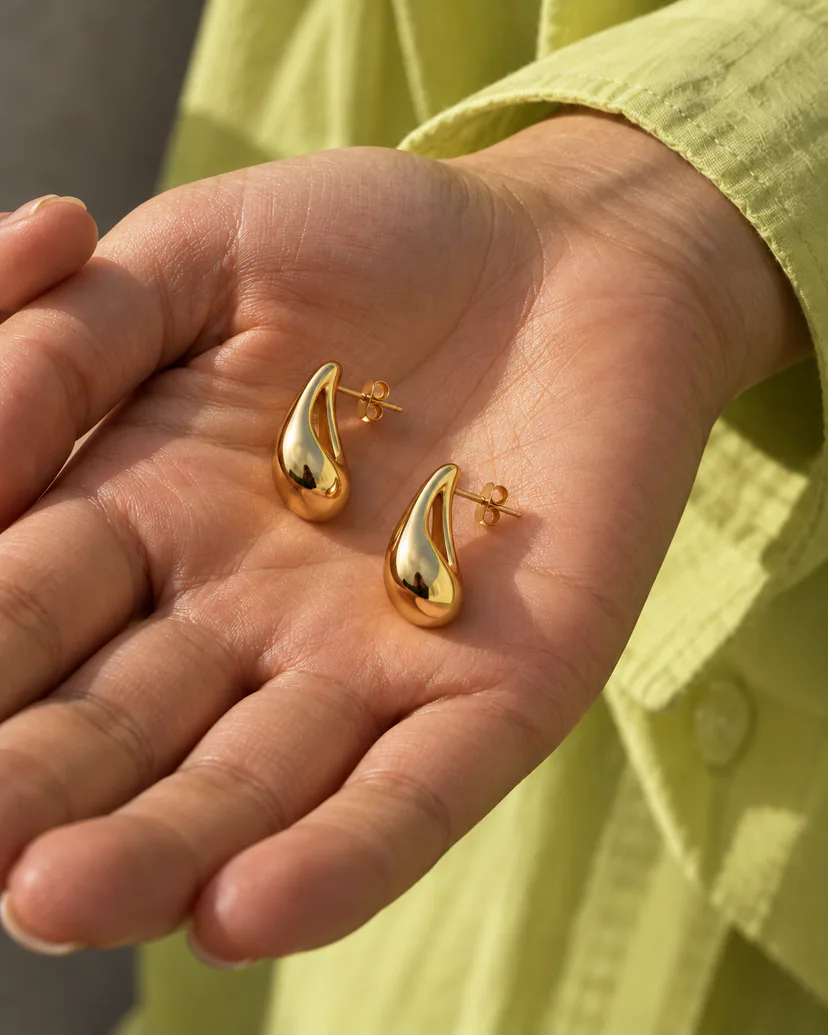
In the mirror, an earring appears beside your face, hair and collar. In your hand, you can turn it until those relationships disappear. Its outline becomes easier to follow. A shape that looked almost flat from the front may have a curve you only notice when it is held sideways.
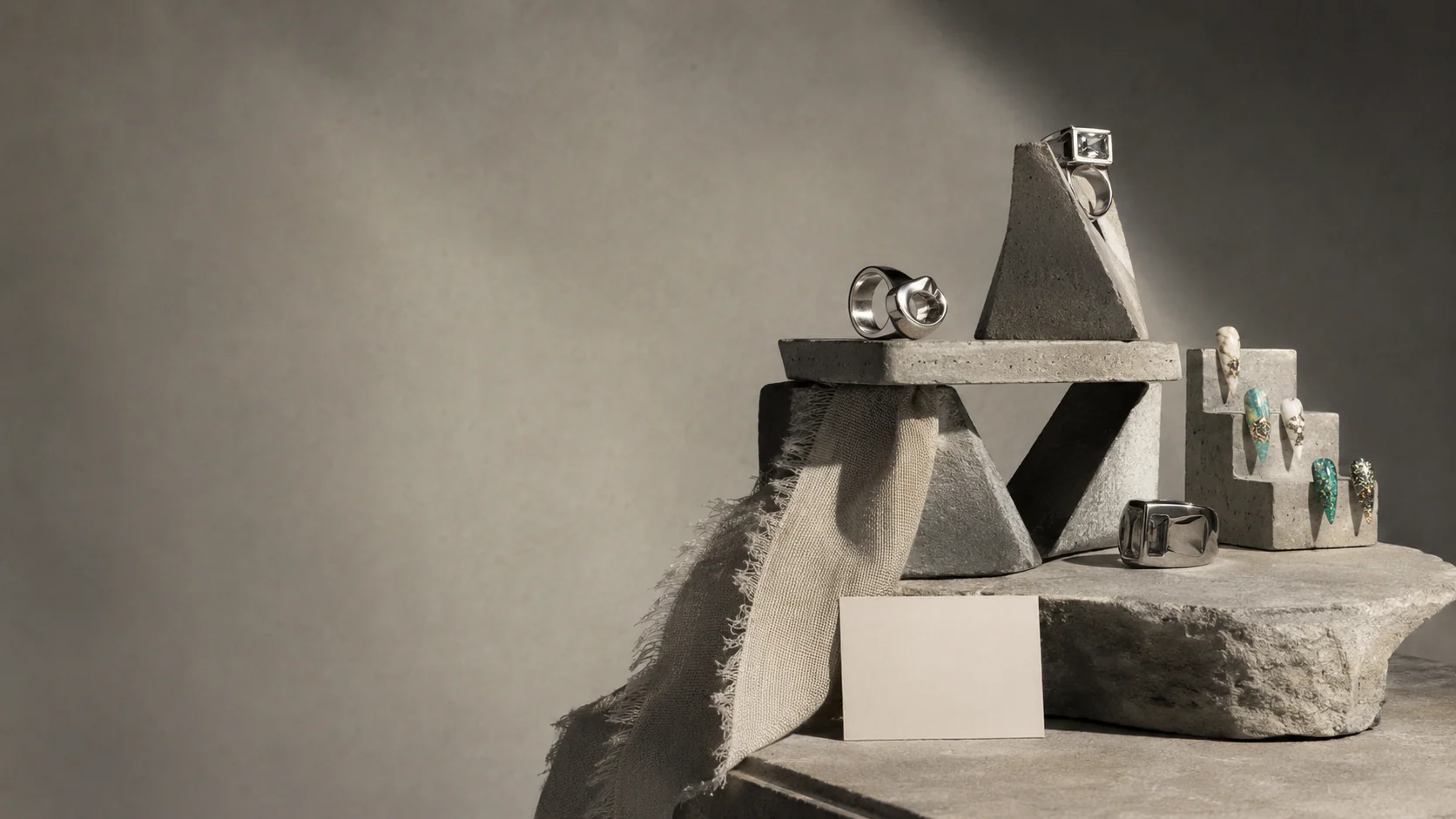
A ring offers another version of this change. Worn, its opening is occupied by a finger. Removed, the opening becomes part of what you see. Set within the larger rectangle of an open drawer, that small circle has a very different scale from the one it had on your hand.
There is pleasure in recognizing something familiar from a less familiar angle. You may find that you like a piece’s side view almost as much as its face, or notice that the part you always describe first is scarcely visible when you wear it. These are small discrepancies between owning an object and seeing it.
If you reach up later to adjust an earring you have already removed, your fingers meet the edge of your ear. For a second, you are adjusting an outfit that is already partly in the drawer. Then you finish pushing your hair back and go on with the evening. The piece has a location in the room; your hand has briefly looked for it somewhere else.
For the practical decisions about where a piece rests, see our guide to storing jewelry at home. Before putting it away, take that sideways look if you like. You can know an earring very well as part of your reflection and still find something to notice when you hold it.
Visible to whom?
Picture a bedroom with the door open. From the corridor, a dressing table reads as part of the room: lamp, mirror, a dark rectangle of a box. Standing beside it, you can see much smaller things. Open the box and the view changes again. Visibility depends on where someone stands, and who gets to open what.
You might like seeing your jewelry when you get dressed and prefer a closed lid for the rest of the day. Someone else might enjoy a glimpse of a piece while passing through the room. At home, an object can come into view for a few minutes and then disappear until it is wanted again.
In a shared room, the distinction can become especially clear. Something you remove without thinking may catch another person’s attention. An earring prompts a comment; a ring invites the question of whether you wore it today. Sometimes that is welcome. Sometimes you would rather finish taking your shoes off.
Choosing what stays visible can be as modest as choosing which conversation to have. A private object need not be a keepsake of the kind considered in The Farewell Drawer. The pair you wore to buy groceries can remain private simply because you prefer to decide when someone else sees it.
Showing someone a piece from your palm creates a different encounter again. You choose which side faces them, turn it, point out a detail they missed when you wore it. They lean closer. For a moment, the jewelry has two people’s full attention, and you can see exactly what they are looking at. Then it goes back and the conversation moves on. Its appearance in the room can be that brief and that specific.
Try considering the room from two positions: where you usually stand to dress, and where another person would enter. What is available to each view? You may be perfectly happy with the difference. It is useful to know that there is one.
A recent design offers one specific answer to what belongs together. In her October 15, 2026 report for National Jeweler, Natalie Francisco describes Wolf and Marla Aaron’s Some of the Things Box, which accommodates notes and keepsakes alongside jewelry. The interesting choice is the allowance for different kinds of possessions within one object. That choice brings a domestic question into view: when you open a box, do you want to see jewelry on its own, or encounter it among other parts of your day?
The room carries on around it
Once the jewelry is off, there are other things to do. A book gets moved. The lamp is switched on. Someone retrieves a sweater from the chair. The room changes around the place where you left it, whether the jewelry remains visible or disappears behind a closed front.
That is part of what makes these domestic encounters interesting to look at. A jewelry photograph can give an object the whole scene. At home, your eye may have to pass a charging cable and a laundry basket before reaching it. The surrounding things make the scale wonderfully clear: a pair that occupied a surprising amount of your attention this afternoon takes up very little of the room.
Later, you might open the drawer for something else and see the earrings again. This time you are looking down, with the lamp behind you, wearing glasses you had left at home. Your view of the arrangement has changed because you have approached it differently. You notice a shape, then carry on looking for what you came to find.
If the lid stays closed all evening, the next sight of the pieces will be in the morning. In between, the box is simply part of the furniture: a familiar outline beside the lamp while the rest of the evening happens elsewhere.
Tomorrow gets another look
In the morning, you open the same place before you have finished getting dressed. Yesterday’s earrings are there, but the shirt on the chair is different. Seen together, they suggest a combination you had not planned. Or you reach for the same pair immediately, pleased to have one decision already settled.
Repetition has details of its own. You may put the earrings on before choosing a top, allowing their outline to become the first visible decision. On another morning, you add them last and see how they sit with everything else. The pieces have stayed the same; their place in the sequence has shifted.
If yesterday’s choice feels automatic, pause long enough to look at the piece before looking in the mirror. Are you drawn to its shape this morning? Does it still belong with what you are putting on? You can answer by wearing it, trying another piece or leaving without jewelry. The question need only last as long as the clasp.
There is also the morning when you open the box, recognize what is there and close it again. A piece can be part of today’s view without becoming part of today’s outfit. Later, it may look right with the clothes you change into before going out.
For now, one earring is on and the second is in your hand. The same arrangement as last night, facing the other direction. You lift it toward your ear, turn your head to see, and finish getting dressed.