Switchroom Journal · Art / Fashion / Body Surface
The 2026 Met Gala theme gives Switchroom a precise language for what a handmade press-on nail set and a sculptural ring can become: not decoration after the outfit, but part of the dressed body itself.
Every year, the Met Gala gives fashion a temporary permission to speak in a larger language. Clothes are no longer only clothes. A gown becomes architecture. A sleeve becomes a reference. A train becomes a moving room. A jewel becomes a sentence about power, memory, or performance. In 2026, that conversation becomes especially useful for Switchroom because the Costume Institute’s exhibition Costume Art places the dressed body at the center of the discussion.
The Met describes the exhibition as an exploration of depictions of the dressed body across its collection, pairing garments with artworks to reveal the relationship between clothing and the body. For a brand like Switchroom, that phrase — the dressed body — is more important than the red carpet itself. It suggests that fashion is not limited to the garment. The body is dressed through surfaces, gestures, textures, ornaments, colors, and pieces. A hand can be dressed. A finger can be dressed. A nail can be dressed.
This is why the 2026 Met Gala should not only inspire a moodboard of gowns. It should inspire a product philosophy. If fashion is art, then handmade press-on nails can be miniature paintings. If the body is the site of fashion, then jewelry can be wearable sculpture. If a museum can place garments next to paintings and pieces, Switchroom can place nail sets next to rings, styling cards, and mood fragments. The scale changes, but the logic remains: the body becomes a gallery.
This article is not a celebrity recap. It is a way to translate a cultural event into a Switchroom point of view. The question is not “Who wore the most dramatic look?” The better question is: what does it mean to treat the hand, the nail, and the ring as parts of the dressed body?
The Dressed Body Is Not Only Wearing Clothes
In everyday language, people often separate clothing, beauty, and accessories into different categories. A dress is fashion. A manicure is beauty. A ring is jewelry. A scent is fragrance. But on the body, these categories do not remain separate. They are seen together. A hand adjusts a collar. A ring touches a glass. Nails appear near a sleeve. A bracelet changes how the wrist moves. The final image is not a dress, a hand, a nail, or a ring. It is a dressed body in motion.
This is the space where Switchroom can build a stronger identity than a normal beauty or accessories brand. Instead of selling press-on nails as an isolated manicure, Switchroom can sell them as surface design for the dressed body. Instead of selling jewelry as a finishing touch, Switchroom can sell it as a structural element in the hand’s composition. The brand does not need to imitate luxury fashion houses. It needs to own a smaller, more intimate scale.
A hand is one of the most expressive areas of the body. It points, holds, touches, writes, scrolls, opens doors, takes photos, lifts cups, and rests near the face. It appears in mirrors and phone cameras constantly. In a social situation, the hand is often seen before a full outfit is understood. That makes the hand a powerful site for styling. The detail is small, but the frequency is high.
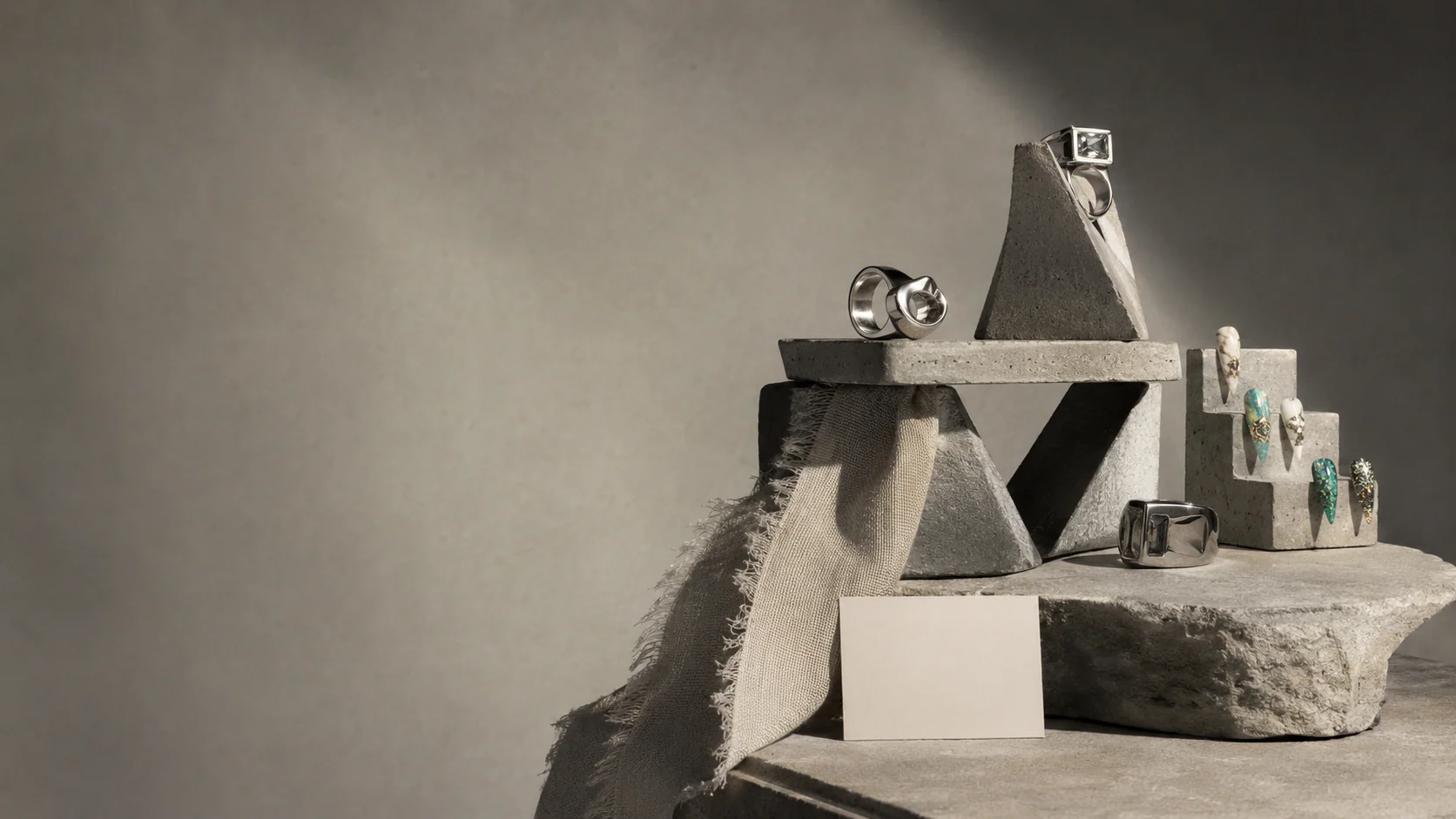
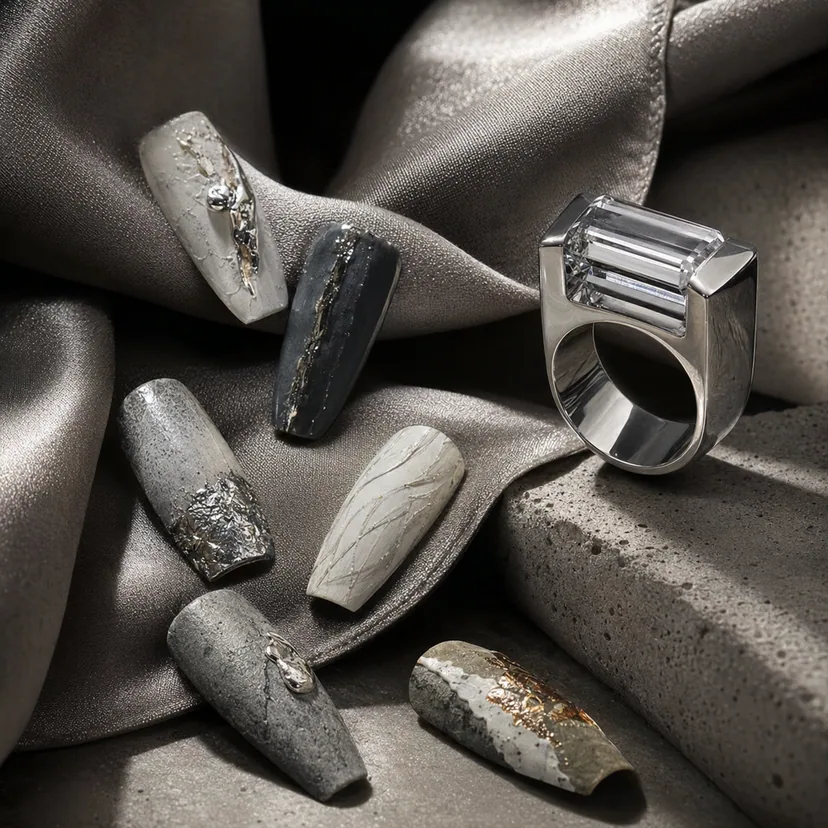
A handmade press-on nail set can therefore function as a set of tiny panels. Each nail carries color, shine, shape, and mood. A ring can add height, shadow, rhythm, and tension. Together, they create a small sculptural scene. This is why handmade press-on nails and sculptural jewelry should be photographed, described, and sold together whenever possible.
Press-On Nails as Miniature Paintings
A nail set is often treated as a beauty product, but it can also be a tiny canvas in motion. It has a surface, a frame, a color field, and a relationship to the body. A square short nail creates a different visual language from an almond nail. A pearled surface reads differently from a jelly surface. A translucent grey reads differently from an opaque red. The nail may be tiny, but it still has composition.
This is especially true for handmade press-on nails because the surface can be prepared with more intention than a rushed daily manicure. A hand-painted detail, a layered chrome finish, a blooming gel effect, a cat-eye shift, or a pearl powder surface can be completed as a small piece before it ever meets the customer’s hand. That means the nail is not simply a service outcome. It is a portable artwork.
For the Met Gala-inspired article, Switchroom should avoid the most obvious interpretation: copying red carpet gowns onto nails. That can become too literal and too trend-chasing. The stronger interpretation is structural. Drapery, silhouette, surface, material contrast, body framing, theatrical gesture, art reference, and ornament as meaning can all be translated into nails without copying any celebrity look directly.
For example, a “Costume Art” nail set could use ivory and old gold to echo museum walls and gilt frames. A translucent smoke-grey set could reference shadowed sculpture halls. A pearl-white set could recall marble, skin, and fabric. A deep wine set with a thin metallic line could suggest velvet ropes and evening formality. These are not costume copies. They are emotional translations.
Jewelry as Wearable Sculpture
Jewelry is the most direct bridge between fashion and sculpture. It occupies the body, but it also has independent form. A ring can be curved, architectural, heavy, open, sharp, soft, molten, polished, or rough. It can make a hand feel restrained or expressive. It can frame a manicure the way a plinth frames a piece.
For Switchroom, the key phrase is wearable sculpture. It is more precise than “accessory” and more useful than “statement jewelry.” A statement piece can sound loud. Wearable sculpture sounds constructed. It suggests form, proportion, material, and intention. This language also fits the brand’s interest in spatial poetics and small installations. A ring is not just a ring. It is a small spatial interruption around the finger.
The relationship between nail and ring is where the concept becomes commercially useful. A pearl nail with a soft silver ring reads like a museum study. A chrome nail with a heavy gold ring reads like performance. A smoky translucent nail with a blackened metal ring reads like cinema. A nude gloss nail with an organic open ring reads like quiet luxury. The same nail set can change completely depending on the jewelry next to it.
Switchroom’s Hand Styling Notes continue this study through individual nail-and-jewelry pairings, moods, and scenes.
The Hand as a Small Gallery
The strongest sentence for this article is simple: the hand is a gallery. It is small enough to be intimate, but visible enough to communicate. It carries pieces. It frames gestures. It appears in photographs and in memory. A person may forget a full outfit, but remember the way a silver ring looked against a dark manicure while someone held a glass.
This is why the hand should be photographed with the seriousness usually reserved for a face or a full-body look. For Switchroom’s visual direction, hand photography should not feel like a nail salon menu. It should feel like a still from a film, a page from an art magazine, or a detail shot from an exhibition catalogue. The lighting should reveal surface. The composition should create atmosphere. The hand should not only display the product; it should perform a mood.
Useful gestures include holding an art book, touching a silk scarf, resting on a stone table, lifting a glass, opening a drawer, adjusting an earring, or tracing the edge of a mirror. These gestures make the nail and jewelry feel lived-in. They also connect directly to the Met Gala theme without needing to show red carpet imagery.
Switchroom does not need celebrity images or borrowed red carpet photos to participate in the conversation. The cultural theme can act as a conceptual anchor for original still-life and hand-detail imagery around the brand’s own pieces.
How to Style Fashion as Art Without Looking Like a Costume
The danger of any Met Gala-inspired trend is over-literal styling. When a theme is dramatic, people may assume the only way to participate is to become dramatic too. A more wearable approach needs only one controlled artistic detail.
The easiest formula is one art reference, one wearable surface, and one modern restraint. A pearl nail can reference marble while the outfit remains a white shirt and black trousers. A gold ring can reference a frame while the hand stays clean and minimal. A smoky nail can reference old oil-painting shadows while the styling remains simple enough for dinner.
The language can stay precise: surface, frame, gesture, sculpture, gallery, dressed body, miniature painting, wearable piece. The result is not “Met Gala nails you need right now,” but a small study in how the dressed body begins at the hand.
The Switchroom customer is not only chasing trend images. She is building a personal style language across fashion, film, art, beauty, and the pieces she can actually wear. Fashion may enter through the gown, but it often stays in the hand.