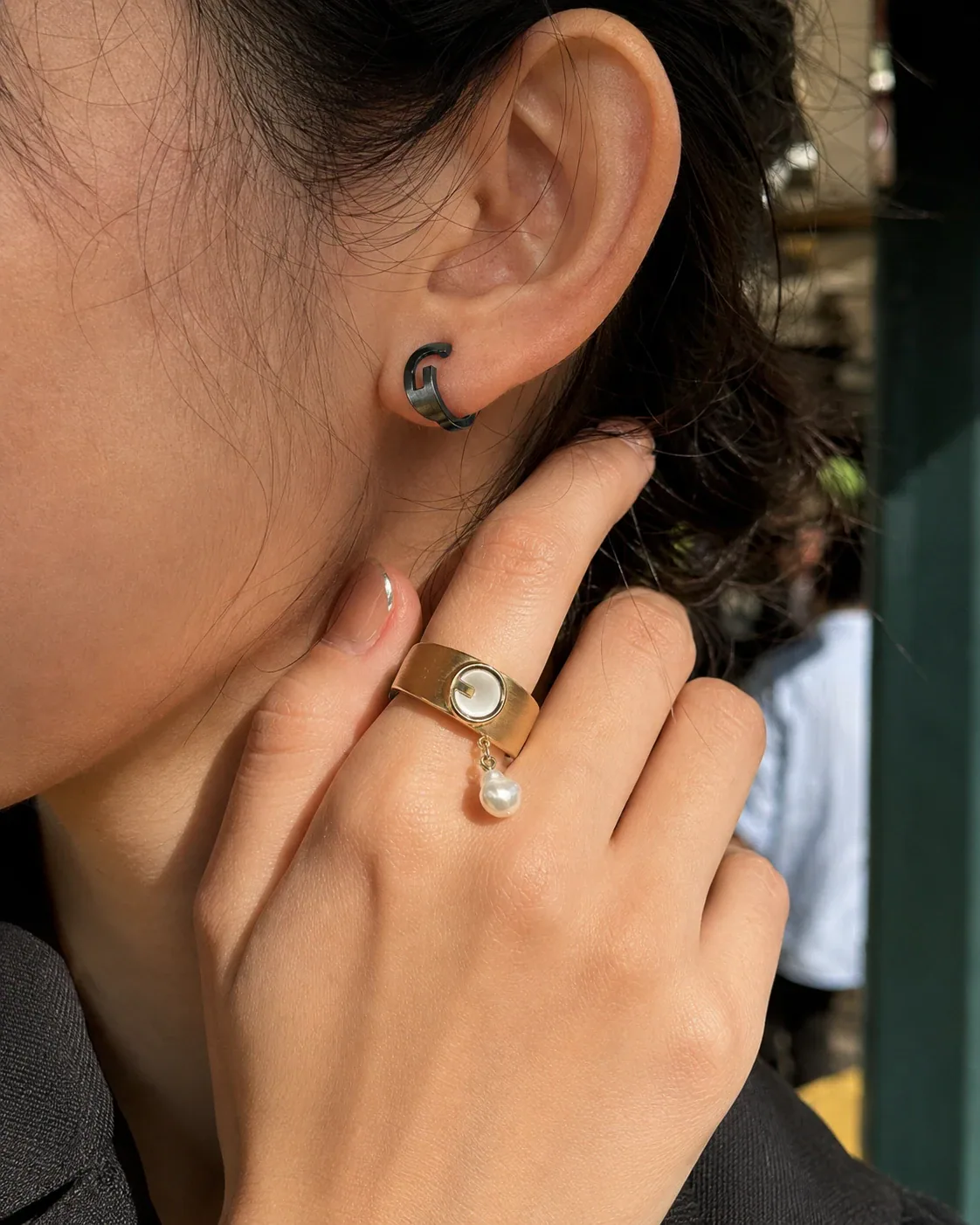
A graduation box is carried down three flights of stairs: charger, folded programme, one shoe that never made it back into its pair, and a pearl earring wrapped in tissue. The earring is not valuable because it is “classic.” It is valuable because it has acquired a role. It belonged to the version of its wearer who crossed the stage, hugged the wrong person first, and left before the photographs became repetitive.
That shift—from pearl as symbol to pearl as character—defines the most useful way to read pearl jewelry trends 2026. The uniform strand has not disappeared, but designers and wearers are treating pearls as irregular actors: baroque charms, suspended fragments, nets, hinged details and small surreal pieces. The important correction is scale. Directional pearl jewelry does not have to fill the shoulder or cover the head. A single strange pearl, held by a clear mechanism, can carry the whole idea.
The strand has become a cast of characters
A strand asks us to read repetition. A baroque pearl asks us to read difference. Its ridges and uneven light make it closer to a found piece than a bead, already suggesting a tiny body, stone or weather pattern without becoming a literal motif.
There are visible 2026 signals for this move. In an official Pandora press release, the company describes the first act of Pandora Wonders, co-created with Harry Lambert, as a freshwater-pearl collection built around one-of-a-kind baroque pearl dangle charms. The company says each pearl is micro-pierced, hand-set and finished with 14K gold plating. The relevant point is not a forecast that every pearl will become a charm; it is the renewed attention to the individuality of each pearl and to the hardware that lets it move.
At the opposite end of scale, JCK’s editorial reporting on Mikimoto’s L’éclat high-jewelry collection describes diagonal pearl cascades, colored gemstones, celestial head jewelry and brooches conceived as light moving across the body. These are high-jewelry propositions, not everyday templates. Their value for styling is compositional: pearls can travel, cluster, interrupt a line and occupy hair, shoulder or décolletage rather than remaining centered at the throat.
Five pearl directions worth separating
1. Baroque characters
Choose one pearl whose silhouette reads at a glance. Let its irregularity remain visible instead of forcing symmetry. For baroque pearl charms and talismans, use one character pearl, one attachment point and one clear place on the body.
2. Suspended fragments
A short bar, open ring, hinge or fine chain can suspend a pearl so that air becomes part of the piece. Movement may swing, rotate or settle against skin, but it should look designed into the structure.
3. Nets and body traces
Pearl nets can move through hair, around an ear or from collar to shoulder. The wearable lesson is to distribute weight across several attachment points while preserving negative space.
4. Charms and modular pieces
A pearl can move from earring to brooch, collar to bag, or hair pin to hand ornament. Keep the conversion mechanically legible: a visible seam, loop or hinge is more convincing than a hidden fastening.
5. Small surreal pieces
Surreal jewelry can work through displacement: a pearl where a rivet should be, a stone interrupting a structural line, a tiny piece migrating to the shoulder. Album-era styling offers a cultural echo without requiring costume or retro quotation.
Switchroom design analysis: from atmosphere to mechanism
The Switchroom pearl-light edit begins with two design questions: where can a pearl interrupt architecture, and how can that interruption be changed? In B01, a pearl lattice travels through braided hair while a chromatic titanium collar holds the neck in a harder register. The contrast is not simply “soft pearl, hard metal.” The pearls behave as points of light; the titanium establishes direction, weight and interval.
B02 compresses the same language into a collar-and-shoulder configuration. Exactly two articulated pearl strands connect a brushed-titanium collar to a detachable shoulder pin. The visible joints matter because they explain how the piece sits, moves and separates. One emerald enamel event and one violet stone prevent the pearl field from becoming uniformly precious or bridal.

This is where material reading becomes part of design reading. Finish changes how a form behaves visually: brushed metal absorbs and spreads light; polished nodes sharpen it; pearl nacre returns a softer glow. Before choosing a directional piece, it is useful to understand why quality jewelry is about materials, construction and the relationship between surfaces—not only the presence of a pearl.
The daily-wear correction: scale, fastening, weight and movement
Editorial imagery often makes a piece look effortless because the frame lasts one second. Daily wear lasts through a train ride, a coat collar, a phone call and several hours of unconscious touching. Four practical variables decide whether a pearl piece remains compelling after the photograph.
Scale
Completedworks’ official product page lists its Chasing Shadows small earrings at 18mm high, 10mm wide and 6g per side. The design wraps pearl, zirconia and metal around the ear while remaining compact in footprint. Six grams per side may still feel substantial depending on the wearer, but the dimensions show that directional construction can be concentrated rather than oversized.
Fastening
The same Completedworks product page specifies a post and butterfly back. That familiar fastening gives the more unusual front-facing structure a stable reference point. For modern pearl earrings, ask where the load begins, where it is stopped and whether an ear cuff, second post or hair attachment is decorative or genuinely structural.
Weight
Sophie Buhai’s official product page lists the Small Eleanor earrings at one inch long and 1.6g each. The quiet two-pearl drop is a useful correction layer: a pearl look can remain directional through proportion and spacing while staying physically light. Weight tolerance is personal, but published measurements let you compare fantasy with likely wear time.
Movement
Movement changes perceived weight. A fixed cluster may feel dense but physically calm; a light drop may repeatedly touch the jaw or collar. Check whether it catches hair, collides with headphones or disappears beneath a lapel.
A practical styling idea: character pearl + supporting metal + quiet neckline or hand
Character pearl: begin with the pearl that has the clearest identity. It may be a single baroque drop, a compact ear cluster or a removable charm. Avoid adding several equally expressive pearls unless the piece is intentionally a field or net.
Supporting metal: choose one metal line that explains the pearl’s position. A brushed arc can follow the collarbone; a narrow titanium bar can carry a hand ornament; a darkened chain can supply counterweight. The metal should organize the pearl rather than merely decorate it. Explore the broader Switchroom jewelry collection to compare how structure changes across ears, neck, hands and clothing.
Quiet neckline or hand: leave one nearby surface calm. With a sculptural ear piece, use an open neck or a plain high collar rather than another competing necklace. With a pearl hand ornament, keep at least one finger bare and the manicure restrained. The same principle appears in press-on nails as miniature canvases: a small gesture surface can echo a jewel through one line or micro-detail without becoming the main event.
How to style modern baroque pearl jewelry through real scenes
The graduation box: wear one compact pearl earring with a clean shirt and bare neck. The pearl carries the event; the clothing does not need to reenact it. If the original pair has separated, let the remaining earring become the intentional asymmetry rather than buying a visual substitute.
The friendship earring: pair a pearl talisman with one repeated metal note on the opposite hand. The echo should be quieter than the ear. A narrow ring, one bar or one small pearl is enough. This keeps the emotional piece in focus without turning sentiment into a themed set.
The first apartment drawer: build a small collection: one pearl anchor, one metal support and one detachable element. Store each with its fastening visible rather than tangled beneath unrelated pieces.
The record-shop song: a compact ear talisman sits beside a headphone cup while a fine hand ornament touches the cable or listening station. The scene works because the pearl remains sharp and the memory stays indirect. We do not need to know the friend’s name or the song title; the held pause is enough.

For this kind of close styling, begin with the earrings edit and assess attachment before color. Then decide whether the hand should repeat one material or remain completely bare. A violet nail micro-detail can answer a violet stone; it should not match every component.
Editorial-scale inspiration versus wearable product direction
Editorial scale is useful when you want to test a composition: a pearl net across hair, a shoulder trace, a collar linked to a brooch. It shows how the body can become architecture. Product direction begins by reducing that composition without losing its logic. The net might become three pearls around an ear. The shoulder trace might become one detachable connector. The chromatic collar might become a single enamel joint.
The reduction test is simple: remove half the elements and ask whether the remaining piece still has a readable character, secure fastening and purposeful movement. If it does, the design has moved beyond spectacle. If it collapses into a generic pearl drop, the structure was depending on quantity rather than identity.
Beyond the strand, not against it
The point of pearl jewelry trends 2026 is not to declare the strand obsolete. It is to widen the roles pearls can play. A strand offers rhythm. A baroque charm offers character. A suspended fragment offers movement. A net offers spatial drawing. A small surreal piece offers a private interruption in an otherwise ordinary look.
Explore Switchroom jewelry and the focused earrings collection for pieces that begin with structure rather than a default persona.
Subscribe to the Switchroom Journal for the next jewelry, styling and culture radar—observations designed to help you see what a piece is doing before deciding whether it belongs in your life.