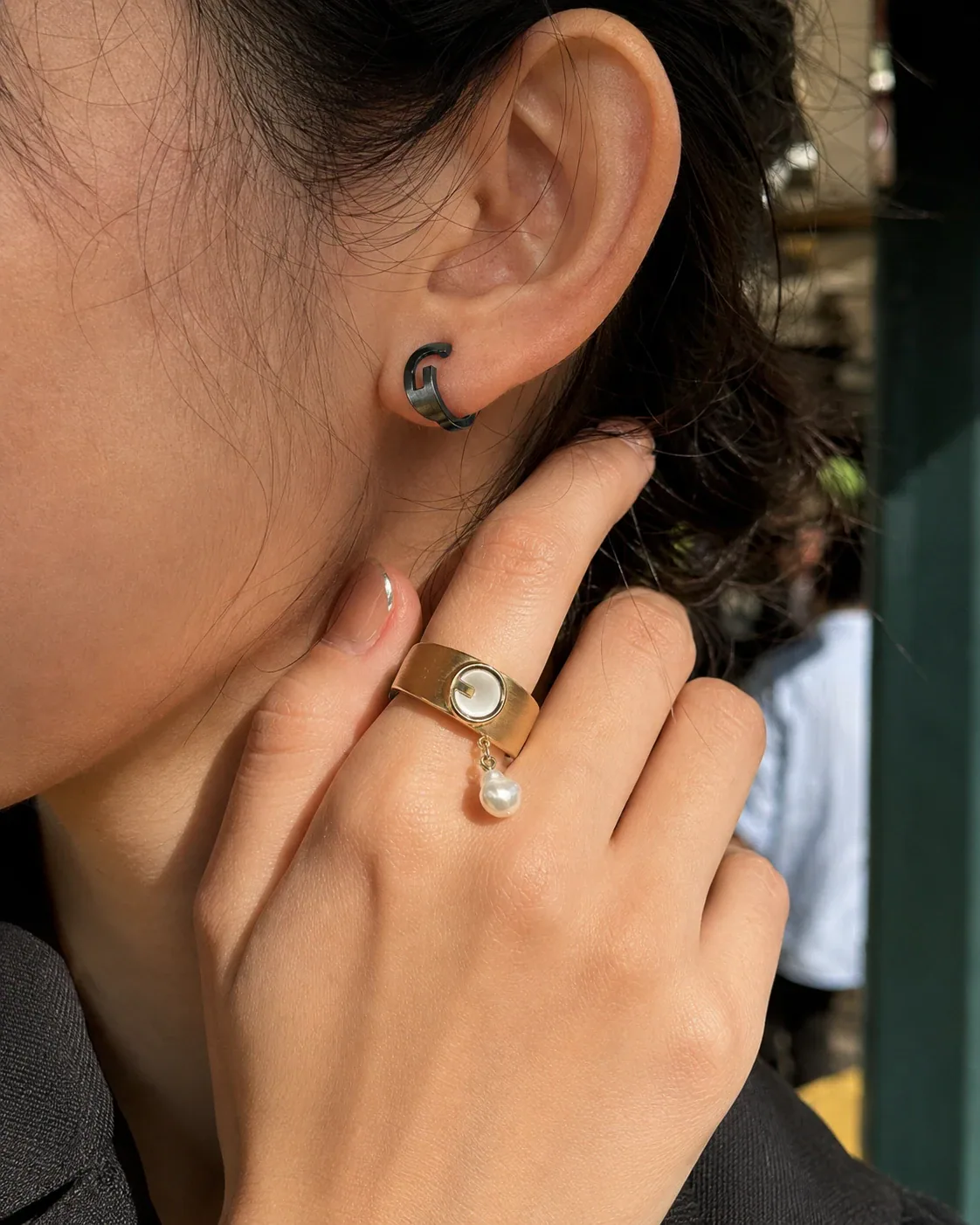
Some jewelry announces itself across a room. Other pieces begin at the thumb: a ring that asks to be turned, a small charm chain that catches against a sleeve, a pearl attachment that changes the edge of an ear. The second kind is not necessarily discreet. Its real audience is the wearer first.
A private talisman is an action, not a symbol
A talisman can mean many things, but its usefulness in design is physical. It invites rotation, rubbing, clasping or re-positioning. İTÄ’s Yarí İznik Whirl Ring is an official reference for a rotating-ring proposition. The product is its own work. Switchroom’s inference is that rotation gives a ring a second clock: it can be read by the person wearing it even when no one else notices.
That private reading changes scale. A large gemstone is not required; a ceramic disc, a ridged metal bezel, one pearl or a dark pivot can offer enough information to touch. The construction must still tolerate the hand’s real life—bag straps, a coffee cup, a coat pocket and the repeated unconscious movement of a thumb.
Contrast makes touch legible
The strongest tactile pieces often separate materials. A smooth ring shank can meet a matte ceramic rotor. A blackened chain can hold a polished charm. A pearl can interrupt a hard titanium route. This is not a prescription for a single Switchroom palette; it is a way of giving the hand distinct surfaces to read.

In the second design study, a striped ceramic ring, pearl ear loop and small silver hardware share the same close-range vocabulary. The hand is present because it tests the piece rather than presenting it like a product card. The image remains jewelry-led: the manicure is restrained, the model is adult, and the piece’s motion is the visual subject.
Chains can carry a private archive
Monica Rich Kosann’s official collections are a reference point for charm-chain language. A charm does not need to declare a biography. It can be a small permission to remember a room, a song, a departure gate, or the first evening in a new apartment. The editorial mistake is to load every link with a story. One or two specific interruptions are enough.
For daily wear, use a chain as a quiet route rather than a crowded display. Let the main charm sit where the hand can find it. Keep the clasp and counterweight honest. If the charm turns over constantly, that is a design problem to solve, not an imperfection to romanticize.
Pearl changes the temperature
Roseate’s Angela Cummings Seahorse earrings are a verified official reference for a sterling-silver ear construction with removable pearl attachment. The broader lesson is that pearl can lower the temperature of a technical look without making it precious by default. Against cobalt resin, brushed titanium or a dark chain, pearl becomes a point of soft light and a literal point of touch.

The final study holds that contrast at the ear: a large cobalt counterweight, a pearl and two titanium arcs trace a profile without requiring a full jewelry suite. This is a design research proposal, not a product promise. Its next test would be manufacture: post placement, pressure points, weight, surface durability and how the pearl is retained.
Choose a piece you will actually touch
Ask what your hand needs from the piece. Rotation? A pause at the collarbone? A light edge at the ear? Then choose one primary action and one supporting material contrast. A tactile piece should still read at arm’s length, but it earns its value in repeated close contact.
Read more material and styling notes in the Switchroom Journal, compare current pieces in the jewelry collections, and follow Room Key for future design field notes.
FAQ: What is tactile jewelry?
Tactile jewelry is designed to reward touch through rotation, texture, movement or an easily found attachment point. The visual form and the physical action should support each other.