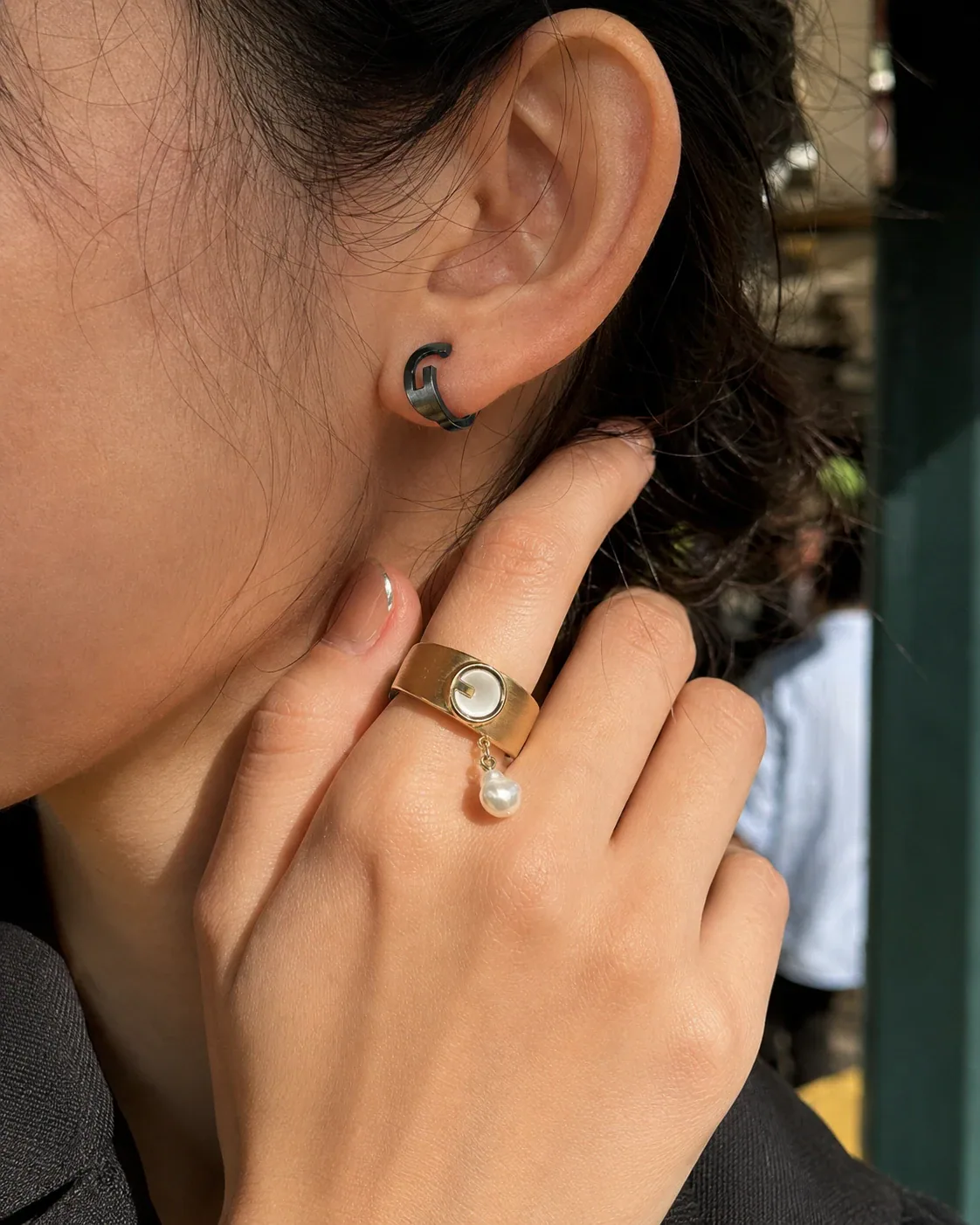
A piece of jewelry can change position without behaving like a costume change. It can close in for a subway platform, lengthen when a coat comes off, or migrate toward one ear when the rest of the body wants to stay quiet. The useful question is not how many configurations a piece can claim. It is whether each configuration has its own weight, gesture and reason to exist.
Three positions, not one trick
Convertible jewelry becomes convincing when it offers distinct body positions. A compact position sits close and survives hair, collars and movement. An extended position changes the line of the neck or shoulder. An offset position makes asymmetry intentional rather than accidental. These are design inferences from this week’s references, not claims about a market-wide rule.
Graff’s Artistry in Motion is a high-jewelry reference for transformation across brooch and pendant logic. Vhernier Freccia offers a separate modular direction. Neither should be reduced into a daily-wear template; their value here is permission to treat attachment, direction and proportion as visible design material.
Attachment should remain legible
A brooch that becomes a pendant needs more than a hidden conversion. The wearer should be able to read where the load begins, what stabilizes it, and why the altered position does not sag. The same goes for an ear attachment: a removable element must feel designed for the ear’s architecture, not added after the fact.
In the first Switchroom study, folded silver planes meet a dark-blue flexible collar and an oxblood cord. The cord does not decorate the approach; it changes tension between neck and shoulder. Its shape is intentionally different from a brooch-to-chain conversion: one is a surface held against clothing, the other is a line that pulls the body into the composition.

Courtney Leidy is included here as an official maker reference for cord-led jewelry. The lesson is tactile rather than literal: soft material can establish a structural route. The cord may be silk, leather or textile; what matters is that it is measured against a harder edge and a believable fastening.
Body positions are styling positions
Think in scenes. In the morning, keep the piece close to the ear or collarbone so that a phone, scarf and commuter bag do not compete with it. At a desk, allow one module to extend below a shirt opening or sit beside a bare wrist. At dinner, remove a pearl or shift a suspended segment to one side; do not add a second unrelated statement piece just to signal occasion.
The point is not day-to-night language. The same body has different spatial needs across a day, and the jewelry should meet them with a readable change. One strong ear construction can hold a white shirt, an oversized knit, or a narrow black dress more effectively than several small accessories trying to explain the same idea.
Small removable parts need a larger logic
Roseate’s Angela Cummings Seahorse earrings provide a concrete official reference for sterling silver and removable pearl attachment. The specific product remains its own work. Switchroom’s inference is broader: when a pearl or charm detaches, the remaining base must still look complete. The removed part should create a new silhouette, not a missing detail.

That is why a useful convertible piece begins with one stable anchor: an ear cuff, a brooch back, a collar seam or a ring shank. Then it gives the wearer one variable—not five. A cobalt resin counterweight can turn an ear construction into a clear profile; a pearl can soften the lower edge; a titanium arc can describe the route without requiring a matching necklace.
How to choose a convertible piece
Before choosing, test three things. First, can you identify the attachment point without an instruction card? Second, does the altered position leave a coherent piece behind? Third, would you still wear the compact state on an ordinary Wednesday? If the answer is yes, transformation has become a wearing language instead of a feature list.
Explore the evolving Switchroom Journal for more material studies, visit Boxes to see how pieces become rooms, and follow Room Key for future field notes and editions.
FAQ: What makes convertible jewelry feel intentional?
It needs a stable anchor, a legible attachment point and at least two positions that each look complete on the body. More functions do not automatically create more meaning.