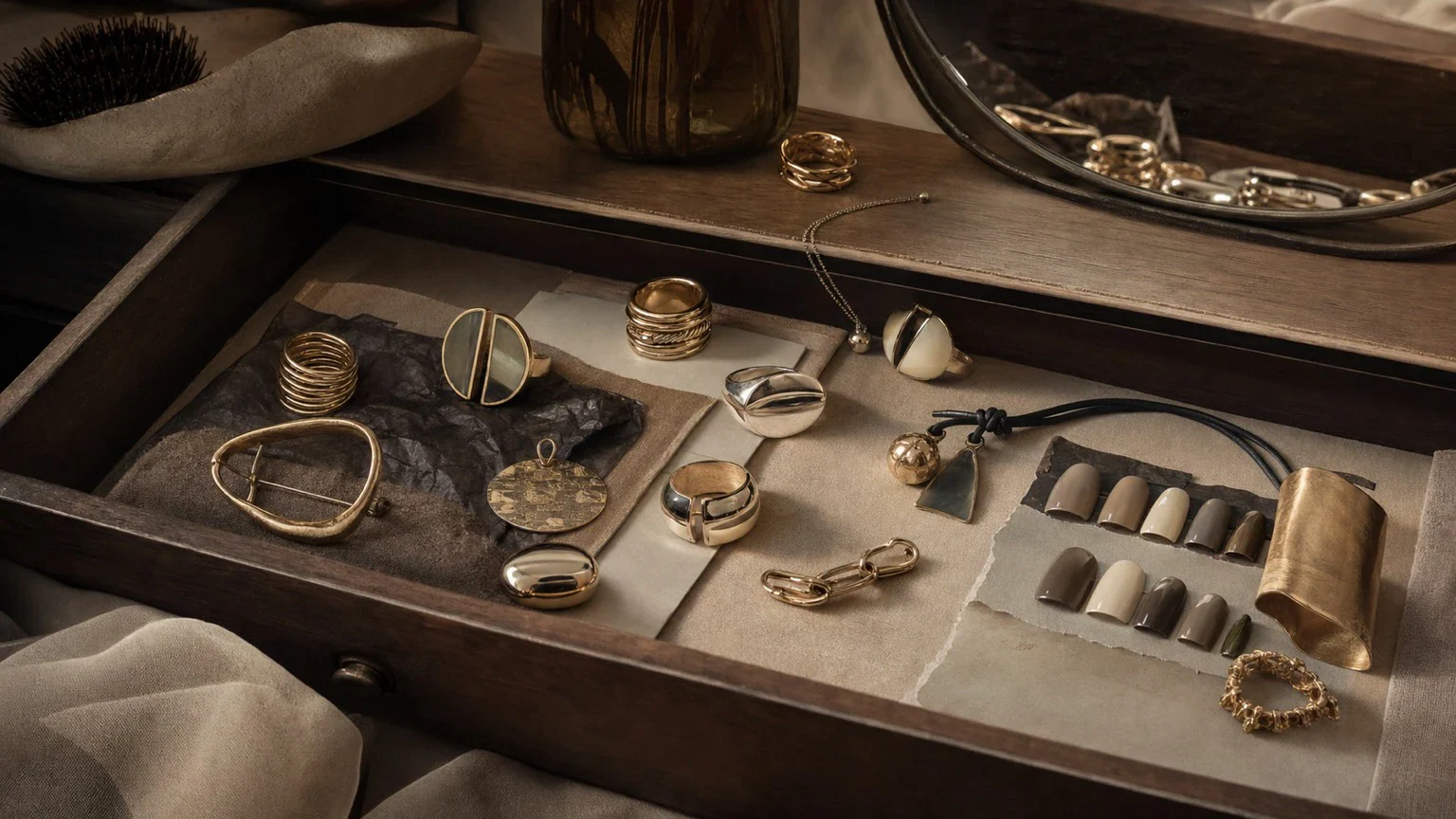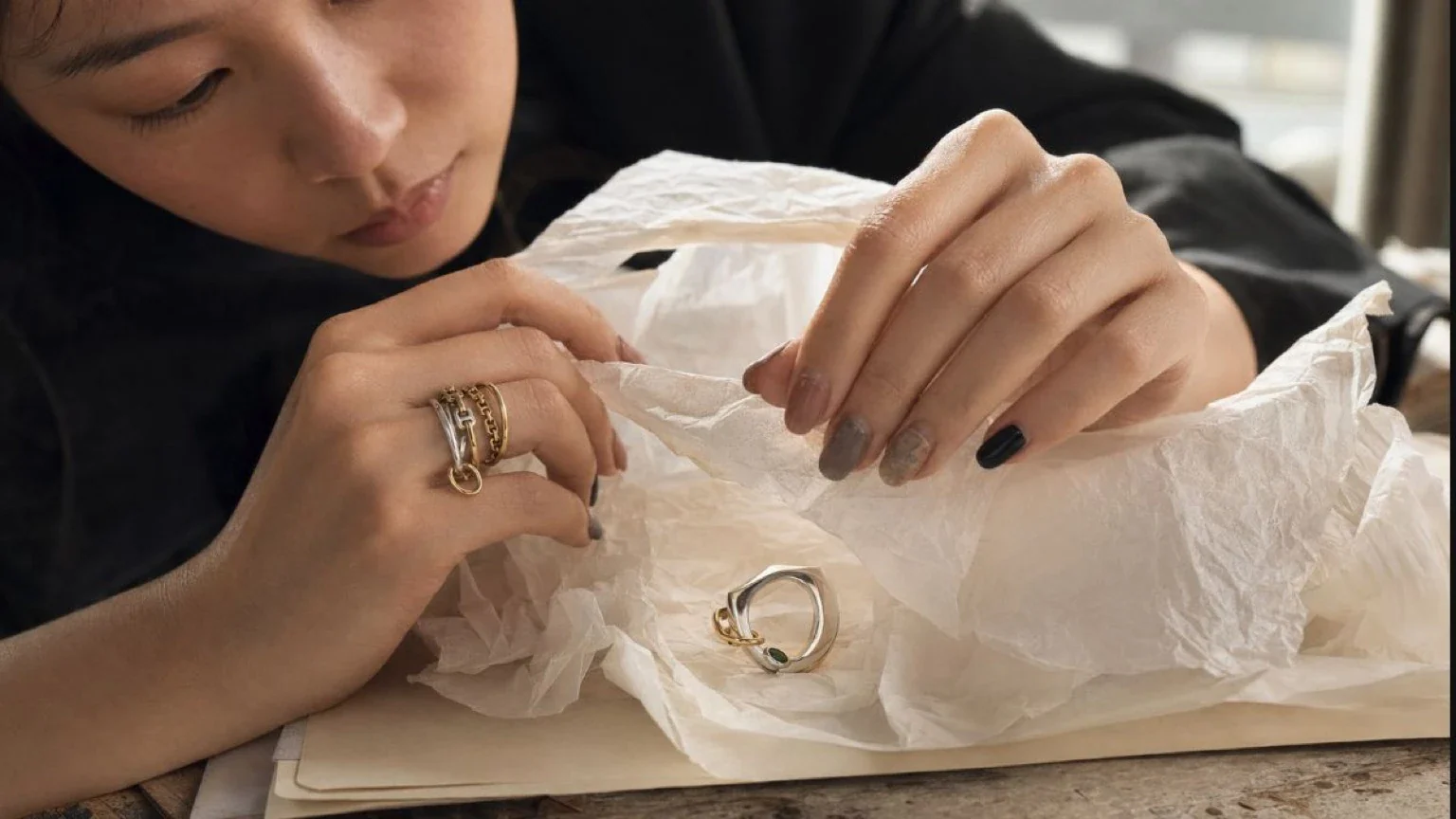
A meaningful shopping guide begins where the discount banner ends. The drawer is half open, the light is gray-warm, and one piece waits without performing desperation. The cultural question is not whether buying can be justified, but whether one piece can hold its place clearly enough to be worn again. We begin there: in the drawer, with one room, one gesture, one piece.
Meaningful Shopping Guide: Why Discount Is Too Small a Story
A lower number can be useful. It is not a point of view. When discount becomes the main character, taste is pushed backstage and urgency gets the best light. We would rather ask a sharper question: what piece will change the way your daily uniform enters the room?
This meaningful shopping guide is not anti-shopping. Switchroom makes pieces; we believe in pieces. We also believe a piece should earn its place. A brooch should move the eye. A charm should change the bag’s silhouette. A nail set should give the hand a new surface without asking the body to become a billboard.
The cleanest purchase is often the one that refuses excess. Not because minimal is morally superior, but because one piece can be read. When everything is accented, nothing is accent. When one lacquer edge cuts through taupe gray, the room knows where to begin.
The Drawer Is the Room You Meet Every Morning
The drawer tells the truth about what we use. It holds the pieces we reach for when there is no time to perform a whole theory. It also holds the almosts: pieces bought during noise, then abandoned because they never found a room.
We like the drawer as private architecture. A soft pouch, one piece with weight, a space around it. This is where Archive Pearl becomes more than a collection name; it becomes a way of thinking about continuity. Jewelry as a wearable archive—small, private, precise.
A meaningful shopping guide should make the drawer easier to open. If the new piece has no place to live, pause. If it belongs beside the pieces you already return to, continue. The drawer is not storage after the fact; it is part of the choice.
How to Buy One Piece That Changes Your Mood
Change the first gesture
We do not promise that a piece will transform your emotional life. We do not sell magic. But one piece can change the mood of a look when it changes the first gesture. A sculptural nail changes the hand on the table. A brooch changes where the shirt begins. A charm changes how the bag moves beside the body.
If the hand leads your day, begin with press-on nails as wearable sculpture or a finger-scale piece. If the shoulder line carries the look, begin with a brooch. If the daily bag is your portable room, begin with a charm. The first piece should meet the repeated gesture, not the fantasy version of a life you do not live.
Choose material before drama
Material is where mood becomes precise. Pearl quiets light. Chrome sharpens it. Lacquer holds color like a small architectural plane. Enamel gives a clean edge. Brushed metal lowers the volume. A meaningful shopping guide should ask what the material does before asking how loudly the piece announces itself.
Against mist gray, cobalt enamel reads exact. Against taupe gray, lacquer orange reads warm and awake. Against smoky ivory, jade feels deep rather than decorative. The piece changes the mood because the material changes the temperature of the room.
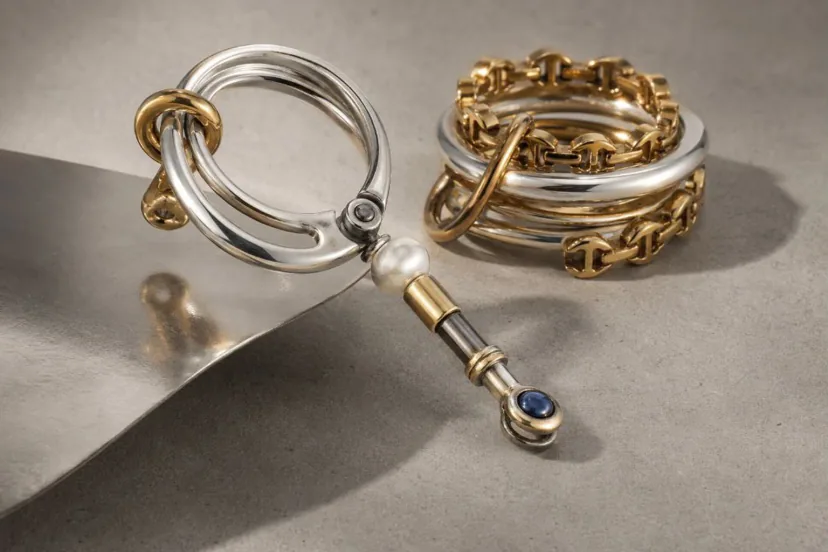
A Curatorial Paragraph: The Piece as Room Key
We do not ask a piece to perform a miracle. We ask it to hold its place. A pearl-gray ground, a lacquer-orange edge, a small chrome hinge, a jade mark no larger than a breath: this is enough architecture for a mood to enter. The piece is Room Key, not label; access, not costume.
That is why one good piece can feel larger than five weak ones. It creates a turning point. It lets you step from office to dinner, from errand to gallery, from public room to private room, without changing the whole skin of the day.
Shop or wait?
If you cannot name the room, wait
If the piece is only interesting because the moment is loud, let it stay outside the drawer. Name the room first: Mirror, Chocolate, Archive, pearl, shadow, smoke, corridor, backstage. The name does not have to be literal. It has to be useful.
If your wardrobe is mostly gray, black, white, and denim, choose one vivid accent
This is the easiest place to begin. Neutral wardrobes are not empty; they are ready. Choose cobalt for precision, jade for depth, ruby for intimacy, lacquer orange for heat, peacock for movement. Keep the accent visible as one focused accent.
If statement pieces fail you, choose touchable material before scale
A smaller piece in better material often works harder than a large piece with no surface intelligence. Choose pearl, chrome, enamel, lacquer, leather, silk, brushed metal, or stone color because you know how it behaves against your clothes.
If you want surprise, choose bounded curation
Surprise is useful when it has walls. Mood Boxes can help if you know the room but do not want to choose every detail. That is different from handing your taste to chance. It is a collaboration with limits.
If the piece has no drawer, wait
This is the least glamorous rule and possibly the most useful. If you cannot imagine where the piece lives, how it is stored, what it touches, and when it leaves the house, it is not ready to enter.
The Proportion Rule: One Sculpture, Ten Percent Signal
The first piece needs enough scale to be legible. We call this the one-sculpture rule: one piece gets to carry the room before smaller companions arrive. The vivid accent should usually sit around a focused accent of the look. This is not mathematics for its own sake; it is visual mercy.
Too little accent and the piece becomes shy. Too much and the room becomes a costume. A cobalt enamel detail on chrome can be small because chrome catches motion. A matte jade piece may need more scale because it absorbs light. A lacquer orange edge can be narrow and still cut through taupe because lacquer carries depth.

Sustainability Is a Practice, Not a Mood Board
A meaningful shopping guide has to include what happens after the piece arrives. Will you wear it repeatedly? Can you store it safely? Do you understand the material? Can it be cared for, repaired, or kept in use instead of replaced by the next noise?
We do not use sustainability as perfume. We prefer specific practices: responsible material choices where verified, small-batch discipline, care instructions, repair thinking, honest language, and fewer pieces asked to do more. For material notes, start with our Materials page. For the broader line we draw around care, consent, and claims, read Our Ethics.
Buying one piece can be more demanding than buying five. It asks you to know what repeats. It asks you to choose the accent that will still make sense after the shopping season has left the room.
Where to Go Next If One Piece Is Enough
If you want the practical hand-first guide, read the 618 entry point guide. If you want formulas, use the Starter Mood Box guide. If the room, material, and first gesture are already clear, enter the Shop with restraint. If not, waiting is also a choice with taste.
FAQ
Is this a meaningful shopping guide or a no-shopping guide?
It is a meaningful shopping guide. We are not against buying; we are against letting urgency replace taste. Buy when the room, piece, material, and use case are clear.
Can one piece really change your mood?
One piece can change the mood of a look when it changes gesture, focus, proportion, or material temperature. We do not promise emotional results; we offer a styling method.
How do I know whether to shop or wait?
Shop when you can name the room, the neutral base, the vivid accent, and the first place you will wear the piece. Wait when the answer is only pressure or novelty.
What piece should I buy first?
Buy the piece connected to your repeated gesture: nails or finger-scale work for hands, a charm for a daily bag, a brooch for repeated clothing, or a Mood Box when you want guided curation. That is the meaningful shopping guide in one sentence: one piece, one room, one reason to return.