Why Quality Jewelry Is About Materials You Can Feel, Not Just See
Over the past few years, jewelry has become increasingly screen-ready—styled, lit, and polished to look flawless on camera. At Switchroom, we believe real luxury isn’t just what you see; it’s what you feel. The best quality jewelry pieces go beyond the photo: they have weight, texture, and presence—meant to be worn, touched, and lived in, not just admired on a feed.
For a while, that “flawless” standard is intoxicating. Soon you start measuring everything by how it looks through a lens:
- Does it catch the light in one perfect flare?
- Is the surface mirror-smooth?
- Can you spin it in 3D and never spot a single imperfection?
But jewelry was never meant to live on glass.
A screen can show you the sparkle, but it can’t show you the weight. It can’t capture the cool bite of metal the first time you slip it on—or the quiet way a ring warms against your skin, until it stops feeling like something you’re wearing and starts feeling like part of you.
Your phone doesn’t know the difference between a clasp that’s just “good enough” for a still image and a clasp that feels satisfying every single time you fasten it—a tiny, confident click that tells you, without looking, “You’re secure.”
Your skin does.
Digital perfection can wipe away the human trace. Hand finishing, tiny tool marks, the barely-there unevenness in a stone setting—your eyes might not linger on them, but your body reads them as real. They’re the quiet signatures that make a piece feel made by someone, not processed by a pipeline.
Online, jewelry is optimized for the swipe: catch attention, hold for three seconds, move on. In the real world, it’s optimized for repetition: how it feels the 500th time you buckle it, whether you can close it half-asleep in the dark, whether it still feels like you when trends shift.
So there’s a quiet conflict now:
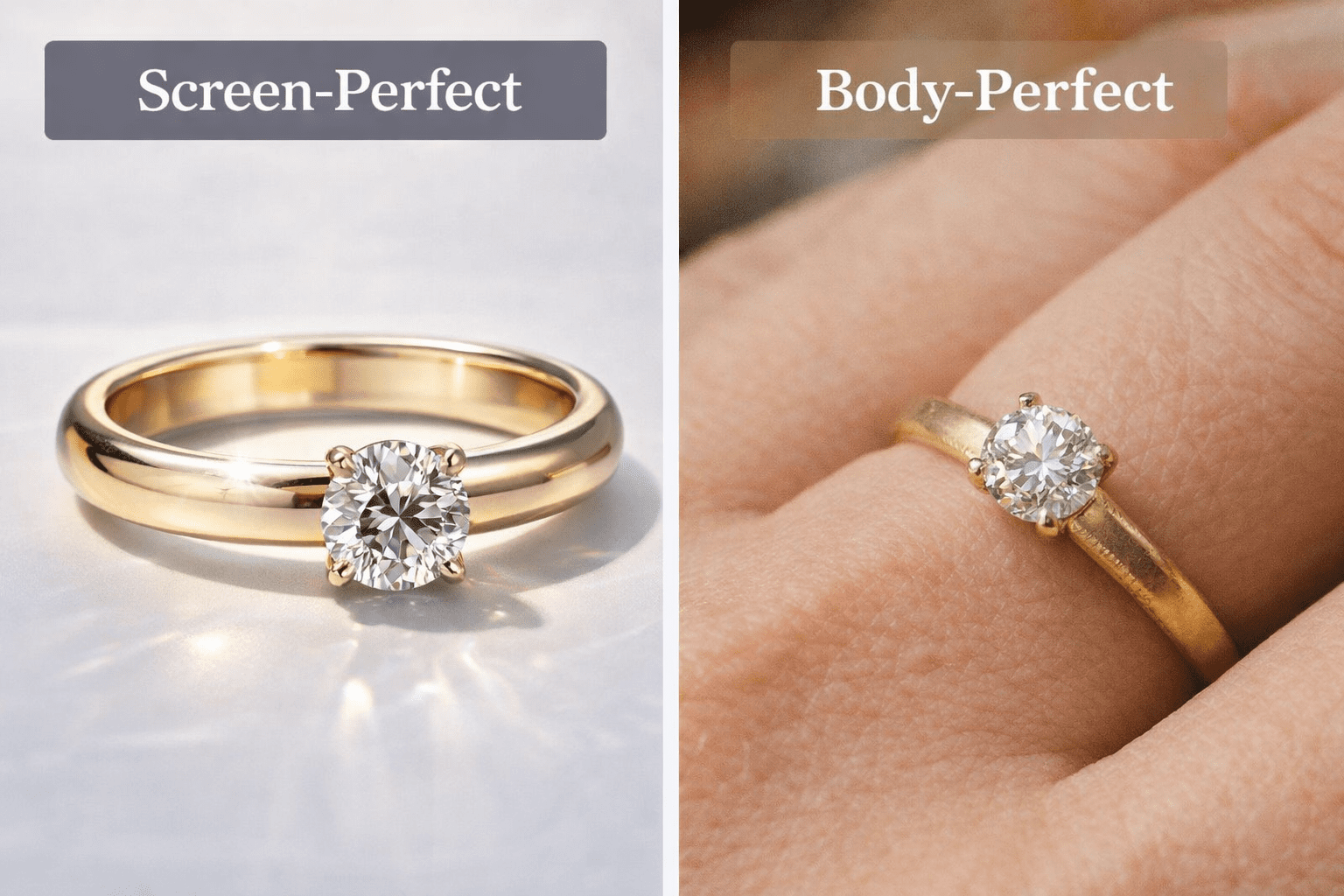
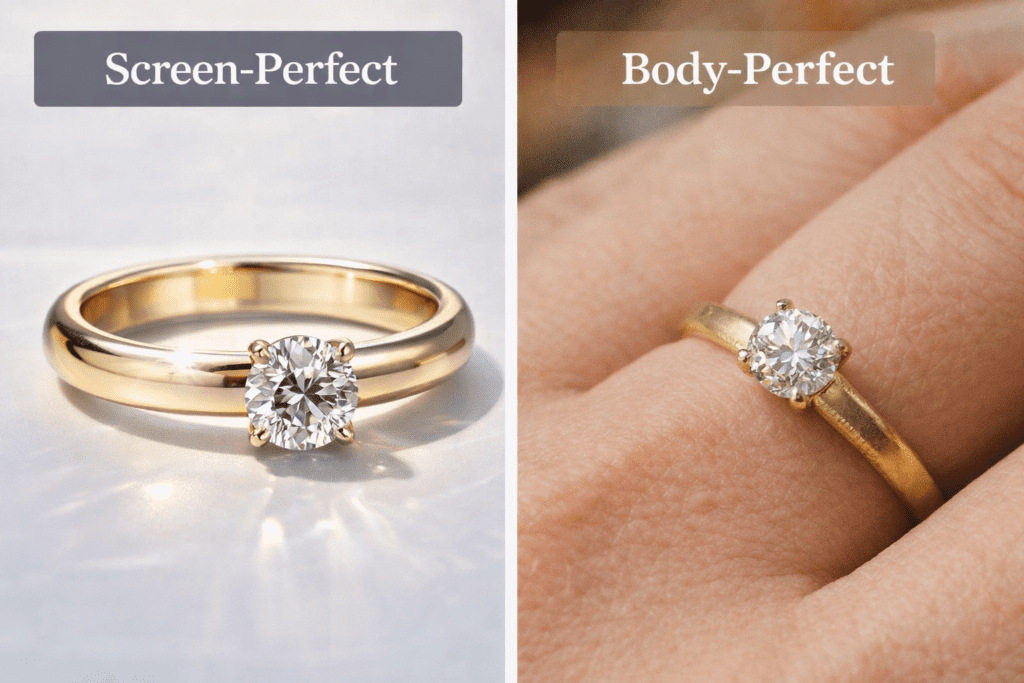
- Screen-perfection: identical hands, frictionless surfaces, impossible light.
- Body-perfection: balance, comfort, tactile pleasure, the way it settles into your daily movements.
Your phone only measures the first.
Your skin, your muscles, and your daily habits reveal the second.
Choosing jewelry based only on how it looks on a screen means you’re judging it with the wrong sense. You end up designing for the algorithm’s gaze—not for the real body that will wear it, move with it, and feel it every day.
True luxury isn’t how perfect something looks when you zoom in to 300%.
It’s how effortlessly right it feels when you slip it on—especially when no one’s watching.
The problem: jewelry that only looks good on screen
Scroll any feed and you’ll see hundreds of pieces that look almost identical: • unrealistically smooth “gold” • no visible joins, no hint of weight • prices that tell you the base metal is probably a mystery
A lot of brands quietly rely on this distance. As long as the piece survives the photoshoot and the first week, it’s “good enough”.
Some brands do go further, building entire material libraries and complete guides about 14k gold, gold vermeil, recycled metals and care routines, because they know that educated customers feel the difference between marketing language and actual alloy percentages. 
But most of the fast content you see isn’t interested in your long-term relationship with the piece. It just wants your tap.
If you’re interested in the materials and craftsmanship behind our jewelry, Explore the Materials and Craft Story of Switchroom to learn about our choices and philosophy.”
What “tactile quality” actually means
This is one of the fastest ways to tell if a piece is quality jewelry, long before you read the product description.
When I talk about “the feel” of a piece, I don’t mean luxury for luxury’s sake.
I mean very concrete things your body can register in one second:
• Weight. Real metal has gravity. sterling silver, gold-filled – each has a different density. Your fingers know when something feels hollow.
• Temperature. Metal that has real mass takes a moment to warm up against your skin. Plastic doesn’t.
• Texture. Is the surface too perfect, like it’s been sprayed on? Or can you sense the soft edges where it’s been cast, filed, polished?
• Movement. A clasp that clicks with a tiny snap instead of a vague bend; a chain that drapes rather than twists.
Some heritage brands openly call their main material a “living” one — untreated brass that slowly develops a patina over years, not weeks.
That’s tactile quality: the metal keeps talking back to you over time.
To ensure your jewelry retains its tactile qualities and appearance, Learn How to Care for Your Jewelry.
Materials you can feel: from Stainless steel to 14K gold-filled
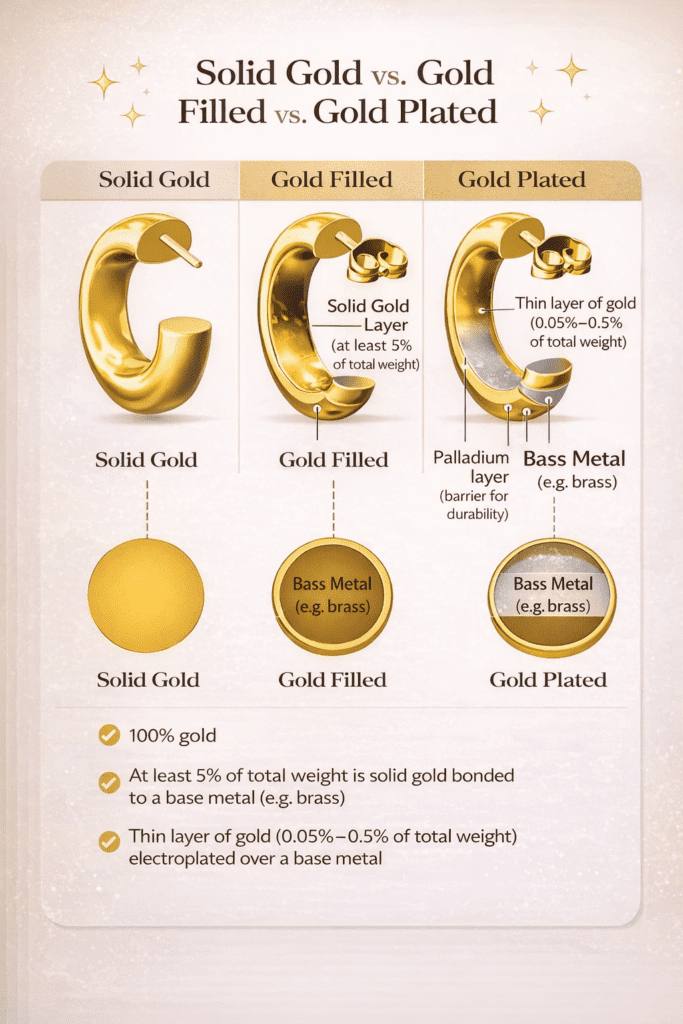
Our material selection spans from gold-plated stainless steel to 18K gold vermeil, 14K and 18K gold-filled, and even solid 14K/18K gold. We also incorporate natural pearls, genuine gemstones, and lab-grown diamonds and gemstones.
Stainless steel also tends to be more hypoallergenic than many base metals commonly used in fashion jewelry. For those with sensitive skin, this makes a noticeable difference in comfort and confidence—pieces feel good to wear all day, not just look good
Gold vermeil isn’t just about shine — the thickness and base material also affect how jewelry ages and feels over time. For an approachable explanation with care tips and material context, see Gold vermeil jewelry explained by GQ
By combining this sturdy base metal with gold plating, we’re able to offer quality jewelry materials that have the look and feel of fine pieces, but at a price that makes sense for an entry-level subscription box.
Switchroom is not here to shout “buy solid gold or nothing.”
It’s here to offer a quieter, more grounded alternative: to say that wanting substance—without needing perfection or pedigree—is valid.
That’s what “the room is holding” means here.
It means the standard is not status; it’s continuity.
Not luxury; but longevity of feeling.
Switchroom isn’t about pressuring you into “forever purchases” in solid gold, nor about dismissing more accessible materials as lesser. It’s about this question:
Will this still feel honest, reassuring, and quietly satisfying when the novelty has worn off?
If the answer is yes—if, years from now, that absent-minded gesture is met with a sense of calm rather than disappointment—then the room has done what it promised.
How can I tell if jewelry is good quality?
A quick checklist: weight that doesn’t feel hollow, clasps that close with a clean click, honest labeling of materials (brass, sterling silver, gold-filled or gold vermeil), and surfaces that keep their finish longer than just a few wears.

The red flag for me is not “non-precious metal”. It’s pretending: plating so thin it vanishes in a month, base metals that turn fingers green, chains that feel like painted air.
Ethical brands that talk openly about recycled silver, recycled gold and fair labor are, in a way, all circling the same point:
materials have consequences — environmental, social, and tactile.
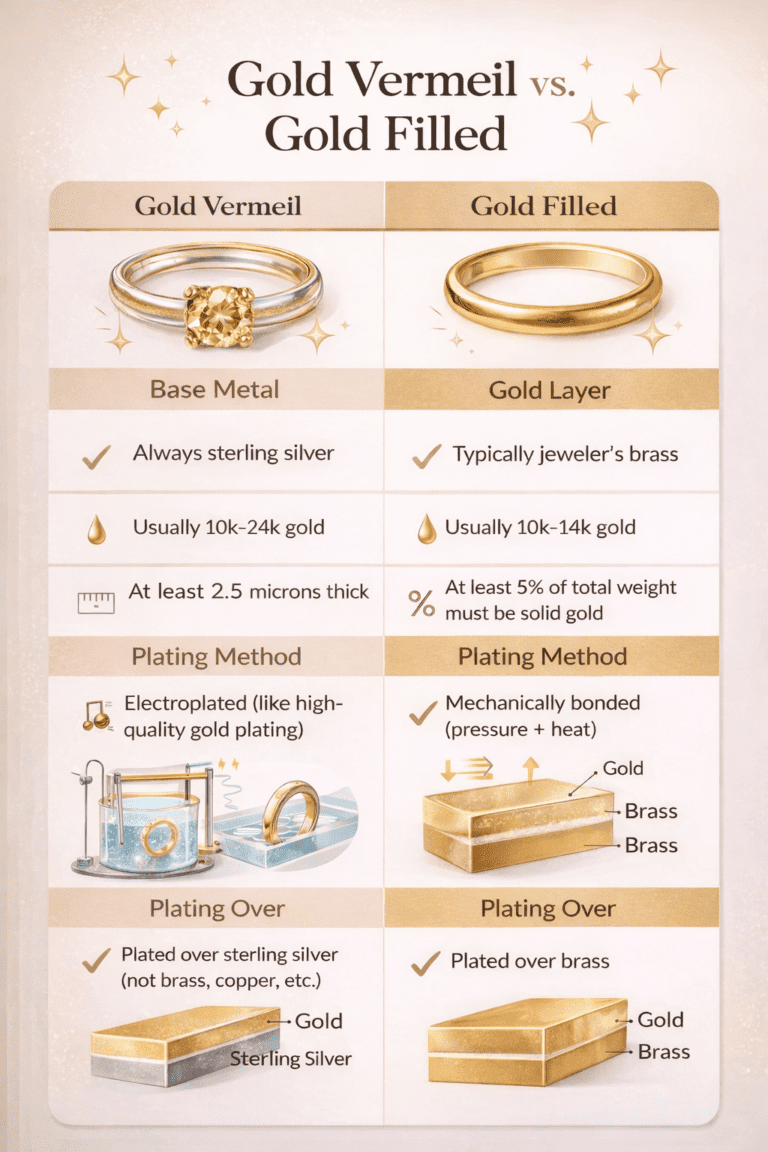
Gold Vermeil vs gold filled, which is better?
When comparing gold vermeil and gold‑filled jewelry, “better” depends on what you care about most: durability, price, skin sensitivity, or appearance. For a clear explanation of the material differences and practical pros/cons, see this Gold vermeil vs gold filled difference explained overview from a jewelry brand.
What each one actually is
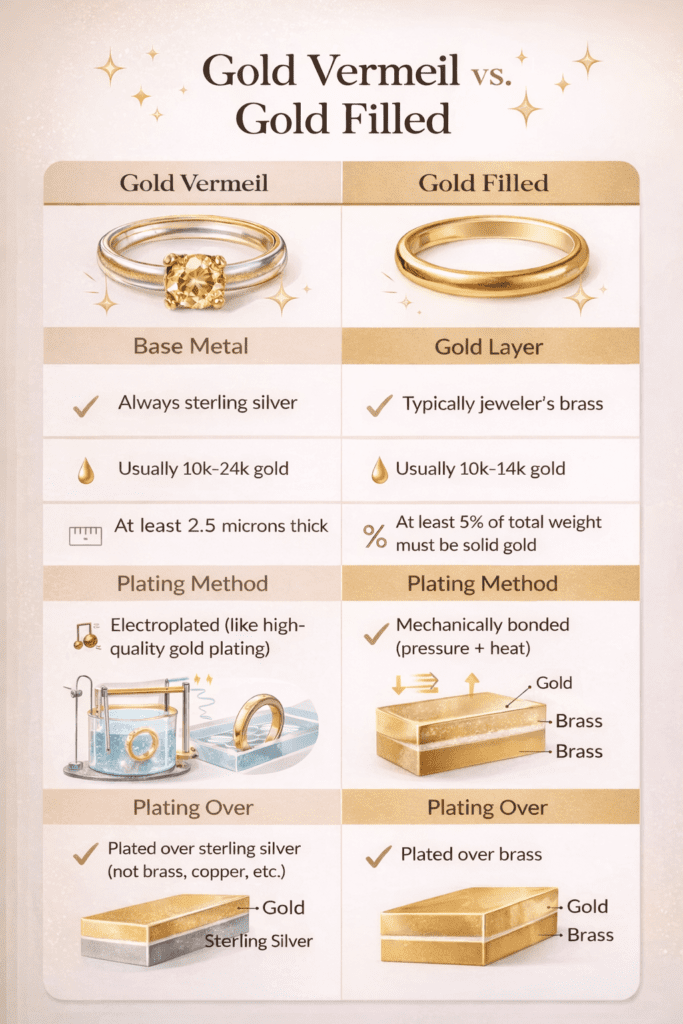
Gold‑filled jewelry is created by bonding a thick layer of gold to a base metal, often making up at least 5% of the piece’s weight — learn more about how this standard is regulated and what it means in practice in this gold‑filled jewelry overview. 
Tarnish behavior
Gold-filled
- The gold surface itself doesn’t tarnish.
- Over many years, if the gold wears through in small areas, the brass underneath can tarnish—but with good-quality pieces and normal wear, this can take a long time.
Gold vermeil
- Gold doesn’t tarnish, but the sterling silver underneath can.
- If the vermeil layer is thin or worn, you may see slight darkening where silver is exposed or close to edges.
If you tell me what matters most to you (budget, skin sensitivity, type of jewelry, how often you’ll wear it), I can give a direct recommendation between gold-filled and vermeil for your specific situation.
Explore the difference between gold vermeil and gold filled
Craftsmanship as time made visible
Handcraft is not about romanticizing “imperfection”. It’s about time that refuses to be completely erased.

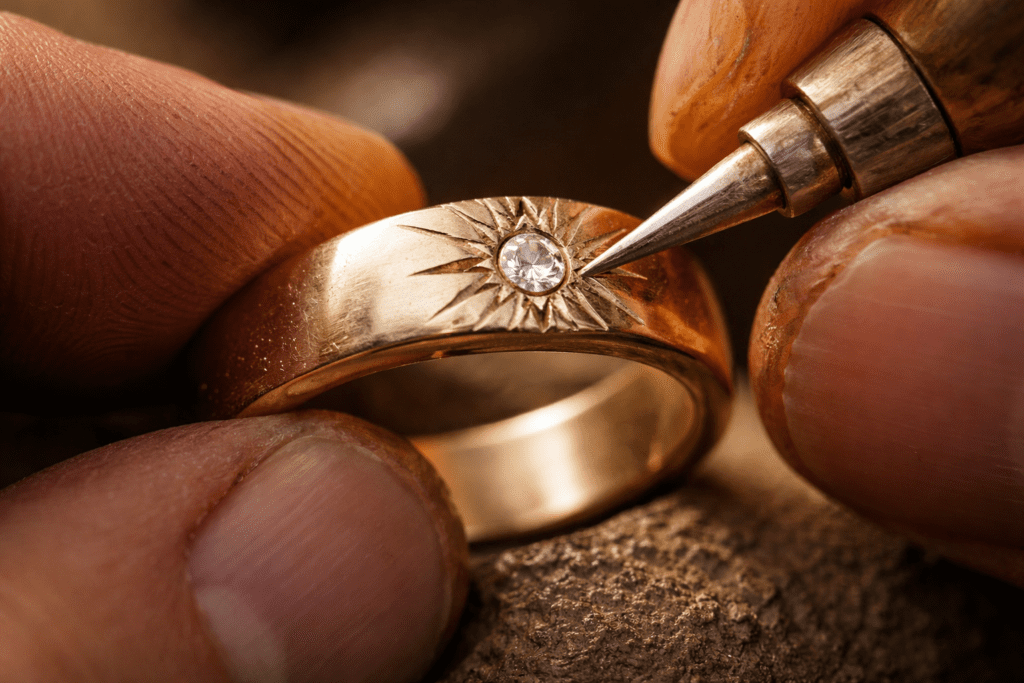
You can often sense: • slightly thicker junctions where a ring has been soldered • a curve that follows the logic of a hand, not just a CAD spline • a subtle irregularity in engravings that tells you a human held the tool
Some brands tell long stories about centuries-old foundries, meteorites and historical chandeliers to explain why their brass objects feel the way they do. 
How to train your hands to recognize quality
If you’ve been surrounded by fast jewelry for years, your hands might be a little out of practice. Here are a few small experiments:
1. Compare weight. Hold one of your lightest “mystery metal” rings in one hand, and a solid silver or brass ring in the other. Close your eyes. Which one feels like it will still be here in five years?
2. Check the edges. Run your fingertip along the inside of a band. Is it knife-sharp, or has someone softened the inner edge so it’s comfortable over time?
3. Listen to the clasp. Real clasps have a tiny sound — a click, a snap — instead of a vague bend.
4. Notice the temperature over an hour. Does the metal slowly warm and adapt to your skin, or does it stay strangely neutral, like coated plastic?
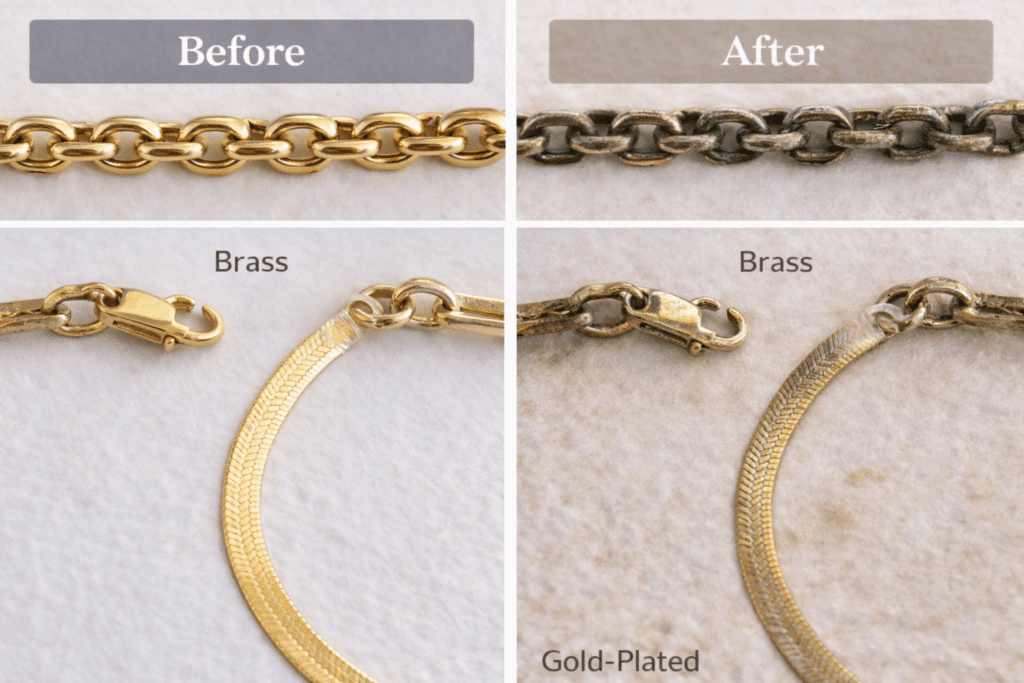
5. Watch how it ages. Good brass and silver will change, but they change in a way you can polish or embrace; bad plating just flakes.
You don’t need to memorize every metal composition chart.
You just need to start trusting what your body already knows.
Closing: tiny rooms you wear every day
Switchroom isn’t about preaching purity or perfection. It’s not here to declare that anything less than solid gold is a mistake, or that you have to buy heirloom-level pieces to have “good taste.”
It’s here to make a quieter, more grounded promise:
Your senses are not naïve.
You actually can tell the difference between something that’s merely shiny and something that’s genuinely well-made. The coolness of metal against your skin, the way a chain settles on your collarbone, the tiny resistance in a good hinge—these are things your body notices even when your brain isn’t trying to. Switchroom starts from the belief that your intuition about “this feels right” is worth honoring.
You’re allowed to want jewelry that feels as real as it looks.
Much of what’s sold today is designed for the photo: high polish, heavy branding, flattering under bright lights—then it shows up and feels hollow, tinny, disposable.
Switchroom exists in opposition to that.
Whether a piece is solid gold, gold-fill, or another carefully chosen material, our standard is simple: does it live up to what it promised when you first saw it? When you hold it, does it have presence, integrity—a quiet, grounded confidence you can actually feel?
You’re allowed to care about patina, weight, and the quiet satisfaction of a well-made clasp.
These details aren’t fussy; they’re the whole point.
Patina: how a surface softens and deepens with time, telling a story instead of just wearing out.
Weight: not heaviness for its own sake, but that subtle density that says, “I’m really here.”
The clasp: the tiny piece you touch every single time you put it on, the moment when you either trust the piece or don’t.
Caring about these things is not being “extra”—it’s acknowledging that jewelry is something you live with, not just something you post once.
When I design or curate a piece, I’m not picturing it on a plinth or in a product shot. I imagine it in motion, half-forgotten, folded into the background of someone’s ordinary life:
- A ring being turned round and round during a long phone call, warmth building between metal and skin.
- A pendant being traced absentmindedly while waiting for a train, the edge familiar under the fingertip.
- A bracelet shifted up and down the wrist in a meeting, the faint sound of links moving like a private metronome.
Jewelry lives in these in-between moments—when you’re not “styling” yourself, not performing, just thinking about something else entirely. That’s where the truth of the material shows up.
If, in that small, distracted moment—years from now—the piece still feels reassuring in the hand, still has its weight, its integrity, its quiet click of a clasp that works every time…
If it doesn’t betray you by feeling flimsy, sharp, tinny, or fake…
Then the room is holding.
That’s what Switchroom is here to protect: the continuity between what you see, what you expect, and what you actually experience every day. Not maximalism, not moralizing—just the simple dignity of an object that keeps its promise over time.
Explore our curated pieces at Switchroom, designed to offer more than just a perfect photograph. Discover jewelry that feels as good as it looks and resonates with you every day.