Ritual jewelry vs Scam: The Cursed Jewelry Scam Problem
Jewelry has always been a little bit ritual: close to the skin, touched daily, charged with memory, worn through thresholds. We love ritual jewelry, that’s the romance. But that closeness is also why the cursed jewelry scam works: the object already feels meaningful, so it’s easy for someone to sell you a story you can’t verify—then make you pay to escape it.
Our position is simple: keep the ritual (transition, care, emotion). Delete the coercion (curses, urgency traps, unverifiable claims, escalating payments). And design the kind of wearable art that never requires blind faith.
One-line thesis
Jewelry is a perfect ritual object—which makes it a perfect scam surface—so our job is to keep the ritual and remove the pressure tactics.
Why jewelry is the ultimate ritual object (and why that’s not embarrassing)
Jewelry isn’t just decoration. It’s contact. Weight. Temperature. The small, repeating gesture of fastening something to yourself—like a private stage cue you can do in public.
That’s why jewelry is so good at marking transitions: a new job, a new city, a new relationship with your own body, a decision you’re not ready to narrate out loud. We don’t need supernatural claims for that to be real. We just need the object to be well-made, wearable, and honest about what it is.
And to be clear: meaning-making with objects is not niche behavior. Pew Research Center’s data on beliefs that crystals, jewels, and stones can hold spiritual energy shows this language is culturally legible at scale. That’s not an invitation to sell certainty—it’s a reminder to design with responsibility.
If you want a longer lineage for ‘intimate objects,’ we love the historical precedent: From hairwork mourning jewelry to today’s bio-jewelry. People have always built wearable containers for grief, devotion, and memory. The ethical question is how you treat that vulnerability.
Why now: wellness language went mainstream—and scammers noticed
Two things are true at once:
- More people are fluent in spiritual/wellness language—even if they use it playfully.
- Platforms reward emotional intensity, not verification.
Pew’s 2025 reporting suggests a massive ‘soft entrance’ into the ritual ecosystem: Pew Research Center’s 2025 report on astrology, tarot, and fortune-telling use (and many participants frame it as “just for fun”). In other words: ritual can be casual, aesthetic, and non-totalizing—more like lighting a candle than signing a contract.
At the same time, we’re watching a platform-era upgrade in persuasion tactics. Fast Company’s reporting on deepfake scammers hijacking TikTok’s wellness craze and Media Matters’ documentation of deepfake/AI-generated influencer-style wellness promotions on TikTok map the same pressure point: aesthetics + urgency + a face you ‘trust’—even if the face isn’t real.
This is why we keep talking about receipts. Not because it’s cynical. Because it’s affectionate. Because we want you to enjoy the vibe without paying a private tax in anxiety.
The “cleansing economy”: how ritual Jewelry becomes a monetization machine
Let’s name the mechanics with calm precision. The scam pattern is rarely “we sell jewelry.” It’s “we sell a story that makes you dependent on us.”
1) The diagnosis trap
Someone tells you an invisible problem exists—your ring is cursed, your pendant is “blocked,” your energy is “attacked.” The important detail is structural: only they can see the problem, and only they can fix it.
2) The urgency trap
Next comes the countdown. You must cleanse now. If you wait, something bad escalates. This is the opposite of care. Care gives you time.
3) The escalation loop
Once you pay, the story evolves. Stronger rituals cost more. Another “layer” is revealed. The fees stack. Your autonomy shrinks.
This isn’t a niche narrative; it’s a well-documented scam script. The U.S. Postal Inspection Service’s description of the ‘psychic scam’ pattern explicitly describes curse/bad-luck claims tied to requests for money—often escalating over time.
If you want a clean litmus test: ethical ritual leaves you more spacious than you started. Coercive ritual leaves you smaller.
A jewelry-native case study: “your jewelry is cursed” → hand it over
We’re going to handle this carefully: not to sensationalize, and not to imply that spiritual practice is inherently fraudulent. This is about a specific fraud pattern, documented by multiple outlets, that uses jewelry’s intimacy as leverage.
In 2025, multiple reports described an Austrian self-styled shaman accused of defrauding victims by persuading them valuables needed “cleansing” rituals. Euronews reporting on the Austrian self-styled shaman case outlines allegations of large-scale fraud tied to cleansing narratives, while JCK’s jewelry-industry recap of the ‘cursed jewelry’ cleansing story reflects how the case traveled through jewelry-world discourse.
When we reference this, we’re not doing “true crime jewelry.” We’re holding up a mirror: jewelry’s meaning can be weaponized. If someone can convince you your heirloom is dangerous, they can convince you to surrender it.
For an additional layer of verification that this was treated as a serious cross-border pursuit, we point to Europe’s Most Wanted (EU Most Wanted) listing context. Again: we’re not trading in drama. We’re insisting on the distinction between personal belief and coercive fraud.
The Gen Z contradiction: “I want ritual, but don’t manipulate me”
We recognize the aesthetic desire. We share it. We also share the allergy to being played.
It matters that many people treat astrology/tarot as a form of play—an interpretive lens, not a binding verdict. That’s one reason we value the way Pew frames participation in this space. Pew Research Center’s 2025 report on astrology, tarot, and fortune-telling use helps explain why ritual language is a common, low-stakes entry point.
Then the platform reality hits: deepfakes, synthetic influencers, and “storytime” persuasion formats. The point isn’t to panic; it’s to adjust our standards. If a face can be generated, then trust has to be earned with traceable details—materials, care instructions, return/repair policies, and boundaries about what a brand will not claim.
If you want our deeper take on receipts culture, this is the dedicated chapter: Gen Z’s idea of real: show receipts, not mysticism.
Cursed jewelry scam literacy: what we refuse to sell
We’re a wearable-art brand. We love ritual. We don’t sell spiritual emergencies.
- We don’t sell curses. We don’t diagnose invisible threats. We don’t position ourselves as the only exit.
- We don’t sell supernatural guarantees. No “activated,” “cleared,” “heals,” “protects,” or “manifestation promised.”
- We do sell craft, design, and clarity. Materials that are named, finishes that are explained, wear that’s described honestly.
Material honesty is part of our design vocabulary. If you’re buying plated pieces anywhere (us included), understanding what plating is—and how it ages—is a form of consent. Start here: Gold plating explained: what it is, how it wears, and how to make it last.
Switchroom’s design stance: ritual Jewelry without scam (our rules)
1) Transition ritual Jewelry: opening the box as a “switch rooms” moment
Our core thesis is “portable installations”: small objects that let you switch rooms—personas, moods, tempos—without losing integrity. A curated box drop can be a threshold: you open it, you choose, you set the tone. That’s ritual as choreography, not coercion.
2) Receipts-based magic: we give meaning, not guarantees
Absolutely! Here’s an expanded version of the original point:
We’re not here to take the magic out of jewelry. In fact, we’re here to honor it.
Jewelry has always been personal—an expression of love, identity, memory, and celebration. A treasured heirloom. A bold statement. A quiet reminder. It’s more than adornment; it’s emotion made tangible.
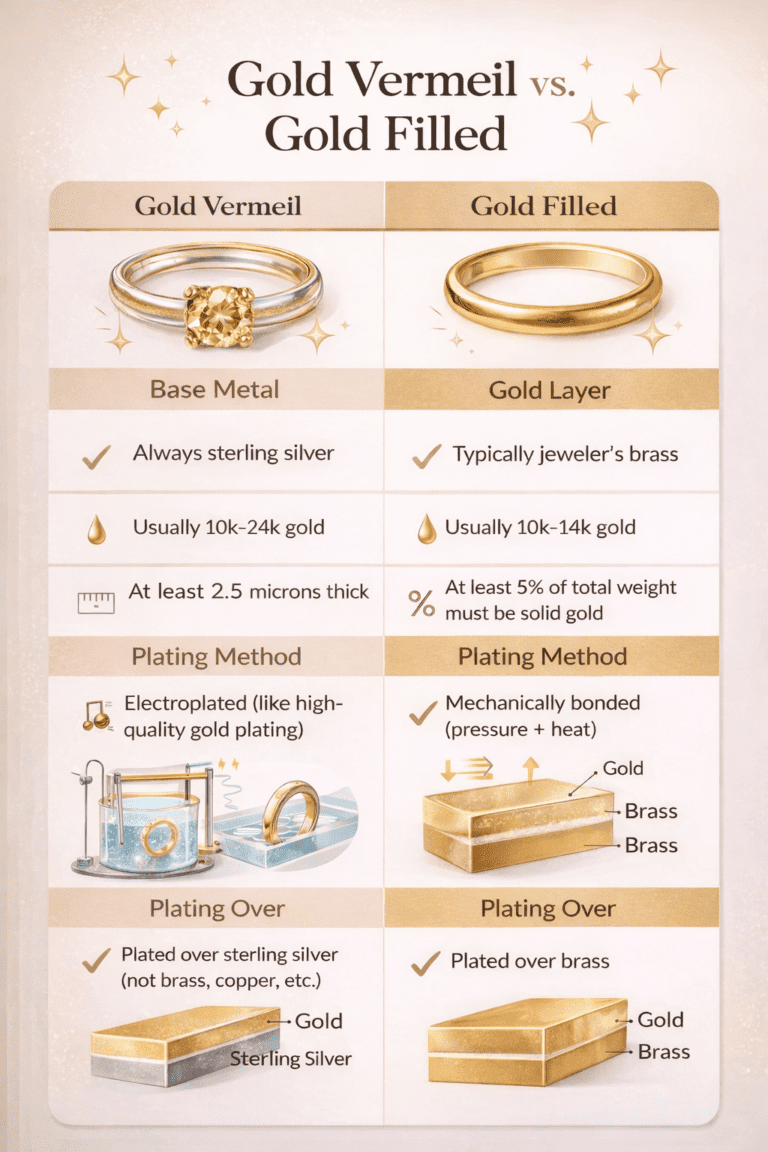
We celebrate that. But we also believe that beauty shouldn’t be mysterious. We’re here to bring clarity—transparency about what each piece is made of, whether it’s solid gold, gold vermeil, or plated. We explain why those differences matter, and how they affect a piece’s quality, longevity, and value.
We invite you to see the craftsmanship behind the shine—the techniques that create a mirror finish or a soft patina, the thoughtful design that ensures every piece moves with you, feels good on your body, and lasts for years if properly cared for. And yes, we’ll show you exactly how to do that, too.
Because understanding what makes a piece special doesn’t strip away its magic—it deepens your connection to it. It turns beauty into meaning, and meaning into something you’ll want to pass on.
That’s the kind of magic we believe in—crafted with care, informed by truth, and made to last.
Care is a ritual we can actually prove. If you want the practical version: Jewelry maintenance tips we actually use (storage, cleaning, wear).
3) Transparency as care (including hygiene)
Hygiene is one of those words scammers love to aestheticize. We prefer to operationalize it: clear protocols, no fear. If you’re curious how we think about intimate-object trust, we wrote it straight: Hygiene, disinfection, and intimate-object trust.
4) Consent & privacy for intimate narratives
Some adornment is intimate without being explicit: a keepsake, a lock of hair, a story you don’t want in a caption. Our rule is consent forward, always. If you want the deeper framework: Turning the body into jewelry: consent chains and boundaries.
5) Anti-coercion luxury: the highest-end feeling is “no pressure”
Certainly!
When we say “real luxury is a brand that doesn’t need to corner you,” we’re challenging the conventional tactics often used in the luxury industry—tactics that rely heavily on psychological pressure, exclusivity gimmicks, and curated narratives of false urgency to convince people they’re part of something rare or superior. True luxury, in our eyes, shouldn’t manipulate; it should resonate.
“Not with scarcity theatre” refers to the performative nature of artificially limiting supply or access just to create the illusion of exclusivity. While limited editions can have value, orchestrating scarcity as a marketing ploy—without any real reason other than to drive FOMO—undermines trust and authenticity. Real luxury should let the quality of the product speak for itself, not its contrived unavailability.
“Not with fear” pushes back on brands that build their messaging on the fear of missing out, not being enough, or not fitting in. When buying something sparks anxiety instead of joy, it ceases to feel luxurious. A real luxury brand should invite you in, not make you feel left out or inferior.
“Not with pseudo-certainty” addresses the way some brands present themselves as absolute arbiters of taste and status—offering overly curated, overly polished identities that leave no room for personal interpretation or individuality. True luxury allows space for nuance, for curiosity, and for the unpredictable richness of human experience.
Instead, we believe real luxury lies in “good design and clean language.” That means products created with intention, care, and aesthetic intelligence—free of clutter, both visually and conceptually. Simplified communication—honest, respectful, and understated—is what allows consumers to engage without feeling manipulated. It’s about clarity over confusion, integrity over image.
In short, real luxury is calm, confident, and generous. It doesn’t need to shout, trick, or coerce. It simply shows up with excellence and lets you decide.
If you’re browsing with that energy, we keep a curated lane for it: Affordable luxury that doesn’t ask for blind faith.
Practical checklist: how to spot “ritual manipulation” in jewelry marketing
This is the shareable part. Save it. Send it to a friend. Use it on us, too.
Red flags
- “You must pay to cleanse.” Especially if the pitch starts with fear.
- Urgency or doom language. “Now or it gets worse.” “Last chance.” “Your family is in danger.”
- Unverifiable claims stated as fact. “We can see your curse.” “This is guaranteed to remove…”
- Escalating payments. The ritual gets “stronger” and the price climbs.
- Isolation tactics. “Don’t tell anyone.” “They won’t understand.”
- Shame. You’re blamed for questioning.
This checklist aligns with the structure described in the U.S. Postal Inspection Service’s description of the ‘psychic scam’ pattern: curse/bad-luck claims, money requests, and often an escalation over time.
Green flags
- Time to think. No countdowns, no punishments for pausing.
- Named materials and care instructions. Receipts you can check.
- Clear boundaries. A brand tells you what it won’t promise.
- Repair and longevity. Sustainability as practice, not vibes.
What ethical ritual design can look like (real, explainable, yours)
Ritual doesn’t need to be paranormal to be powerful. It can be a form of attention—an agreement you make with yourself.
In our world, ethical ritual looks like:
- Transition: a piece that helps you switch rooms—emotionally, aesthetically, socially.
- Care: maintenance as devotion (the non-glamorous kind that actually works).
- Meaning: you bring the story; we build the container.
And yes—materials matter here, too. If you wear silver, learning how it tarnishes (and how to restore it gently) is part of the ritual of ownership: How to care for sterling silver (without the drama).
For us, sustainability lives in those details: longevity, repairability, and honest wear—not a supernatural aura. If you want to see how we think about “better” in materials and making, we keep a focused edit here: Sustainable jewelry (as practice, not perfection).
Quiet close: Here’s how we design ritual objects with boundaries and receipts.