Sustainable Jewelry & Lab-grown Diamonds: A Step Toward a Conflict-Free Future
“Sustainable jewelry” used to be a niche preference. Now it’s a practical way to buy something beautiful while reducing the risk that your purchase fuels harm—whether that’s human rights abuse, unsafe labor, or unnecessary environmental damage.
Switchroom’s approach focuses on traceability, responsible sourcing, and long-lasting quality—especially through lab-grown diamonds and recycled materials. using only sustainable materials in our jewelry sustainable pieces, ensuring that each item is both beautiful and ethically made. It rebuilds the original article into a clear, buyer-friendly framework: what “ethical” really means in jewelry, how lab-grown diamonds compare to mined diamonds, what to ask brands before you buy, and how to avoid common sustainability traps.
Key Takeaways
- Sustainable jewelry is about traceability, responsible sourcing, fair labor, reduced environmental impact, and durability—not just “eco” marketing.
- Conflict diamonds (also called blood diamonds) are tied to armed conflict; avoiding them starts with transparency and verified supply chains.
- Lab-grown diamonds are real diamonds with nearly the same chemical/optical/physical properties as natural diamonds, but with a different origin story. [Source: GIA, n.d.] (4cs.gia.edu)
- “Conflict-free” isn’t the same as “fully ethical.” The Kimberley Process definition is narrow (focused on rebel movements), so you may want stronger standards too. [Source: Kimberley Process, n.d.] (kimberleyprocess.com)
- Recycled metals and reclaimed stones reduce extraction and can be a highly effective sustainability lever.
- Best practice: treat sustainable jewelry like a checklist purchase—ask questions, request documentation, and compare options, not just carat size.
- Trends: clearer disclosure rules and stronger standards are pushing the industry toward better labeling, traceability, and accountability. [Source: Federal Trade Commission, 2018] (ftc.gov)
Why Ethical Jewelry Matters (and Why It’s Bigger Than a Trend)
Ethical jewelry matters because jewelry supply chains can be long, complex, and hard to verify. When a brand can’t clearly show where diamonds and metals come from—or how workers are treated—consumers can’t confidently assess sourcing. Switchroom frames ethical jewelry around traceability, responsible sourcing, fair labor, reduced environmental impact, and long-lasting quality.
Just as importantly, sustainable jewelry turns a personal purchase into market pressure. When more buyers ask “Where did this come from?” and reward brands that provide proof, other jewelers are pushed to improve transparency, adopt stronger sourcing standards, and reduce reliance on high-risk extraction.
The human-rights problem: conflict diamonds
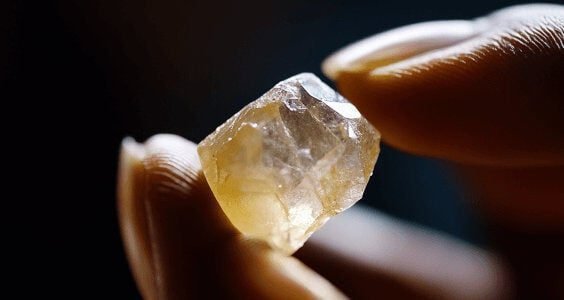
Conflict diamonds (blood diamonds) are diamonds mined in war zones and sold to finance armed conflict against governments. The Kimberley Process Certification Scheme was launched in 2003 to help remove conflict diamonds from the global supply chain. [Source: Kimberley Process, n.d.] (kimberleyprocess.com)
One nuance that many buyers miss: the Kimberley Process definition of “conflict diamonds” is focused on rough diamonds used by rebel movements (or allies) to finance armed conflict aimed at undermining legitimate governments. [Source: Kimberley Process, n.d.] (kimberleyprocess.com) That means “KP-compliant” is a baseline signal—not necessarily the final word on broader human-rights or environmental concerns.
What “Sustainable Jewelry” Means in Practice
In the context of diamond jewelry, “sustainable” and “ethical” should be thought of as a set of verifiable practices—not an aesthetic. Switchroom’s framework emphasizes five pillars: traceability, responsible sourcing, reduced environmental impact, fair labor practices, and long-lasting quality.

These pillars also help you compare brands that look similar on the surface. Two rings might have the same carat weight and the same sparkle, but if one has documented supply chain traceability and recycled metals, the real-world impact can be very different.
A simple definition you can use while shopping
Treat sustainability like “quality assurance.” If a brand can’t show proof (documentation, audits, origin details), assume it’s marketing—not verification.
Lab-grown vs. Natural Diamonds: What’s the Difference?
Lab-grown diamonds and mined diamonds are both diamonds. According to GIA, lab-grown diamonds have the same crystal structure (tightly bonded carbon atoms), resulting in nearly the same chemical, optical, and physical properties as natural diamonds. [Source: GIA, n.d.] (4cs.gia.edu) This is why they can look identical to the naked eye.

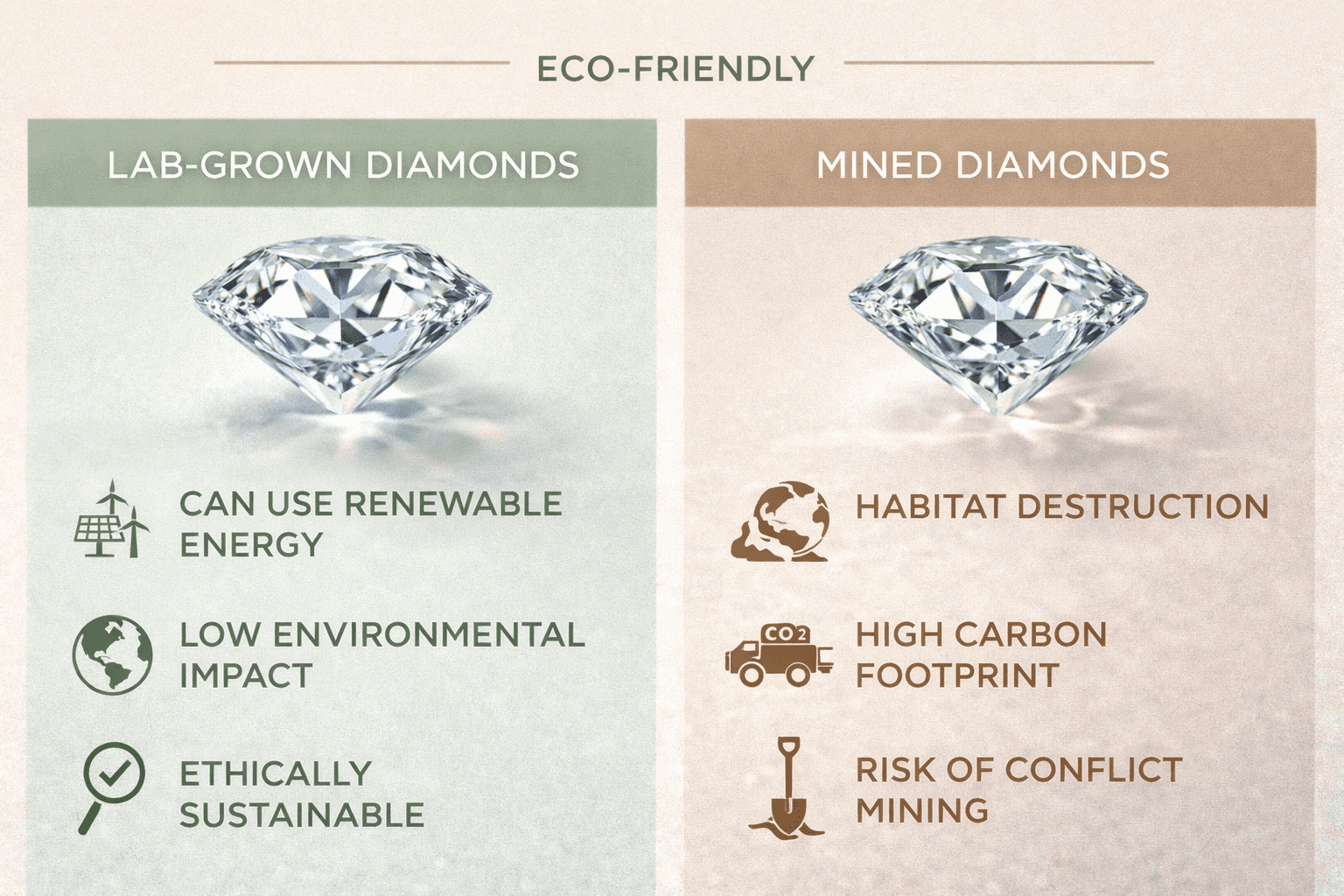
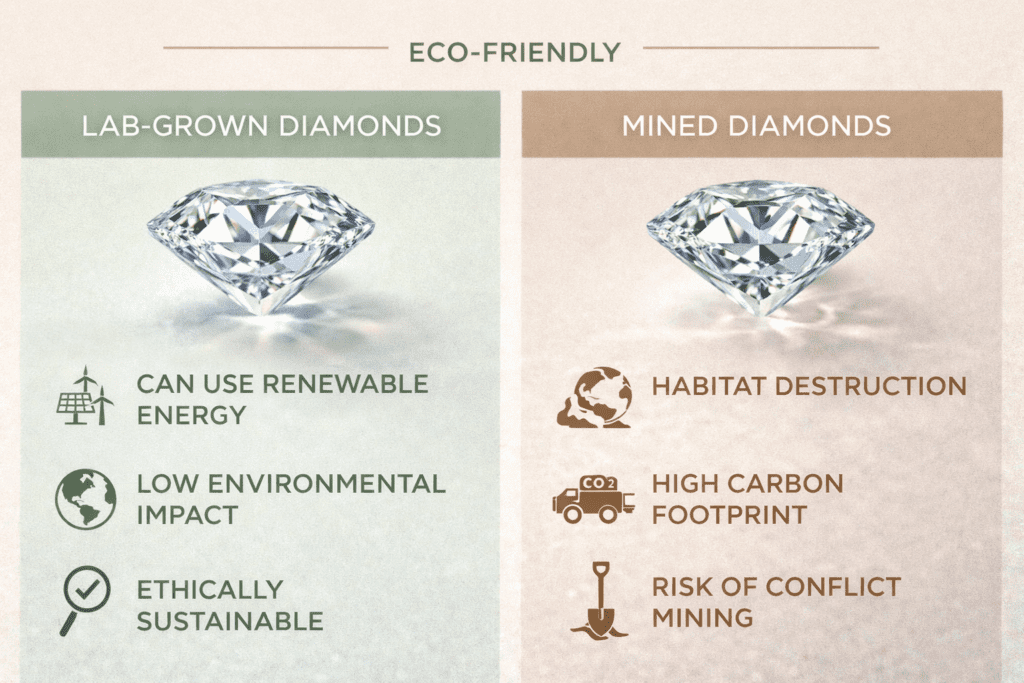
The core difference is origin: mined diamonds formed over geological time, while lab-grown diamonds are created in controlled environments. That difference changes the risk profile of the supply chain (especially around traceability) and can change the sustainability story depending on production energy sources.
Pros and cons: lab-grown diamonds
- Pros: Strong traceability (lab-to-market), lower risk of conflict funding, and often a lower environmental footprint—especially when production uses renewable energy.
- Cons: Environmental impact depends on energy mix; “eco” claims should be supported with specifics (not vague carbon-neutral language). Also, some buyers prefer the rarity and geological story of natural diamonds.
Ethically sourced natural diamonds
- Pros: Natural rarity and heritage appeal; can be responsibly sourced when suppliers go beyond basic compliance and provide third-party certification or strong audits.
- Cons: Traceability can be harder; mining has unavoidable land and ecosystem impacts, so “ethical” typically means “reduced harm + verified practices,” not “impact-free.”
Recycled and reclaimed materials as a third option
If you’re trying to minimize new extraction, prioritize recycled metal first, then decide between lab-grown vs. reclaimed/vintage stones depending on your style and values.



Types of Sustainable Diamond Options (and When Each Makes Sense)
Switchroom outlines three practical pathways for sustainable diamond jewelry: lab-grown diamonds, ethically sourced natural diamonds (beyond baseline standards), and recycled/reclaimed materials.
Rather than treating these as competing “teams,” it’s more helpful to treat them as options for different buyer priorities—budget, customization, heritage, and risk tolerance for supply chain uncertainty.
1) Lab-grown diamonds
Lab-grown diamonds are chemically and physically identical to mined diamonds, and their origin can make them easier to trace end-to-end. They can also offer more flexibility for customization (size, shape, quality) depending on the brand’s catalog.
Best for: buyers prioritizing traceability, conflict-risk reduction, and modern customization.
2) Ethically sourced natural diamonds
Ethically sourced natural diamonds rely on stronger supplier transparency, third-party certifications, or internal audits that go beyond the minimum baseline many consumers associate with “conflict-free.”
Best for: buyers who want a mined diamond but still want rigorous sourcing transparency.
3) Recycled metals and reclaimed stones
Using recycled metal reduces demand for new extraction; reclaimed or vintage diamonds extend the life of existing stones. This can be an excellent path if your definition of sustainability starts with circularity.
Best for: buyers prioritizing circular materials and reduced new mining demand.
How to Choose Sustainable Jewelry: A Step-by-Step Buying Checklist
Sustainable jewelry shopping gets easier when you stop trying to “feel” whether a brand is ethical and start verifying a few key facts. Use the same mindset you’d use for food sourcing: origin, handling, standards, and proof.
Below is a practical checklist that aligns with Switchroom’s five pillars (traceability, responsible sourcing, fair labor, reduced environmental impact, and durability).
Step 1: Ask for traceability (not just “conflict-free” language)
- Where was the diamond created or mined?
- Where was it cut and set?
- What documentation backs the origin claim?
Step 2: Clarify what standard is being used
If a brand cites the Kimberley Process, treat it as a starting point. The Kimberley Process Certification Scheme launched in 2003 and focuses on conflict diamonds as defined within its framework. [Source: Kimberley Process, n.d.] (kimberleyprocess.com)
Ask brands what they do beyond the baseline—independent audits, expanded due diligence, or additional standards that cover labor and environmental performance more directly.
Step 3: Check metal sourcing (recycled vs. newly mined)
- Is the gold/platinum recycled? If yes, what percentage?
- Is there documentation from refiners or suppliers?
- Does the brand design for repair (resizing, stone resetting) to extend life?
Step 4: Watch for marketing clarity (especially online)
Ethical jewelry also includes ethical marketing. The U.S. Federal Trade Commission advises that laboratory-created diamonds should be clearly described with terms like “laboratory-grown” or “laboratory-created” so consumers understand they are not mined. [Source: Federal Trade Commission, 2018] (ftc.gov)
Even if you’re shopping outside the U.S., this is a useful benchmark: clear, prominent disclosure is a signal a brand takes consumer trust seriously.
Step 5: Choose durability over “fast jewelry”
One of the most overlooked sustainability drivers is how long the piece stays in use. Switchroom explicitly calls out long-lasting quality—jewelry designed to be cherished for years instead of quickly discarded.
Practical tip: prioritize timeless settings, solid construction, and brands with clear repair/resizing policies (especially for rings).
Two Mini Case Studies: Making Sustainable Jewelry Choices in Real Life
Case study A (engagement ring with high traceability): A buyer wants a classic solitaire but doesn’t want to gamble on supply chain opacity. They choose a lab-grown diamond for easier traceability and pair it with recycled metal. This aligns with Switchroom’s emphasis on traceability, reduced environmental impact, and conflict-risk reduction.
Trade-off to acknowledge: the buyer asks where the diamond was grown and what energy inputs were used, because lab-grown sustainability can vary by producer. They also confirm clear labeling (lab-grown vs. mined) to avoid confusing or misleading product descriptions. [Source: Federal Trade Commission, 2018] (ftc.gov)
Case study B (anniversary gift with maximum circularity): The buyer prioritizes minimizing new extraction. They choose reclaimed/vintage diamonds (or a family stone reset) and insist on recycled gold for the setting. This reduces demand for new mining while still delivering “real diamond” sparkle and meaning.
Trade-off to acknowledge: reclaimed stones can have less standardized documentation, so they confirm stone condition, setting security, and long-term service options (cleaning, prong checks, resizing) to keep the piece wearable for decades.
Explore our collection of lab-grown diamond jewelry and eco-friendly press-on nails today, and be a part of the change for a better, more sustainable world.
Examples of Sustainable and Ethical Diamond Jewelry Brands
This article lists several brands often associated with sustainability and ethics. Consider these as a starting point, then verify each brand’s current sourcing policies and documentation (because policies can change).
- Brilliant Earth (ethically sourced natural + lab-grown; recycled metals)
- VRAI (lab-grown focus; emphasizes renewable-powered production and transparency)
- Clean Origin (lab-grown focus; conflict-free positioning)
- Kimai (lab-grown + recycled gold; traceability)
- Mejuri (some recycled gold; fine jewelry options)
- Catbird (Brooklyn) (recycled gold emphasis; conflict-free diamonds positioning)
- Monique Péan (recycled metals; ethically sourced or antique diamonds)
- (recycled metals; transparent supply chains emphasis)
Where Switchroom fits
Switchroom positions its jewelry around sustainable materials and offers lab-grown diamonds as a way for customers to move toward a conflict-free, sustainability-oriented future.
Switchroom also leans into education—helping consumers understand differences between lab-grown and mined diamonds—so buyers can match their purchase to their values.
Trends Shaping the Future of Sustainable Jewelry
Trend 1: Stronger disclosure and scrutiny of diamond marketing. Regulators increasingly emphasize clear, non-deceptive terminology—especially around lab-grown diamonds—so consumers know what they’re buying. [Source: Federal Trade Commission, 2018] (ftc.gov) This pushes the market toward better transparency (and makes vague language a bigger red flag).
Trend 2: Standards are expanding beyond “conflict-free.” Industry standards and multi-stakeholder frameworks increasingly aim to cover environmental and labor issues across the supply chain. For example, notice how formal standards groups describe responsible practices “from mine to retail,” including due diligence and claims verification. [Source: Responsible Jewellery Council, 2024] (responsiblejewellery.com)
Trend 3: Better traceability infrastructure. As consumers keep demanding proof, more brands are improving chain-of-custody systems, documentation, and third-party verification—especially for lab-grown stones where origin can be easier to document end-to-end.
Balanced reality check: The Kimberley Process itself highlights high levels of coverage in the global trade, but the definition it uses is specific and has long been debated. [Source: Kimberley Process, n.d.] (kimberleyprocess.com) If you want “ethical” to include broader human rights and environmental protections, you’ll likely want to look beyond a single label.
Common Mistakes, Myths, and Pitfalls (and How to Avoid Them)
Myth 1: “Lab-grown diamonds aren’t real diamonds.” They are real diamonds—GIA notes they share the same crystal structure and nearly the same chemical/optical/physical properties as natural diamonds. [Source: GIA, n.d.] (4cs.gia.edu)
Myth 2: “Sustainability is only about the stone.” Metals matter, manufacturing matters, and product lifespan matters. Recycled metals and durable construction can be as important as your diamond choice.
Counterargument (Fair) + Rebuttal (Practical)
Counterargument: “Lab-grown diamonds are just marketing—mined diamonds have real value, real rarity, and the whole ‘sustainable’ angle is exaggerated.”
Rebuttal: It’s reasonable to value rarity and geological history. But sustainability isn’t only about emotional value—it’s about reducing avoidable harm. Lab-grown diamonds can lower certain risks, while recycled metals and reclaimed stones reduce new extraction. The most defensible approach is choice-with-proof: buy the story you love, but require documentation that supports ethical claims.
Switchroom’s Commitment Beyond Jewelry: Reusable Press-on Nails
This article notes that Switchroom extends sustainability into beauty products through reusable press-on nails—positioned as a way to reduce waste compared with traditional nail art.
If your goal is to align style with values across categories, this is the same principle as sustainable jewelry: reduce single-use consumption, choose longer-lasting products, and support brands that explain materials and sourcing clearly.
FAQ: Sustainable Jewelry & Lab-grown Diamonds
Are lab-grown diamonds conflict-free?
They can significantly reduce conflict-risk because they are not mined and are often easier to trace from lab to market. But you should still ask for documentation and clarity about production and sourcing claims.
Are lab-grown diamonds “real” diamonds?
Yes. GIA explains that lab-grown diamonds have the same crystal structure and nearly the same chemical, optical, and physical properties as natural diamonds. [Source: GIA, n.d.] (4cs.gia.edu)
What does “conflict diamonds” mean?
The article defines conflict diamonds (blood diamonds) as diamonds mined in war zones and sold to finance armed conflict against governments. The Kimberley Process defines conflict diamonds within a specific framework focused on rebel movements undermining legitimate governments. [Source: Kimberley Process, n.d.] (kimberleyprocess.com)
Is the Kimberley Process enough to guarantee ethical diamonds?
It’s a major global framework launched in 2003, but its scope is specific. Many buyers use it as a baseline and then look for additional transparency, audits, and responsible sourcing practices beyond minimum requirements. [Source: Kimberley Process, n.d.] (kimberleyprocess.com)
What matters more: the diamond or the metal?
Both matter. Recycled gold/platinum can reduce demand for new mining, and diamond sourcing affects traceability and ethical risk. A strong sustainability choice often optimizes both.
How can I spot greenwashing in sustainable jewelry?
Watch for vague claims (“eco,” “ethical,” “clean”) without specifics: origin details, documentation, standards, audits, and clear product labeling. If a brand can’t explain supply chain steps, treat the claim as unverifiable.
What should I ask a jeweler before buying a “sustainable” ring?
Ask where the diamond originated (lab or mine), how it’s traced, what sourcing standard is used, whether metals are recycled, where the piece is manufactured, and what repair/resizing support exists for long-term wear.
How do I choose between lab-grown and ethically sourced natural diamonds?
Choose lab-grown if traceability and conflict-risk reduction are top priorities; choose ethically sourced natural if you value geological rarity and can verify strong sourcing practices beyond baseline compliance. Many buyers also consider reclaimed/vintage stones as a circular alternative.
Conclusion: What to Do Next
Sustainable jewelry is easiest to buy when you use a framework: traceability, responsible sourcing, reduced environmental impact, fair labor, and long-lasting quality. Start by deciding your priorities (traceability vs. rarity vs. circularity), then choose between lab-grown diamonds, ethically sourced natural diamonds, or reclaimed materials—while asking for proof, not slogans.
If you want a simple next step: pick one product you’re considering and run it through the checklist above. That single habit—verifying origin, standards, and materials—does more for a conflict-free future than any one “eco” keyword ever will.